1:1 Portfolio123 coaching with Quant Solvings

Most ranking systems are built backwards. Maybe yours too.

Nobody sets out to do it. Testing on P123 is so fast that every small change pays you back with a better curve: you add a node and the sim improves, you tune the weights and it improves again, and fifty runs later it looks perfect. Then new data arrives and it breaks, because it only ever fit the past.

So how can you tell? Ask your system three questions.

1. Can you explain every node in one sentence? "It tested well" doesn't count. The sentence has to say why the node should keep working.

2. Has your tuning ever seen this data? If you tuned the weights on your whole universe, the backtest already knows the answers. P123's docs give a simple fix for your next round: add the rule EvenID=TRUE while you develop, then switch it to EvenID=FALSE and test on stocks your tuning never touched. (Both halves lived through the same years, so it isn't perfect. But it's a start.)

3. What's left after costs? Run the sim with slippage and commissions on, at the size you'd actually trade. Some ideas only exist in stocks you couldn't buy at that size.

A bad answer doesn't prove your system is broken. It means you don't know yet.

Now the pitch, and yes, it's a paid service. I'm Carlos Morales. Quant Solvings is in the initial lineup of P123's new Investing Coaches program, with 50+ retail and institutional clients since 2025. What I teach, one-on-one, is the opposite order: a hypothesis you can explain first, then the system, step by step, with a reason behind every rule, and only then the test, out of sample, with costs on. You still need the backtest. But it comes last, and its job is to try to break your idea. If you'd rather watch than read, here's the same idea in a 45-second film.

Where you'd start depends on where you are:

  • Beginner: over 4,000 factors and no idea where to begin. You finish with a framework deployed in your own account.
  • Intermediate: you have a system and want to know how robust it is.
  • Advanced: machine learning, with walk-forward validation and stress tests.
  • Tailored sessions: one specific problem in something you've already built.

I give every session myself. The notes, the skills you're building and a certificate at the end all stay in one portal. Sessions never expire, and if your first one isn't for you, you can ask for your money back within 14 days, before a second session (conditions). Levels and prices are on the coaching page.

Run the three questions either way. If your system passes all three, you don't need me. If it doesn't, the first step is a free 45-minute intro call, in English or Spanish, to see which level fits, if any.

Book your free 45-minute intro call

Educational content. Not investment advice. Quant Solvings is an independent practice. Services and fees are arranged directly with me.
(Emphasis mine)

It is impressive to me that you understand the usefulness of this and acknowledge the limitations at the same time. I am sure your coaching will be both helpful and honest.

Also your Claude Skills download was impressive and suggests a depth of understanding in both finance and machine learning.

Thank you!!! :slight_smile:

You can get coaching, and moral_es also just opened 9 Designer models at a reasonable price!!!

@moral_es ... I see 'Performance Analysis (backtest data not available until 9 months after launch)'

So, no deep historical IS (In-Sample) Performances data are provided yet for any of the 9 DM's ... how shall one judge and possibly decide to Subscribe?

Thanks, Pierre

Hi Pierre!

Unfortunately, the 9-month rule applies to all DMs within P123, so it’s impossible to view the backtest until then. To work around this, I’ve posted some key risk metrics and a complete analysis in the strategy descriptions.

Unfortunately, that’s the most I can do for now. It’s true that the market has been completely crazy these past few months, which hasn’t helped recent performance. Now we just have to be patient. As I mentioned before, my goal is to keep these models running in P123 for a long time without making practically any changes to them.

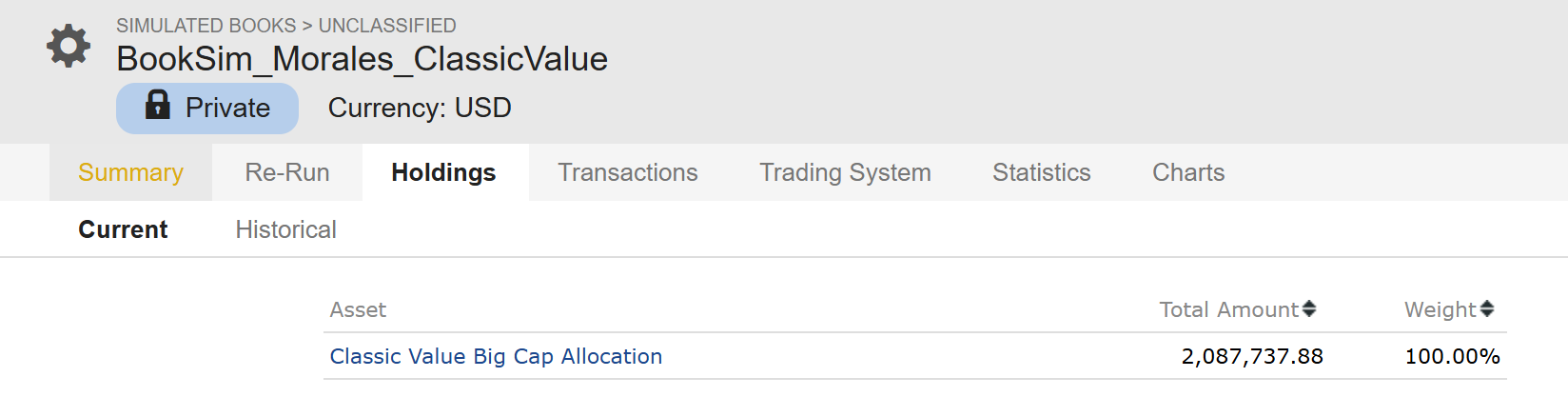
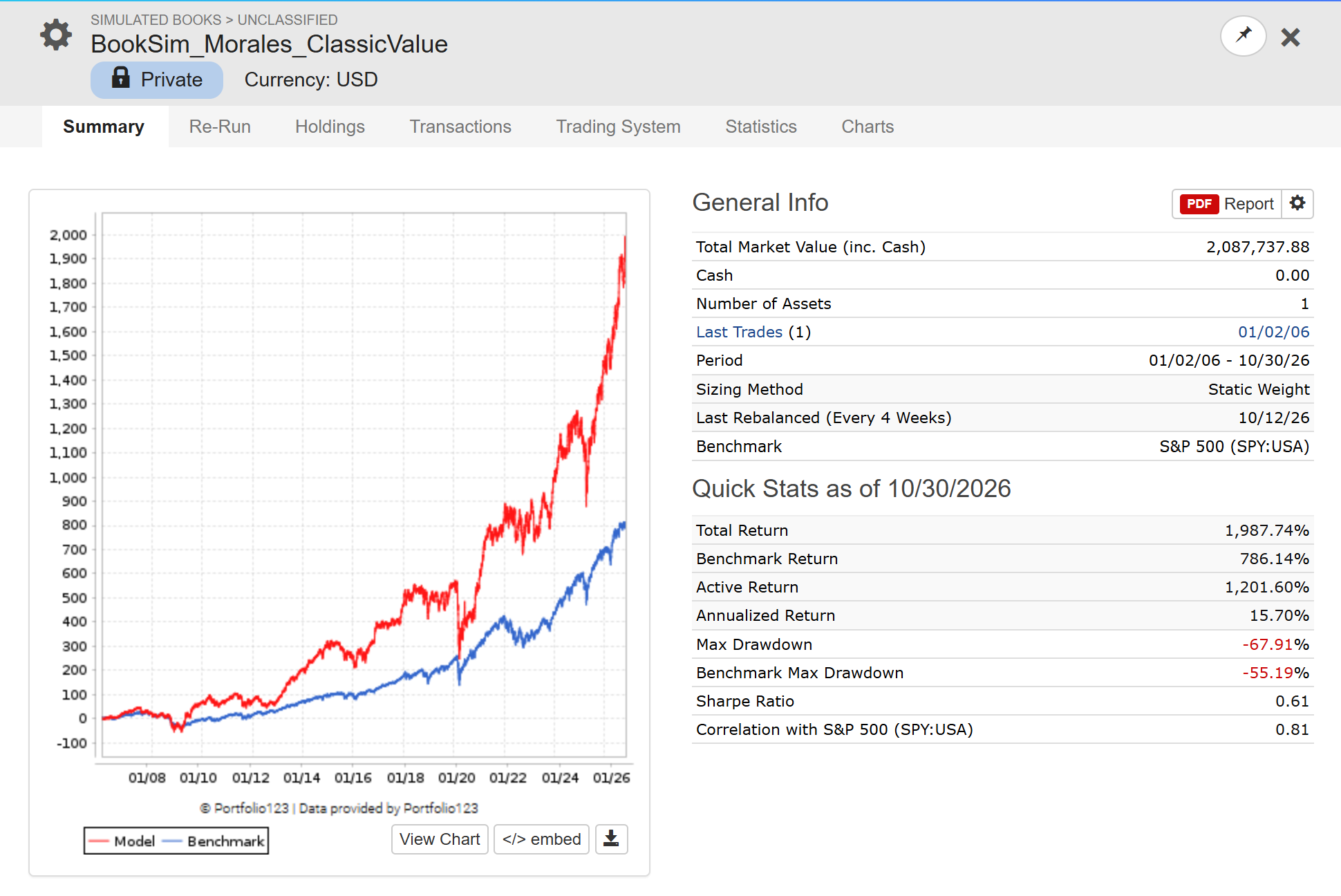
One can add the strategy to a "simulated book" and then get a better look at past performance.

I'm not sure I agree with all this "saving us from ourselves" logic, but there are at least some work arounds for those that want a better look.

I didn't know you could do that!!!

Thanks, ... got it

See

Nice!!

ars7777,

Thanks for the tip.

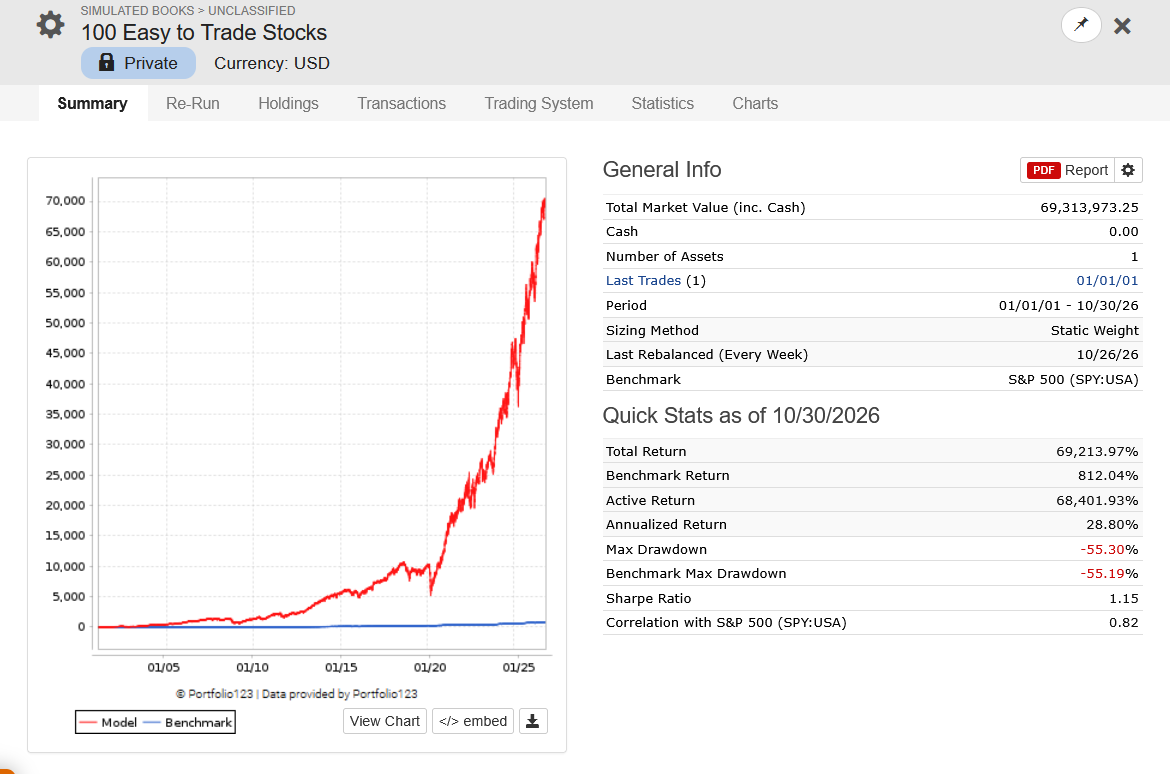
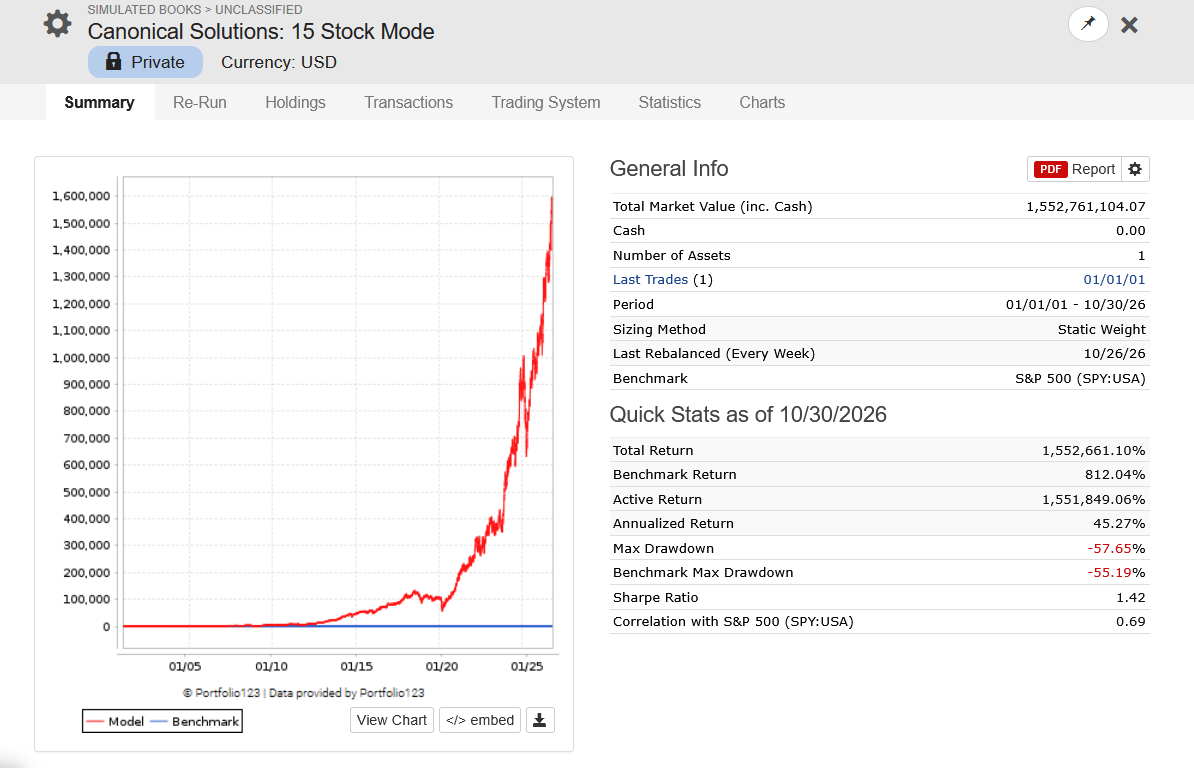
I can now also see (below) the stats for these two models by Jim (Jrinne). The numbers are less spectacular than I thought given the piplines of machine learnings that are used to build them as stated in the description (especially the more than 50% max DD).

ars7777 : Just curious since you invest in DMs, will you still stick with a model if there has been a drawdown of 50% (or even 33% or more)?

Thanks in advance for letting me know your thoughts.

Regards

James

Short answer: yes, if I trust the model and the designer. But not unhedged.

I should be upfront: I subscribe to a handful of DMs and spend an inordinate amount of time in the marketplace, but I only trade one DM, alongside two non-DM models. That brings me back to the question: is it better to trade a few models you know intimately, or to spread across many? I can see a case either way, and it’s probably the biggest open question on my mind. I’d be curious how others here handle it.

On drawdown: I came to factor models from discretionary stock trading, where you can control open risk and drawdown fairly tightly, and from ETF systems, which can be built with very controlled drawdowns. Drawdown has been the hardest thing to think about and control for.

What helped me was separating model drawdown from portfolio drawdown. Even if you put only 50% into factor models with a 55% drawdown, that’s roughly a 27% hit to the whole book before the other half does anything. That’s still too much for my liking.

So I treat the models as the return engine. If I trust a model and its designer, I don’t try to manage that model’s drawdown. I manage drawdown at the portfolio level, in two layers:

  • A standing tail hedge. A small recurring budget for far out-of-the-money index puts. It costs a little every year and is meant to pay off in a crash, not in an ordinary correction.
  • A timing overlay. A composite of a few macro and market signals. When it turns risk-off, I short index futures against the long book rather than selling the holdings. The models keep running untouched: no extra turnover, no friction/slippage, no second-guessing the picks. The hedge does the work. If enough signals fire, I eventually start reducing holdings and accept the turnover, cost, and hassle that come with it.

To pay for the protection, I lean toward higher-returning models. Those are usually the ones with the deeper drawdowns, which is the whole point: the hedges are what make them holdable. They also let me hold less cash and fewer alternatives than an unprotected portfolio would need, which is where much of the cost gets recovered.

I know many here don’t believe in timing, and I understand why. Spend enough time on Allocate Smartly and SSRN and you’ll find some promising methods and plenty of overfitting. In my view, some signals are clearly more logical, and less likely to be overfit, than others. I’ve tried to take the ones I believe most and implement them as loosely as possible.