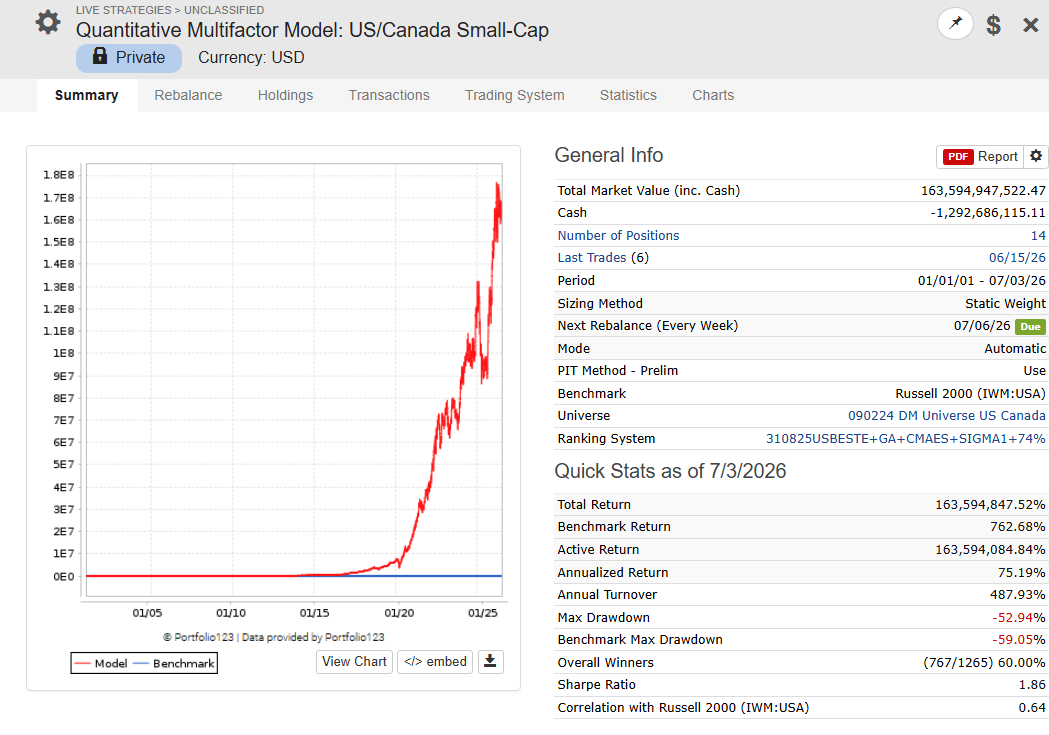
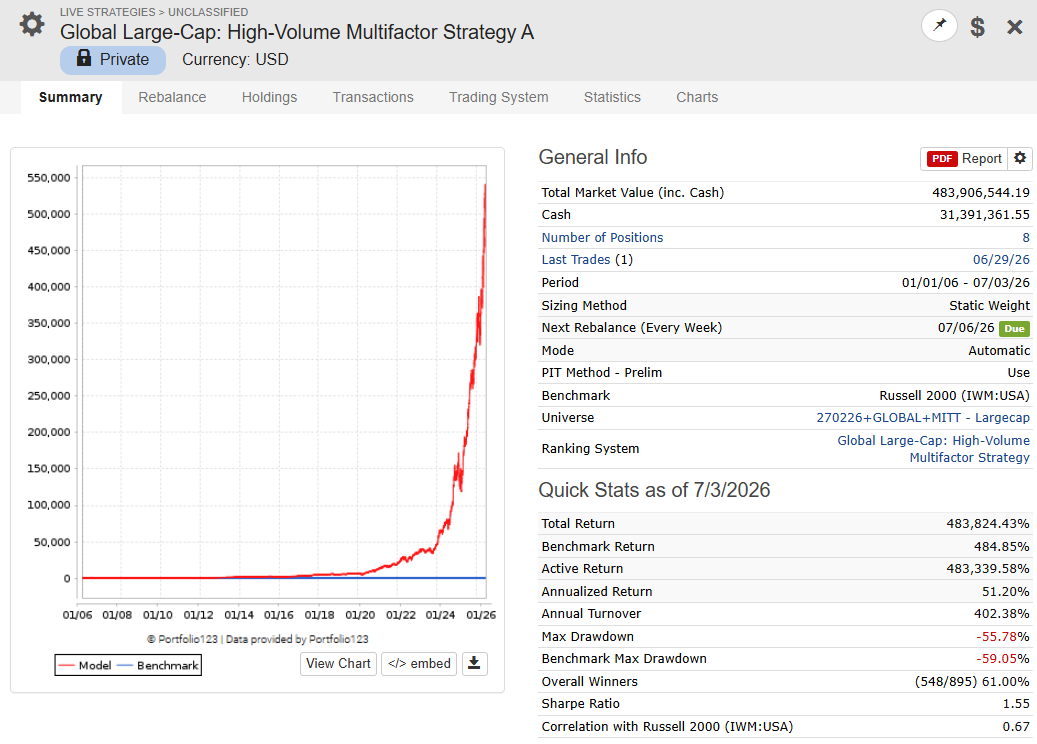
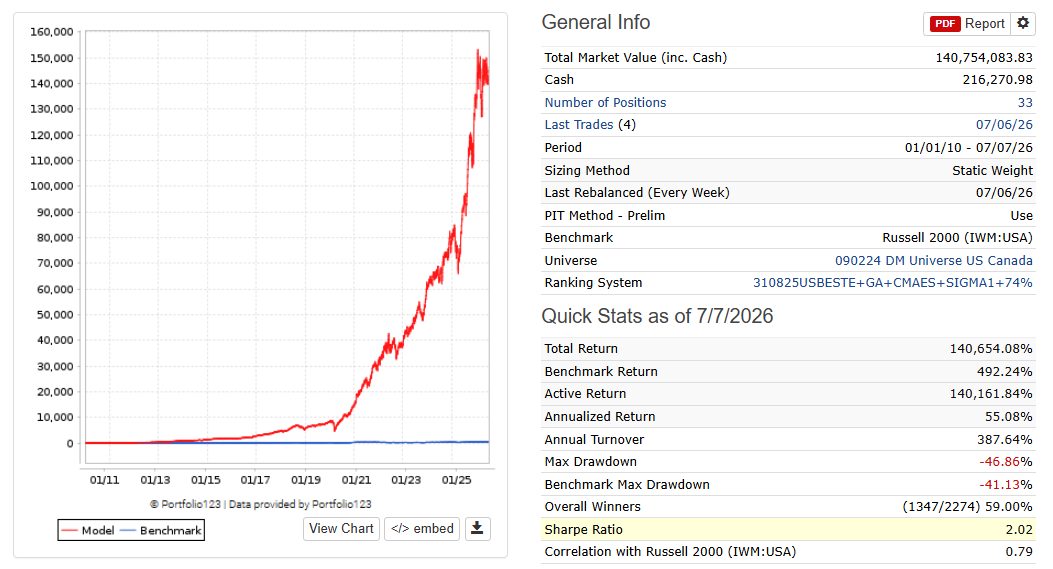
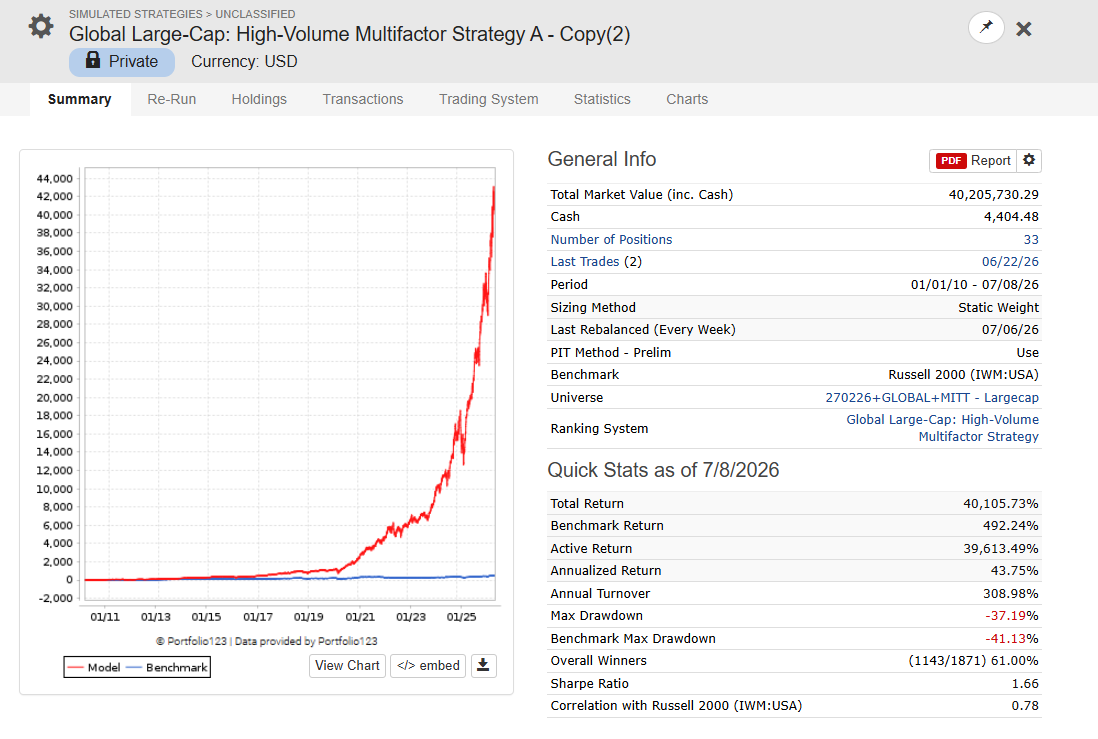
I have been working for a while on developing a Large Cap system and previously worked on a Small and Micro Cap system.
Out of curiosity, I tried to investigate the differences between my Large Cap system and my Small Cap system. It is understandable that an emphasis on smallness and liquidity is a difference, but there were also several other points.
Are others seeing similar results? Here is a comparison for the 15 points with the largest deviation, made with Claude Carloz's p123 skills:
The 15 key differences
| # | Theme / Variable | Small-cap strategy | Large-cap strategy | Main difference / Rationale |
|---|---|---|---|---|
| 1 | Size/liquidity as a factor | Dedicated composite (MktCap, MedianDailyTot, AstTotQ) normalizes to ≈10% of total weight — the largest single node, but not overriding the rest of the model | No equivalent node; MktCap appears only as a denominator inside individual formulas | Small-cap gives size/liquidity a visible, elevated — but not overwhelming — role; large-cap treats size as largely irrelevant since the universe is already large |
| 2 | Institutional ownership | Dedicated factors (each weight ~6, ≈0.85% of total): ownership vs. industry, and change in number of institutional holders (filtered to MktCap>20bn) | No institutional ownership factor | Small-cap looks for early institutional "discovery" as a catalyst; large-cap is already fully institutionally owned, so the variable is non-informative |
| 3 | Insider trading | "Net insider buying/selling vs. share count" (weight 8, Higher) | No insider factor | Information asymmetry is greatest in small-cap, so insider trades carry more signal; large-cap insider activity is heavily regulated and often pre-scheduled |
| 4 | Analyst coverage | #AnalystsCurFY (Lower, weight 6) — fewer analysts preferred; revisions explicitly divided by #AnalystsNextFY | No normalization for analyst count | Small-cap exploits thin coverage; large-cap assumes coverage is already broad and priced in |
| 5 | Earnings quality / accruals | No dedicated accruals-quality factor | Several: "total accruals to total assets" (1.18), "Earning Quality" composite (0.94), "stability of accruals" (0.78) | Large, complex balance sheets carry real earnings-management risk (the classic accruals anomaly); small-cap accounting is simpler, so this risk is instead captured indirectly via cash-flow yield |
| 6 | Earnings stability | No ROE volatility factor | "ROE stab" — LoopStdDev of ROE (weight 1.18, Lower) | Large-cap rewards predictable profitability, a hallmark of mature-company quality investing; small-cap earnings are expected to be inherently more volatile, making stability less discriminating |
| 7 | Capital allocation — buybacks | No buyback factor | "Net Buyback Yield (Shares) TTM" (weight 0.58, Higher) | Mature, cash-generative companies return capital via buybacks; small-caps typically reinvest all capital into growth |
| 8 | Enterprise Value (EV) vs. raw MktCap | Uses EV in several places too (e.g., Sales/EV, (FCF+IntExp)/EV, .../EVPS) — not exclusively MktCap as I first stated | More frequent, though also not exclusive, use of EV (e.g., FCF/EV, OperCashFl/EV, EV/EBITDA-style); one formula ("74.V-FCF PEG") still uses raw MktCap | Both systems use EV where debt-adjusted valuation matters; large-cap leans on it somewhat more consistently, likely reflecting more complex debt structures on average, but this is a difference of frequency, not an absolute rule |
| 9 | Growth acceleration ("growth of growth") | Fewer acceleration factors — more weight on raw growth and estimate revisions | Many acceleration factors (sales, EPS, operating income acceleration YoY) | Large-cap growth is typically incremental, so the change in the growth rate carries the marginal alpha; small-cap growth is often already high, so the raw level/estimate revision matters more than its second derivative |
| 10 | Log transformation of size variables | Uses Ln(Price), Ln(AvgDailyTot(200)) | No equivalent log transformation | The small-cap universe is heavily right-skewed (many micro-caps, some mid-caps); log transforms normalize this. The large-cap universe is far more size-homogeneous |
| 11 | Seasonal/cyclical sector filter | "Seasonal filter for cyclical/non-cyclical sectors" by month, RBICS-based (weight 4) | No seasonal factor | Small-cap incorporates tactical sector rotation as a systematic edge; large-cap is closer to pure stock-picking without macro timing |
| 12 | Short-term momentum, spread, volume turnover | More weight on 4/8/13-week estimate revisions than raw short-term price action | Dedicated factors for 1-week return, 30-day spread, and 3-month volume turnover | Large-cap stocks are liquid enough that short-term technical signals are reliable; in small-cap, short-term price moves are often illiquidity-driven noise, so they're captured indirectly through the liquidity composite instead |
| 13 | Weight distribution / concentration | Composite (~10% of total) is the largest node; the remaining ~90% is spread across ~100 factors, each individually worth roughly 0.14%–1.7% of total weight | No node dominates; individual factors range ≈0.6%–2.6% of total weight — a much flatter, tighter distribution | Small-cap concentrates a meaningful (though not majority) share of weight in one thematic group (size/liquidity); large-cap has no comparable concentration anywhere in the system |
| 14 | Employee efficiency / adjusted book value | Has "empl/(sharesfdq*price)" and a conservatively weighted book-value formula (cash 100%, inventory 50%, other assets 20%) | No equivalent employee factor or granular book-value adjustment | Small-caps are often more human-capital-driven with less reliable balance sheets, so conservative, granular adjustments add more signal than raw book value |
| 15 | Scope usage (Universe/Industry/Sector) | Predominantly "Universe" scope; few Industry/Sector-relative factors | Frequent use of "Industry" and "Sector" scope for relative ranking | Large-cap companies sit within well-defined, mature industries suited to peer-relative ranking; the small-cap universe is more heterogeneous and less reliably classified, favoring absolute (universe-wide) ranking |