Dear all,
This just came out from Bloomberg.
It describes that the market may fall even further if computer driven funds switch to sell their positions following the fundamental driven money managers.
Regards
James
Fast-Money Quants Are at Odds With Fundamental Stock Investors
By Jess Menton
October 14, 2026 at 8:05 PM GMT+8
Updated on
October 14, 2026 at 10:25 PM GMT+8
Takeaways by Bloomberg AI
- Money managers are showing growing doubts about the rally in US stocks due to worries around lofty Treasury yields, the war in Iran and sticky inflation.
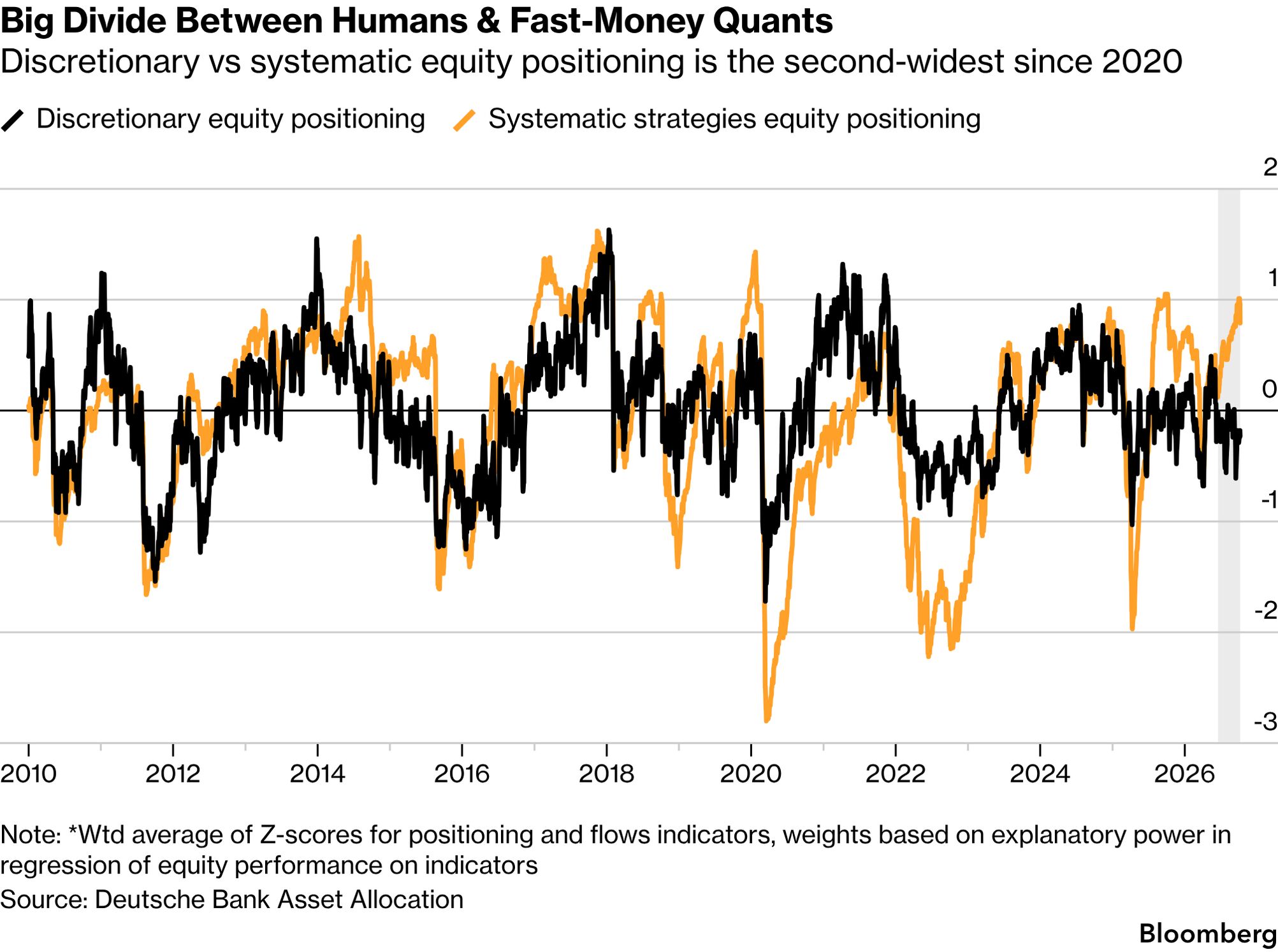
- Computer-driven funds have continued to buy stocks, causing a gap between these funds and discretionary investors, who have reduced their stock exposure to the bottom-third of the range.
- The gap between the two types of investors is the second-widest since 2020, and one side will have to give in soon, according to Parag Thatte, a strategist at Deutsche Bank AG.
Money managers who focus on economic growth and the strength of earnings are showing growing doubts about the rally in US stocks.
Worries around lofty Treasury yields, the war in Iran and sticky inflation have pushed discretionary investors’ stock exposure to the bottom-third of the range, data compiled by Deutsche Bank AG show. Meanwhile, computer-driven funds continued to snap up stocks thanks to steady gains in benchmark indexes and decline in volatility. The gap between the two, where the former is underweight and the latter is overweight US stocks, is the second-widest since 2020, the data show.
“The gap can’t widen much further from here so one side has to give in soon,” Parag Thatte, a strategist the bank, said by phone.
If prices keep going up, quant funds, who are typically indifferent to the scope of the market’s prior gains, will have to keep buying, eventually forcing money managers to cave in. On the flip side, a renewed selloff will tempt discretionary investors, who have been largely sitting out the recent rally, to take a victory lap.
While systematic funds are not considered to be the largest market participants by the amount of money they manage, they’re definitely one of the fastest. When their algorithms hit a certain threshold such as a buying or selling indicator, they instantly unwind or add positions. That could result in tens of billions of dollars that flow in or out of major stock indexes.
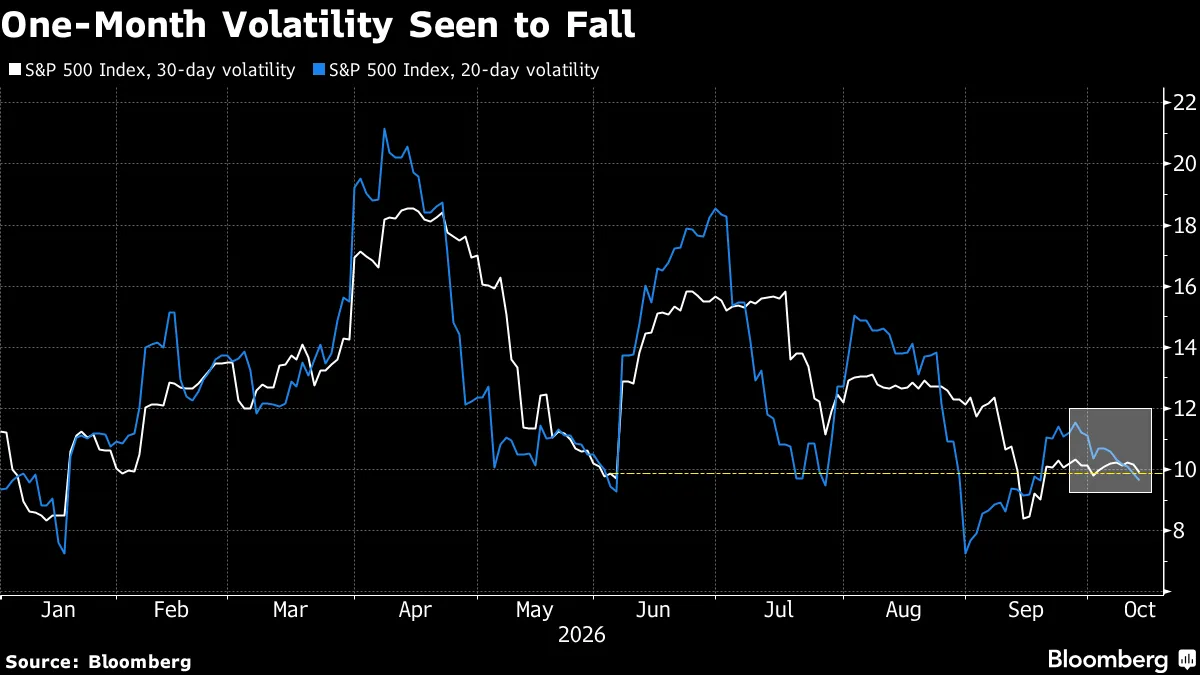
With realized-one month volatility in the S&P 500 sitting near 9.9, the lowest level since June, vol-control funds, which buy more equities when markets are calm and sell when gyrations get more intense, have been scooping up stocks, said Maxwell Grinacoff, head of equity derivatives research at UBS Group AG.
“It would take an exogenous shock to force systematic positioning to flip, with a string of bigger down days in the S&P 500” to force “a cascade of outflows in equities — but we haven’t seen that yet,” he added.
US stocks have enjoyed smooth sailing, with the S&P 500 rallying 23% from its trough in March and adding $13 trillion in value in the process, despite worries around a bubble in artificial intelligence stocks and a break out in long-term borrowing costs to the highest in decades.
The 500-member gauge has gone 89 trading days without a drop of at least 2%, and it’s seen just two sessions with such losses this year. It traded down 0.6% on Wednesday after data showing the fastest increase in inflation since April bolstered bets the Federal Reserve will keep raising interest rates.
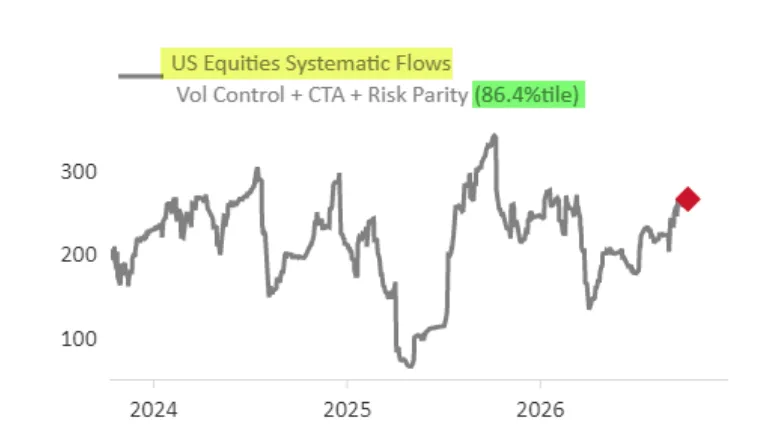
Equity exposure of systematic funds, which include vol control funds, commodity trading advisors, or CTAs, and risk parity funds, is now back up to the 86th percentile, near highs of the year, according to data compiled by Charlie McElligott, a cross asset strategist at Nomura Holdings Inc.
Source: Nomura Vol
Given how systematic funds operate, selling may start with vol control funds unwinding extreme positioning, Deutsche Bank’s Thatte said. That would increase the risk of sharp reversals in the stock market, although there would need to be a substantial selloff, with the S&P 500 sliding at least 5% from its peak for a spike in volatility to last, he added.
The buying and selling activity at volatility control funds has an inverse relation with realized volatility: The wider the price swings, the louder the signal for the vol-control funds to de-risk. That’s what happened when volatility jumped in the spring on the back of rising concern over the war in Iran and the state of the economy. These funds reduced their equity exposure as their sensitivity to selloffs rose.
If discretionary traders start selling in response to fears over weaker growth or softening corporate earnings trends, that theoretically may push volatility higher and force computer-based strategies to unwind their positions as well, Thatte said.
But that doesn’t mean the advance can’t keep on going. Low equity positioning among discretionary money managers means investors have more dry powder to buy equities in the months ahead, warding off a more severe selloff.
“There are certainly investors out there who have been underweight the ‘right’ equities that would step in on dips,” said Colton Loder, managing principal of the alternative investment firm Cohalo. “Something has to come along to spike volatility or create a negative equity trend. Systematic can last; it does until it doesn’t.”