Well...I did not begin from 0 to be honest, background helps of course
1 Like
The account is an IRA in withdraw mode. There s a 15% policy cash allocation. It is managed with a definite tilt towards limiting drawdowns. Total return was 27.15%. Sharpe Ratio is 1.20 and Sortino Ratio is 1.83. Max drawdown was 16.02% from mid-February to the Liberation Day bottom.
Measured against the Russell 2000 (IWM) the beta was 0.68 and the alpha was 16.26%.
Measured against the S&P 500 Equal Weight (RSP) the beta was 0.82 and the alpha was 17.45%. This looks to be the most appropriate benchmark for the account as the drawdown is only 6bp more, the standard deviation 5bp more, and the downward deviation identical.
For grins, since it is a bad benchmark, measured against the S&P 500 (SPY) the beta was 0.72 and the alpha 12.45%.
A very good year considering my self imposed constraints. I had some screens kick into gear mid-year with all the out performance from August on.
Happy New Year All,
Rich
2 Likes
I hedge my currency risk with FX futures. Of course, that did not work out well in 2025 since the dollar has fallen so hard. But it's a very cheap and direct hedge.
1 Like
Yes, the USD/SEK implosion was brutal.
Compare the difference in results for the same strategy between SEK and USD this year.
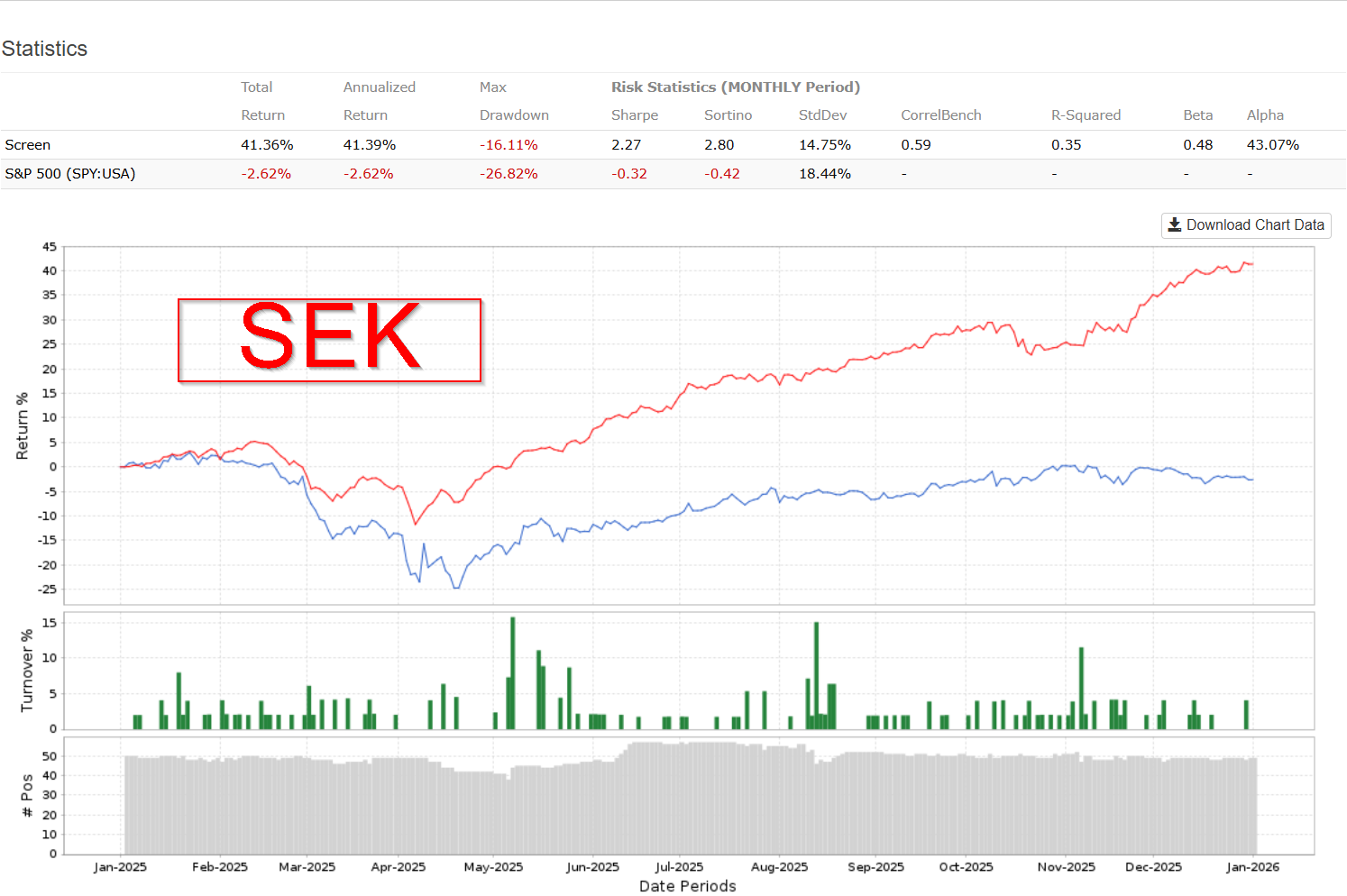
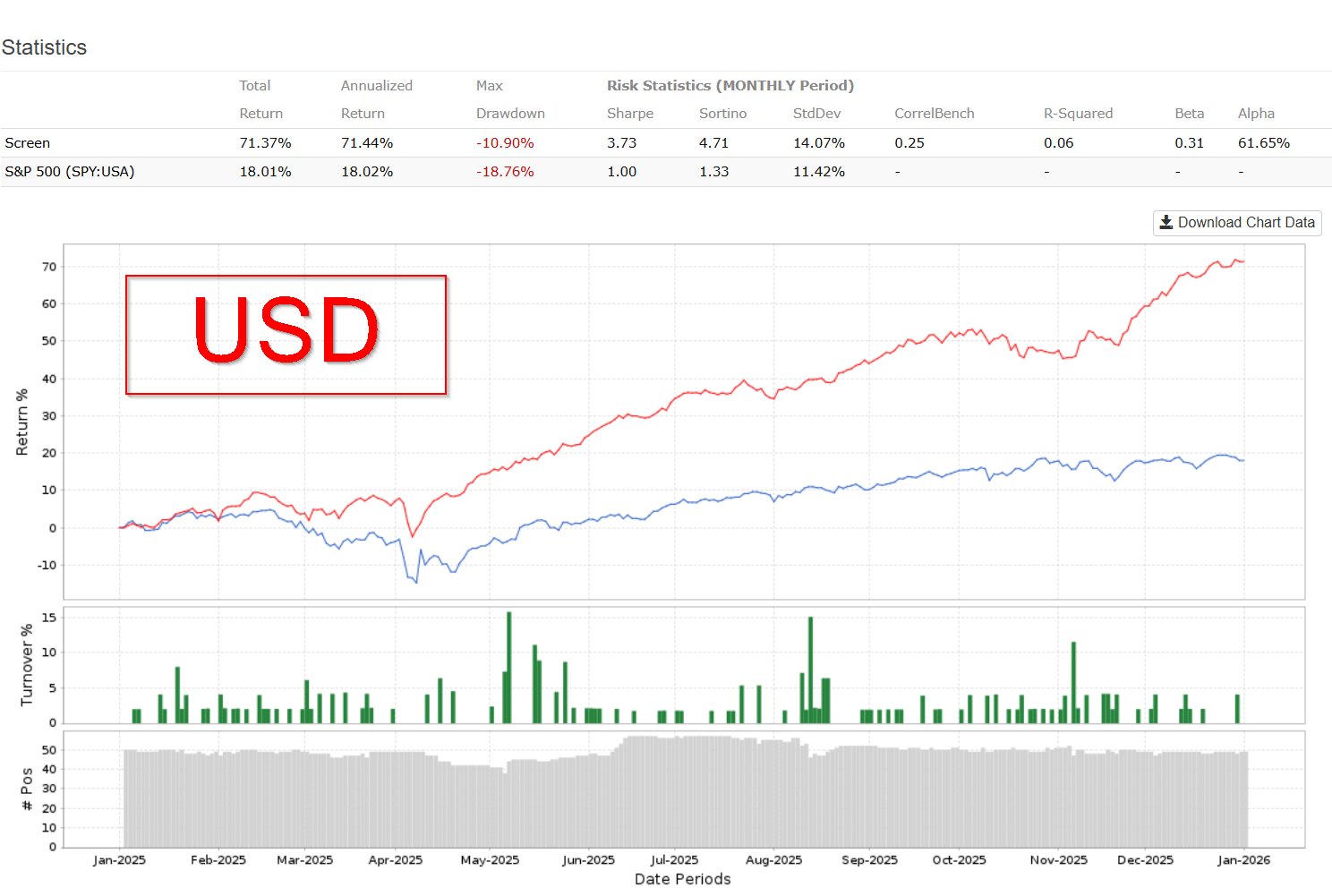
The biggest hit came in the down market in March-April, it was painful, but a very unique situation. USD is typically a very good hedge in bear markets against SEK, so I’m still ok with it.
2 Likes
I have beaten both of the reference indexes that I follow, so I am satisfied with that, but I am not satisfied with the year as a whole. Again, I have gone in and overridden the system too often and tested out strategies that are a drag on the performance.
In my pure EU portfolio, I had 32% (15 stocks), which is around 70% of my investments.
In my USA-Canada portfolio, I had 4.7% (15 stocks), but I had a dollar decline against me of 12%. But in this one, I messed it up with too many adjustments and some European stocks after Liberation Day and some unnecessary attempts at a little active buying of gold, and 12% cash.
I would have done much better if I had just followed my strategy instead of making too many of my own adjustments. My design models are based on many of the same criteria in the ranking system and have done better:
EU: https://www.portfolio123.com/app/r2g/summary?id=1764562 (67%) (In EUR, so for a US investor you could add 13% in FX effect.)
US\Can: https://www.portfolio123.com/app/r2g/summary?id=1762580 (22%)
I have little faith in the consensus view of macroeconomists, but I read it nonetheless.  I had an AI summarize the consensus assessment for Q1 2026. Still hope for a good year: (PS: I dont agree on the view on large-cap)
PART 1: EXECUTIVE SUMMARY (BLUF)
- Increase allocation to US stocks (especially large cap) by 10-15% to capitalize on AI-driven growth, but hedge with stop-loss at 10% downside to limit geopolitical risk.
- Reduce exposure to oil and energy sector by 20%, and diversify into gold as a hedge against inflation and currency fluctuations, focusing on asymmetric upside in uncertain markets.
- Maintain neutral position in Nordic stocks, but selectively buy small caps to capture low-consensus growth potential, with a risk/reward ratio of at least 2:1.
The overarching "Market Theme" for Q1 2026 is "AI Resilience Amid Policy Turbulence": Strong consensus on AI-driven growth in the US counters risks from trade wars and lower oil prices, with asymmetric upside in gold and crypto for Nordic investors seeking diversification.
PART 2: GLOBAL CORE
| Asset Class | Upside Base Case (Q1/H1) | Consensus Strength | Strategy (Norwegian Investor) | Inst. Backing | Direct Link |
|---|---|---|---|---|---|
| S&P 500 | +8% Q1 / +14% H1 (towards 7,500-8,000 at year-end) | High (12 institutions agree, incl. broad Wall Street consensus) | Buy for growth potential; risk/reward favors upside from AI, but hedge against tariff risk | GS, JPM, MS, BlackRock, Citi, Schwab | https://www.thestreet.com/investing/stocks/every-major-wall-street-analysts-sp-500-forecast-for-2026 |
| Gold | +10% Q1 / +15% H1 (towards $4,500-5,000/oz) | High (11 institutions agree, strong consensus on hedge value) | Buy as hedge; high reward against inflation, low risk in geopolitical uncertainty | GS, JPM, BofA, UBS, MS | https://www.gold.org/goldhub/research/gold-outlook-2026 |
| US 10Y Yield | +0.3% Q1 / +0.5% H1 (towards 4.35-4.55%) | High (10 institutions agree, broad interest rate consensus) | Sell bonds; low reward in rising yield environment, high risk for Nordic portfolio | JPM, Schwab, RBC, GS | https://www.schwab.com/learn/story/fixed-income-outlook |
| Oil | -5% Q1 / -10% H1 (towards $55-62/bbl) | Medium (8 institutions agree, oversupply dominates) | Sell/hedge; low reward in downside, high risk for Norwegian energy exposure | GS, JPM, BofA, EIA | https://www.jpmorgan.com/insights/global-research/commodities/oil-price-forecast |
| USD/NOK | -2% Q1 / -4% H1 (towards 9.5-9.8) | Medium (7 institutions agree, weaker USD expected) | Hedge against NOK strengthening; balanced risk/reward for exporters | ING, MUFG, RBC, Danske | https://think.ing.com/articles/g10-fx-outlook-2026/ |
| Bitcoin | +15% Q1 / +30% H1 (towards $120k-170k) | Low (5 institutions agree, high variation in forecasts) | Buy selectively; high reward in volatility, but asymmetric risk for correction | GS, StanChart, JPM, Ark | https://qz.com/2026-crypto-predictions-bitcoin-stablecoins-clarity-etfs |
PART 3: SMALL CAP
| Asset Class | Upside Base Case (Q1/H1) | Consensus Strength | Strategy (Norwegian Investor) | Inst. Backing | Direct Link |
|---|---|---|---|---|---|
| US SMALLCAP (Russell 2000) | +12% Q1 / +20% H1 (strong growth in cyclicals) | Medium (8 institutions agree, outperform vs. large cap) | Buy for rotation; high reward in low-consensus upside, moderate risk | MS, GS, Royce, Schwab | https://www.royceinvest.com/insights/2025/4Q25/whats-next-for-small-caps-in-2026 |
| CANADA SMALLCAP | +10% Q1 / +18% H1 (resource-driven rebound) | Low (4 institutions agree, limited data) | Buy selectively; asymmetric reward in energy rotation, high risk from oil | RBC, TD, Vanguard | https://www.rbcgam.com/documents/en/articles/market-outlook-new-year-2026.pdf |
PART 4: EUROPE AND US CANADA COUNTRY DEEP DIVE
| Country | Upside Base Case (Q1/H1) | Consensus Strength | Strategy (Norwegian Investor) | Inst. Backing | Direct Link |
|---|---|---|---|---|---|
| USA | +7% Q1 / +12% H1 (S&P/TSX growth) | High (11 institutions agree, AI dominates) | Buy large cap; strong reward in growth, low relative risk | GS, JPM, MS, Schwab | https://www.goldmansachs.com/insights/outlooks/2026-outlooks |
| Canada | +6% Q1 / +10% H1 (TSX rebound) | High (9 institutions agree, resource support) | Buy resource stocks; balanced risk/reward for Nordic-like economy | RBC, Vanguard, TD | https://www.rbcwealthmanagement.com/en-ca/insights/global-insight-2026-outlook-canada |
| Sweden | +5% Q1 / +9% H1 (OMX growth) | Medium (6 institutions agree, moderate GDP) | Neutral/buy cyclicals; moderate reward, low risk | Morningstar, SEB | https://global.morningstar.com/en-nd/stocks/where-nordic-investors-should-look-value-2026 |
| Norway | +4% Q1 / +7% H1 (OSEBX moderate) | Medium (5 institutions agree, oil-dependent) | Hedge energy; low reward in downside, moderate risk | DNB, SEB, Morningstar | https://content.dnb.no/docs/8529159/250819-economic-outlook.pdf |
| Denmark | +4% Q1 / +8% H1 (OMXC25 stable) | Medium (5 institutions agree, low growth) | Neutral; balanced risk/reward | Morningstar, EC | https://simplywall.st/markets/dk |
| Germany | +5% Q1 / +9% H1 (DAX rebound) | Medium (7 institutions agree, economic recovery) | Buy industrials; moderate reward, high risk from macro | GS, DB, LBBW | https://www.lbbw.de/article/to-the-point/outlook-2026_ak1yc835b8_e.html |
| France | +3% Q1 / +6% H1 (CAC 40 stable) | Low (4 institutions agree, political uncertainty) | Sell luxury; low reward, high risk | Bloomberg, Kepler | https://www.bloomberg.com/news/articles/2025-12-05/france-germany-profit-rebound-at-risk-as-luxury-car-sectors-struggle |
| Spain | +6% Q1 / +11% H1 (IBEX 35 strong) | Low (5 institutions agree, growth leader) | Buy; high reward in undervalued, moderate risk | JPM, Reuters | https://www.reuters.com/business/finance/spains-ratings-upgrades-add-sunny-outlook-markets-bull-run-2025-09-30/ |
| Italy | +4% Q1 / +8% H1 (FTSE MIB moderate) | Low (4 institutions agree, budget support) | Neutral; balanced risk/reward | JPM, Reuters | https://longbridge.com/en/news/270485846 |
| Netherlands | +3% Q1 / +6% H1 (AEX stable) | Low (3 institutions agree, moderate growth) | Hedge; low reward, low risk | AFM, EC | https://www.afm.nl/~/profmedia/files/publicaties/2025/trendzicht-2026/trend-monitor-2026.pdf |
| Finland | +4% Q1 / +7% H1 (OMXH25 moderate) | Low (3 institutions agree, volatile) | Neutral; moderate reward | Morningstar, EC | https://global.morningstar.com/en-nd/stocks/where-nordic-investors-should-look-value-2026 |
3 Likes
That's right. And anyway, in the long run, exchange rate fluctuations are offset by the capital gains of the securities. Stocks have an intrinsic value independent of the currency in which you invest.
In any case, your performance remains remarkable, whether in SEK or USD. Well done.
Generally speaking, I'm quite amazed by the performance shown here. I wonder if I've missed something this year when I see returns of 50% and more.
It's true that I apply a balanced asset allocation across the entire portfolio, aiming to maximize the Sharpe ratio. I therefore sacrifice several percentage points of profitability by investing in listed real estate companies, a bond ETF, and several defensive equity strategies. It's the price I pay for peace of mind, given that my family depends on this income to live.
If I focus on my more aggressive strategies (especially micro-caps), I also achieve gains of around 50%. I also started experimenting with AI factors. At first, I wasn't very convinced. My results were less impressive than my real-world strategies. But I persevered, and now, after several months, I have a live strategy that's showing very good results, and several others that I'm currently testing in paper portfolios. I hope this will help in the coming years.
2 Likes
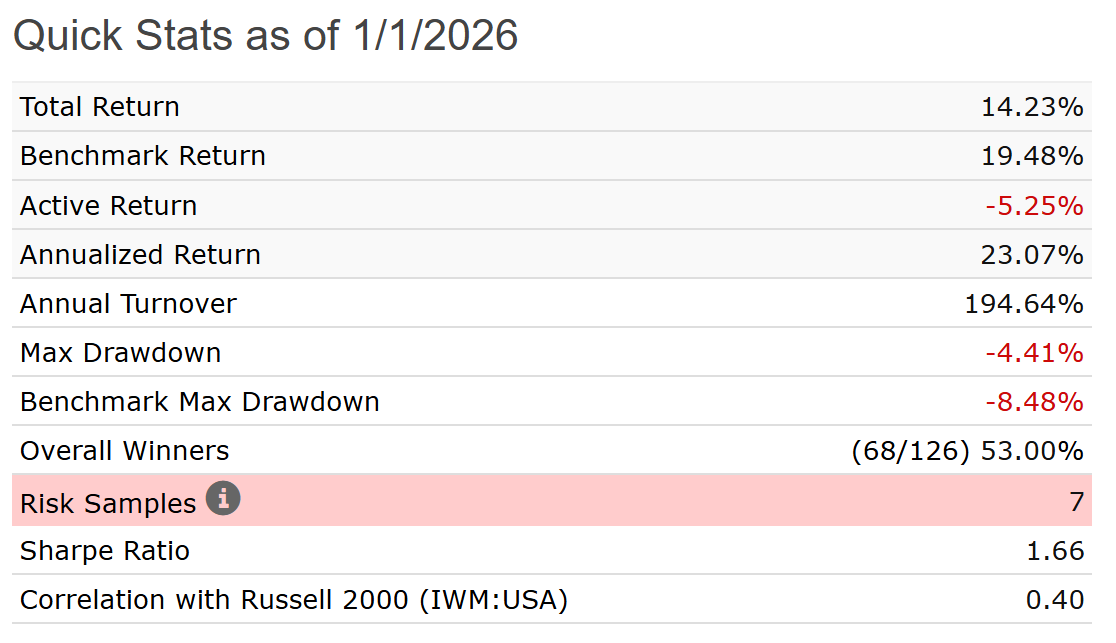
My composite book is only up 14% YTD in GBP, I’m net short market and got some upside VIX calls which caused underperformance this year. However my objective is minimal drawdowns and total returns even if the market tanks so I’m fairly happy with the 2025 performance. The below are 4 strategies (2 AI, 2 classic ranking). The 2 classic ranking systems alone returned 21% on a 1.8 Sharp for the full year in USD despite being 80% short IWM, ARKK, SPY, SOXX. The 2 AI systems went live mid May. Book target is 30% return on a 2.5 Sharpe but real performance is always going to be lower than backtest.
3 Likes
Pulling off a 14% TR with a 0.4 correlation, Max DD of just 4.4%, and a sharpe of 1.66 is nothing to sneeze at, well done 
2 Likes
Thanks, Yuval — helpful context. I’m mostly trying to make sure I understand the mechanics and trade-offs.
As a U.S.-based investor, is my understanding correct that when I close out negative foreign currency balances, I’m effectively removing the natural currency hedge by no longer being short the foreign currency? In other words, I’m intentionally re-introducing FX exposure rather than hedging it away.
I appreciate that your situation is different given fund structure and policy constraints. But for an individual investor with USD liabilities, if foreign holdings are, say, ~25% of total assets, does maintaining that level of unhedged currency exposure strike anyone as unreasonable?
Even setting aside recent dollar weakness, it seems like a defensible choice from a diversification and robustness standpoint rather than a tactical FX call. Or no?
Yes when you close the FX balance you “remove” the FX hedge to your base currency. IB charges 50bps spread on each leg, on top of the interest differential, so the hedge becomes costly from a carry perspective. I clear the balances unless I want to run a macro trade (currently I’m long JPY as we are close to BOJ intervention levels and JPY shorts are crowded).
Thank you! To clarify, you typically clear the balances as they occur? That’s what I’ve been doing… and will likely continue to do.
You might already know this, but it should be mentioned that those are margin loans since you didnt hold cash in that currency. If you held cash in that currency it would be just a cash purchase like any other stock. FX risk is part of the calculi but so is whether you want the margin loan or not
I understand that, but appreciate you checking. But taking the margin loan and immediately closing it seems economically equivalent to pre-buying the currency first—which feels like mostly operational busywork—right? No reason to buy the currency first, I presume.
Yes I don’t prebuy myself anyways but do have dividend income in various currencies so will use that sometimes
1 Like
Thanks for the topic - I really enjoy reviewing these results every year. This year was especially interesting.
Italy had a massive impact on my strategies, and I made several key changes after June. Of course, the results could have been better if I had done this earlier, but that’s part of the learning process.
One interesting case:
One of my strategies was originally launched to test the impact of leverage and slippage when trading with very small capital. I simply allocated $20,000, and the AI-driven strategy delivered over 100% without leverage and 157% with leverage.
It sounds fantastic - and honestly, that’s where the story should end  The strategy is practically not scalable: it holds only 5 positions, has extremely high turnover, and would completely choke with a portfolio above $100k.
Still, I can now proudly say at parties that I made 100% in a year - and it’s actually true.
The useful takeaway: turnover above 800% is not a death sentence. On larger accounts, I now use AI strategies with high turnover, and surprisingly, the total trading cost impact is only a few percent per year.
Real-money results on larger accounts:
Traditional strategies:
• ~32% YTD
• No hedge, no leverage
• Very high liquidity - comfortably scalable up to ~$10M
(Again, results could have been better; most key changes were made in July-August.)
AI strategies:
• ~32% without hedge
• ~26% with hedge
These AI results are since August, not from the beginning of the year, because that’s when I switched real capital to AI-based strategies. I don’t feel comfortable sharing results that are not from live money.
What this year taught me
I understand myself much better now. Earlier, I was chasing big numbers and secretly envying your results. Over time, I realized how this really works.
50% on a $50k account is not that hard.
Doing the same on $1M requires a much deeper understanding.
Doing it on $10M is elite-level execution (super hero level  ).
).
That’s why I truly respect those of you managing large capital - you’re doing an amazing job, and I’m glad I now understand what that actually means.
Looking forward
Starting now (and into next year), I’m increasingly focusing on institutional-style metrics. I’d rather earn 20% with a 15% drawdown than 45% with a 55% drawdown.
It’s harder to achieve, but when it works, you really feel that you’re in control — regardless of market behavior.
Next year:
• High-return strategies will remain on accounts up to $1M
• Anything above that will move to more balanced, lower-volatility strategies — lower returns, but much smaller drawdowns.
These are purely my personal conclusions. Investing is a highly individual process, and everyone has to choose strategies and risk levels that fit their own goals, psychology, and constraints. I’m not suggesting this approach is universally “better” - it’s simply the result of understanding more clearly what I personally need and what allows me to stay consistent and comfortable over the long run.
Happy New Year to everyone 
10 Likes
Congrats on a great year
US only here, no hedging, long only, real money, no AI, just classical methods.
The only port that I let run all year, 10 midcap to megacap stocks, returned 66.53% versus RSP’s 11.21%. From its start May 26, 2021 to January 2, 2026 it is up 206.95% vs RSP’s 38.91%. I am very happy with it!
I replaced a 40 stock smallcap to megacap port in March. From March 21 to end of year, it made 14.74% vs RSP’s 12.1%. The old port was essentially even with RSP for the year before being replaced.
All in all, I am very happy with 2025 results using Portfolio123. Thanks for the platform!
5 Likes