I’ve been using Portfolio123 for a few months and recently developed my first systems focused on small-cap universes — one for Europe and one for the US.
Each strategy holds 20 stocks, with a minimum median daily volume of $100k. Assuming I trade around 5% of the daily volume to minimize slippage, this implies a maximum AUM of:
2 × 20 × $100,000 × 0.05 = $200,000
My question to the community is: What’s the best way to increase AUM without significantly diluting the strategy’s alpha?
Some ideas I’ve considered include:
Splitting orders over multiple days
Increasing the number of holdings
Raising the minimum daily volume threshold
I’d really appreciate any personal experiences on how you’ve managed scalability in small-cap and what you think is the max AUM achievable?
Then compare the four and see what has the least impact. All of these should simulate roughly a doubling in AUM.
Regarding point 4, this is the most vague one. A doubling in trade value affects the market impact, it can have significantly lower than effect than slippage doubling but also higher, depending on order book. If you are using variable slippage setting, resimulate with fixed setting first and find a value that matches the varSlip results, then doublethis fixed value.
That should give you a first quick’n’dirty idea.
Regarding practical experience: Imo the fear of limited scalability is often overblown. With modern algo orders and some patience, you can easiliy scale in/out positions within a few days. Unless you are swingtrading nanocaps with 800% annual turnover, $1M AUM are easily managable (see e.g. @judgetrade ). Depends on strategy but imo sub $10M AUM there are easy tweaks to scale with limited alpha erosion. Especially with AIFactor and if you just add stretegies e.g. if we get the Asian/Pacific Data soon…
I agree with the prior two responders statements, but will add some comments.
The use of the median daily total dollar amount traded in the universe definition is an attempt to prevent yourself into liquidity situations that you consider less desirable. It is a lower bound. It is a median which means half the values are higher and half are lower – sometimes much lower. I have a $200K value, but when I look at the 4 liquidity challenged trades from Monday they were 2.5%, 4.0%, 5.0%, and 25.0% of the day’s trading volume. All were at or below my limit price. All had trading days below the median dollar trade.
Walter’s suggestion to estimate off the actual median dollar trade for the stocks selected is a good one as it provide a more reasonable view (and higher) figure. Since you are using two distinct universes that are expected to be different, calculate the value for each one.
Since you are looking at AUM and not trading size, it can reasonably be spread over several days if needs be. I rarely have it as a consideration, but start getting concerned around 20% of the actual median daily dollar trading volume. Between performance bonus weightings and multiple models with overlaps it is concentration risk that is more a concern. I currently have one name that is 11% and one time it reached 15%.
Summing it up your AUM capacity is in multiple millions of dollars.
I don't know what the max AUM is but I'm running microcap strategies over several accounts with about $25M, and some of my largest holdings have daily dollar volumes of well under $100,000. For example, one of my biggest holdings is Conrad Industries; its median daily dollar volume is now about $80,000 but when I first started buying it about six months ago it was about $25,000. All three of the ideas you're considering are good ones, especially easing into positions slowly. Also, use VWAP orders whenever possible.
Also remember that market impact costs are measured this way: C = γ · σ · (Q / V)^(1/2). C is the cost, γ is a multiplier that's invariant between transactions, σ is a measure of the stock's volatility, Q is the quantity you trade, and V is the overall volume traded by everyone in the market. So let's say that trading 5% of the daily dollar volume of a particular stock costs you x%. What will trading 50% of dollar volume cost you? 3.16 times x% (the square root of 10). In other words, increasing your trading volume 10X does not increase your costs 10X. What about buying 100% of the stock's median daily dollar volume (which I've done quite a few times)? That'll cost you 4.47 times x%.
Many thanks to everyone who took the time to respond — it’s been particularity helpful to hear insights from those dealing with this issue in their own trading
I’ve rerun my simulations incorporating Doney’s suggested changes, each showing only a minimal impact on returns. Regarding the rebalancing period: if I were to change this from weekly to every quarter, would it be reasonable to expect a potential 13x increase in AUM by scaling into the position, without increasing expected slippage?
However, since the transaction price assumption — “average of next high, low, and 2× close” — would no longer hold, am I correct in thinking this could affect the strategy’s robustness in practice?
You can estimate (very loosely) trading on different days by setting your simulation to daily and then adding rules where it will only trade on a Tuesday. And then a Wednesday. And so on.
It won’t mirror real life perfectly either as ranks in live trading are updated daily whereas ranks are updated weekly in the sim. So live trading should have an advantage over backtest there (I think).
Also holidays will mess you up if for some reason the market isn’t open on a Tuesday. But you will get an approximation of fills by delaying your buys by 1 day then 2 days an so on.
It’s all quick’n’dirty. The only thing an increase in n13x-ing rebalancing period does is also 13x-ing the average lag to significant signals like earnings calls. You could even work with lag functions in the buy/sell rank rules test this.
Try weekly with:
Buy: RankPrevPos(weeksAgo) < n
Sell: RankPrevPos(weeksAgo) > n + x
Compare this to this with “fresh” (normal) rank rules and a scaling-in reality would lie in the middle.
The AvgNextDay Price Setting should stay in place though. You limit execution days and lags via the rules and rebalance settings instead. But the prices for transactions should still use the normal setting.
However, as Yuval said: The scaling problem isn’t linear and even if it were, with a mix of all the tweaks above, a tiny compromise in the right direction easily deals with the problem whenever you run in it (which would be a good thing because that means you printed $$$).
Also IBKR adaptive algo for orders is your friend.
PS: Please consider: These assumptions are mainly for US/Canada Microcaps. Europe Microcaps are a mess when it comes to Spreads+MarketImpact as function of liquidity.
In my experience, US spreads are comparatively easy to model as function of liquidity. In Europe often you encounter non-tradeable or high-friction market segments (UK), regulatory limit execution restrictions (Germany) or sometimes a $1B conglomerate stock with has 5% spread vs. a $100M Microcap which has 2% spread at same daily volume.
Nordic exchanges are good. Also rarely have problems in Italy, Netherlands, France, Austria. UK is tricky for nano/micro below a certain liquidity (high fees, sometimes only auctions or no access at all). German exchanges on IBKR sucks for microcaps, especially if it didn’t trade on the day and bid/ask move away from last close (you will get limit restrictions closer to last price and no execution). Warsaw is nice regarding execution but often bid/ask volume is tiny at same liquidity.
I trade a lot in Europe. It is not critical but overall much messier than US/CAN especially because of the fractured exchange landscape. We really need a central European exchange or something like this but guess this won’t happen in my lifetime…
A few ideas. Some of these are unconventional but common sense:
Larger cap stocks are not your enemy there are great opportunities in larger caps. Some of my best returns ever have come from mega caps even (2400%+).
You can think out of the box regarding liquidity limits. For example, instead of not investing if liquidity is less than 100,000 one could simply have lower weighting for those ideas.
Being open to international markets. The world is big. I have had positions in dozens of countries. Although you must first study each country and have some foundational macroeconomics knowledge if you do decide to go that route. As a tip I would focus more on countries with high economic freedom index numbers or at least improving freedom. I do break this rule sometimes though if I am an expert in the country and the opportunity is there.
Derivatives. Large players use derivatives. easy way to increase size without impacting stock price directly.
Hope these help. If I think of others I might add them later.
Fidelity doesn't offer POV, only TVOL and VWAP. StoneX (my hedge fund's prime broker) does offer POV, so maybe I'll try that--to be honest, I'd never heard of POV before. For relatively illiquid stocks that I trade with StoneX I use not-held orders; ditto with Fidelity European orders.
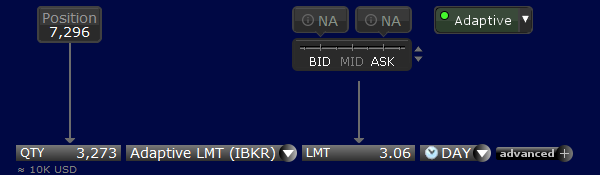
We do not have that within the options of Portfolio123 I think. When you say mid price limit, this is the absolute limit (the one where you see 3.06 below)? If yes what do you do when price spikes?
I tried POV with attempt not to take liquidity but very low execution. I suspect there are spikes of volumes or dark pools. What about a POV where we take liquidity?
Don't know about P123. I trade all my strats manually. I use adaptive for very messy illiquid tickers. I place the limit at mid price with patient setting and adjust it higher from time to time if there is no execution. The limit just neuters the algo. It then tries to sneak small suborders into the orderbook within the confines. But you will get a LOT of trades, so imo it makes only sense for really illiquid stocks with messy orderbooks or exchanges with shady marketmakers where don't want to show all your cards.
And for the ones using VWAP (like Yuval), do you use attempt not to take liquidity (I am afraid that not using it could massively push the price in the wrong direction)?
In my experience, a well-planned limit approach works better than VWAP for thin microcaps. VWAP assumes continuous, deep liquidity and often forces trades, which leads to sloppy execution. Like others here, I typically use adaptive/patient settings and adjust as needed.
I’ve experimented with hiding order size and a few other variations, but most introduce more drawbacks than benefits once tested in real conditions. If anyone has had better luck with those tools, I’d love to hear about it.
Since I’m trading a mix of systems designed by others, I manage sizing at the portfolio (rather than strategy) level. It would be great to have an execution layer that allocates intelligently based on liquidity and portfolio context—favoring smaller names first, then backfilling into larger ones within participation constraints.
On SZ’s point about large caps: discretionarily, I completely agree—large caps are easy to size, easy to exit, and momentum setups can be very clean. But in moving away from discretionary trading, I haven’t found many large-cap quant systems that perform anywhere near as well as small/microcap models, even after accounting for execution risk.
For me, a barbell of muted ETF strategies and small/microcap strategies still feels the most logical, with hedging layered throughout. If anyone has suggestions for a strong large-cap quant model, I’d love to explore it.
It really depends on how thinly traded a stock is. When I was using IB, I did not attempt not to take liquidity. But I have a close colleague (P123 user and hedge fund manager) who avoided the most thinly traded stocks, and he always avoided taking liquidity. He swore by the Fox River VWAP algo, did a lot of measurement of slippage, and said that it executed perfectly, although sometimes it would take him a few days to enter or exit a position. Now that I'm no longer using IB, I use VWAP orders on Fidelity when I can, but they work quite differently than VWAP on IB. (Fidelity does not offer POV orders.) Also for European stocks on Fidelity I use not held orders (the default). For trading with my hedge fund, now that I've learned about POV orders, I use those (limit 35% of volume}) for orders greater than 25% of the daily volume, VWAP orders (limit 50% of volume) on other stocks, and not held (desk) orders for extremely thinly traded stocks like ARTW, ESP, and AKT.A:CAN. So far, I'm OK with this solution, but I may revise my approach down the road.