Munger on Drawdowns

Denny - everything you said is anecdotal and can’t be evaluated by a third party. The basic problem I see here is that the timing systems that reduce drawdown/risk are not likely the same ones being used in many of the high flying systems on R2G. Risk reducing timing strategies have a delay associated with them that will keep the investor out of the market for significant periods of time, thus reducing profits, even when the market is recovering - often the best time to be in the market. In addition, there will be many “misfires”, causing short term losses that will drive amateurs out. As I don’t see these characteristics in most R2G models I have to conclude that they are using high frequency strategies that are less likely to work than long term strategies. In any case, the developer should provide LONG TERM statistics to demonstrate the market timing, much longer than is available at P123.

So here is some bedtime reading:
(1) http://www.businessinsider.com/back-testing-etfs-to-improve-your-odds-2010-4

What I get out of this is:

  • most people would not be able to trade a 200-day MA crossover
  • stays on the sidelines for long periods of time
  • majority of the trades (77%) are losing trades
  • patience and conviction are severely tested

(2) http://www.blueowlpress.com/WordPress/trading-systems/200-day-moving-average/

I have some issues with this article as it seems to be a little biased:

  • both long and short were tested. This is OK for max return but should only consider long side for risk reduction
  • the individual stock test is unfairly biased. Only 30 stocks that traded sideways were tested. MA filters are only good for trending stocks.

(3) Finally from “Technical Analysis Explained” by Martin Pring

(summary of Chapter 8 on Moving Averages)

  • there is no such thing as a perfect average
  • the choice of time span always represents a trade-off between timeliness (catching the trend change needs to be early) and sensitivity (causing an undue amount of whipsaws).

I believe we will see a demonstration of sensitivity in many of these R2G systems.

Steve

P.S. I doubt that Martin Pring is doing beginners a disservice by mentioning the word whipsaw.

Don’s comments did lead me to dig out the old portfolio simulation I made in 2007:

http://www.portfolio123.com/port_summary.jsp?portid=333711

And ultimately it worked, here is the out of sample performance:

http://www.portfolio123.com/port_summary.jsp?portid=1110258

They key is it is very simple - much less risk of curve fitting.

I also came across a post I initiated on Jun 20th 2008:

http://www.portfolio123.com/mvnforum/viewthread_thread,3389_offset,0

To quote (myself):

Quite prophetic really. Reading old forum posts is definately an interesting way of “backtesting” as we can see what analysis was way out there and what was spot on.

Running my Classic model with the same hedge based on a 20 x 200 sma crossover, bench > 50 or 200, sma(10) > sma(50) or sma(200) all return results pretty close to the results of my live model. Not sure off the top of my head how to implement a monthly moving average, but the 20 x 200 should be pretty similar. The hedge used In my Classic model is just about as basic as these, but I deliberately used a hedge that was somewhat aggressive - it trades more than these without any added benefit. For me, the benefit is that it is quicker to react and so more likely to be hedged in a downturn out of sample.

Don

Well first it has nothing to do with paying the bills. I invest to grow my capital, not to lose it. I trade as much to mitigate the risks of investing as to achieve a higher return. I simply do not accept that it is not possible to earn higher risk adjusted returns. It’s been shown to be possible in research and it’s been done by many, including myself over not insignificant periods of time. The quote below stuck with me - you can have your cake and eat it too.

I get your point about a drawdown not being the same as plainly losing money, but I disagree. I view them the same. The “it’s not a loss if you don’t sell” perspective assumes that it will come back. It probably will, but nothing is guaranteed and I don’t take this for granted. Some markets did not come back, (off the top of my head): Germany, Japan, Italy, Argentina. For some really good info about assumptions later proved untrue, see: http://www.mebanefaber.com/2008/07/03/what-will-the-21st-century-look-like/. The links in the article have moved but can be found with google and are well worth reading.

I think this is something of an individual perspective. Warren Buffet accepts a 50% drawdown as the risk of investing, I do not, and I structure my portfolio to mitigate that risk.

Don

I have seen this statement before in relation to stock trading, not about investing. The great majority of Australia’s working population are in trouble then because our compulsory superannuation system is based around equity investing. For those that don’t know, 9.2% of your wages are compulsorily invested into your super account. The average allocation to equities is 54%.There is legislation(which may or may not be changed by the current govt) that is going to move this to 12% eventually. This apparently is what is needed to get someone on the average wage to be self sufficient in retirement. Australia has the fourth largest pool of pension assets in the world at $1.5 trillion (population 23million).
http://www.theaustralian.com.au/business/wealth/nations-15-trillion-in-super-assets-the-fourth-largest/story-e6frgac6-1226570336509#

Gary,
I guess the superannuation contributions are supporting the stockmarket. This is a self feeding cycle. However, you do have a choice to move between interest bearing instruments and stocks. See my MAC model for the Australian market. I wonder what the growth assumptions are for the Aussie market. The AAORD is now at the level where it was in 2006. If it continues going sideways or lower than there will not be much of a pension income for hard working Australians.
At least in Australia you still get some interest on cash, wheras here in the US you get zero interest. So the savers, and retired folks here are being forced into risky investments if they want to have some income. This is not a good situation.
http://advisorperspectives.com/dshort/guest/Vrba-130514-MAC-Australia.php

I love the passion in this thread so far. :slight_smile:

Oliver…Many people have to ‘invest in stocks’ - often beyond their ‘risk level.’ Or feel that they do. They either don’t earn enough, haven’t saved enough or still haven’t recovered from 2008, to the point where they feel they can afford to live on 0-3% annual returns (pre-inflation). In this way, stocks act sort of like a socially approved ‘regressive’ tax on less informed investors. Like lottery tickets. Only the pay out is, on average, slightly better. :slight_smile:

Most retail investors are clearly in portfolios at least slightly above their ‘risk tolerance’. Most retail investors are naive. Over-reacting to popular press. And trailing X period returns. Making very narrow return bets. Winning traders are taking money from them.

Only time will tell which camp I’m in. :slight_smile:

Bottom line. People are living longer. It’s hard to retire on 0-3% annual nominal returns. So the question is how to invest in equities. Many people have to ‘hope that the market goes up’ as a vital component of earning enough to live the way they want to in retirement. How much do they invest? In what systems? A bet on a broad based ETF (why are we still talking mutual funds these days and not ETF’s, given all the research on mutual fund underperformance as an asset class?)…is still a bet on only a couple general factors…GDP growth and PE expansion from the time of purchase based on net stock market capital inflows being the main two. But, yes. Most people should use disciplined asset allocation in line with their ‘risk profiles’ and then own some broad, low cost ETF’s to achieve this. But…should they diversify beyond that? And should market timing be part of that. I think, clearly yes.

Some people want more than two bets (short term bonds and stock market ETF) for their family’s future. Especially given the levels of stock market 10 year CAPE. There are many other return drivers.

So…the question is how to invest in stocks most wisely / putting oneself in position for the best risk-adjusted returns. A blend of strat’s with a variety of ‘return drivers’ is always likely gonna be best. With disciplined rebalancing among them. Market timing is one way to lower peak DD’s and total portfolio volatility in times of market stress.

It is clearly a very strong viable option in this regard.

To avoid the risk of ‘one rule’, vary the parameters across portfolios. Then build books with a variety of systems - some with timing. Some without. Test their sensitivity as a group - by changing components. Post results. After doing this, I am very convinced that adding a blend of systems with various timing rules makes sense at the portfolio level. And many ‘elite’ hedge funds (i.e. Citadel or QIM) have run this way for a decade or more. With posted and audited results. It’s not reinventing the wheel. Or sliced bread. Or the wheel and sliced bread.

…AND -

This ongoing, multi-year debate / discussion is why an audited strategy ‘out-of-sample’ history may help. But…then again…it’s probably still never gonna move people out of their camps. In 3-5 years, some systems will have ‘worked’, some will not. I’ll still use some variety of timing. And some buy and hold. And some shorting. Because I’ve tested the systems I use to my satisfaction. After 5-10 years or so (yes, it’s a long time), we will have some data on various strat’s out of sample. We will be able to talk about what’s worked and what hasn’t. But we’ll always be able to find new rules on both sides that worked better…and we’ll still likely be having this same debate over and over again.

It will likely always be the case that many people will not be convinced a strategy can work until lots of people are writing about it and trading it. But by then, it’s probably lost a lot of its alpha. Right around the time everyone puts their money into it. ( microcaps? with R2G?). But I digress.

By the way, if anyone wants to share notes on ‘unusual systems’, I’d be open to talking.

Best,
Tom

Georg,
Looks Good
I was able to program it in Amibroker and results was similar to yours,
Can be this done in P123?
Emil

Georg,

I have read your research on your MAC system, which is very good. I have traded and invested in all sorts of stuff over the last 15 years. I have been badly burnt by a hedge fund and had poor returns from fund managers, but also had a few good results from managers as well.I have designed and traded longer term trend following systems in Australian equities on Amibroker, with really good results over the last 10 years. The last couple of years have been poor and I have sidelined the systems or now, The All ords index may look okay, but check out the small ords. I started with P123 probably in 2006, then stopped in the end of 2007, when I pulled all my share investments for a business project(lucky timing). The last three years have been great.
My comments related to the average working population. I have had my own business for 30 years and have employees. The majority of these have no idea about investing and generally no inclination to find out, Their contributions just go into default accounts.But, over the longer term Australian equities have been one of the best assets classes in the world - jut not in the last 5 years. The problem is mainly the high US dollar and lower commodity prices. We also have the second highest costs of living in the world.
In any case, my point is that equities as an investment class are required if you are going to build wealth over your working life for the average person.Whether you know it or not.

Denny wrote: [quote]
Now, before anyone else claims that market timing doesn’t work, I want you to justify it with actual information and/or data showing a timing system that has failed to protect capital during major drawdowns, and had many whipsaws that caused significant underperformance. Otherwise allow those of us that have been using timing successfully over and over help the other members avoid major losses, sleep much better at night, and reap the benefits of investing in the stock market
[/quote]
Denny,
I am on the camp that prefers not to use market timing but you are missing my point. Bear markets happen, major crashes happen, and traders should use tools to protect their capital (and hopefully even to benefit) against such events. Timing, hedging, or combinations of the above are all legitimate techniques and the preference for which to use is a matter of one’s trading philosophy.

I do understand and accept that market timing can protect traders against slow moving bear markets. In fact I have no problem with the use of simple and quite robust systems such Georg’s above (which uses just two parameters) for that purpose.

Misleading on the R2G marketplace:
My compliant is in the context of R2G and the fact that quite few developers have worked out “timing systems” that, with the benefit of a hindsight, are supposed to have skipped in and out of the market dozens of times, capturing every zig and every zag in the back test of the data P123 makes available. In my opinion the chances for such highly curve-fitted timer to survive future market swings are pretty slim, but if people want to buy these signals that is entirely their business and is of course fine by me.

The real issue starts when such designers take their curve-fitted timer, place it over a small cap stock selection - and poof – out comes what appears to be a system with fantastic back-tested returns. That in my opinion is misleading. If someone wants to sell a timer – let him (or her) state so. If someone wants to sell a stock system then let him do so, but don’t let people dress up timers and claim to be selling super stock systems because that is simply not true.

It is misleading to P123 users, misleading to R2G subscribers, and damaging to the rest of the community. P123 should enforce a policy that would help buyers understand the context of what they are buying. It should require developers to separate their systems into stock selection and market timer and make clear what section is responsible to what part of the performance.

Back to the other discussion:
Why do I prefer long-short hedging over market timing?
Timing systems – if they are simple and robust – are legitimate tool for preservation of capital against bear markets. But I for one believe that there is yet another risk, one that timers cannot address. That is the real risk of a major sudden crash. The Flash Crash of 2010 is a great example to what may happen. And that was a “no event” !!! If the “no-event” of 2010 caused a 10% drop in one hour, what would a real event cause? Be it a major act of terror or a default by the US government (which would render trillion of dollars in financial collaterals – useless) or even a default by a smaller government . How about a 50% crash in Futures exchange within the realm of several minutes?

Now think of timing systems. How would even the most stable and robust system provide protection against such plausible event? By the time your timer has compiled the end–of-day signal or the end-of-week (as in R2G) – the damage has already been done.

Hence my philosophy – stay hedged at all times. Because only a hedged Long-short system is inherently stable to sustain market shocks. During a crash the shorts will appreciate while the longs depreciate. And that is the ONLY possible solution to protect capital, IMHO. Real time and always on. With the mounting debt all across the developed world, with geo-political instability brewing in dozens of places at any given time, with massive means of destruction available to growing base of governments and to non-government groups – such shocks are a matter of “when”, not “if”.

Just my opinion,
Zvi

Oh, and one more point:
Market timers protected against slow-moving markets of the past when trends lasted years. What if we moved into a neurotic range-bound era with short term trends? You are always late in and late out with a timer. If the trend is long-term than great but what if the trend turned out to be short-term? Timers would whiplash you in and out the signal. Hedging OTOH keep working smoothly.

We can never know in advance what the characteristic of the market we are at is. Only hindsight tells us what was the period like. But Timers always make certain assumptions about the market and therefore – when proven wrong – it will already have been too late. It even happens to professionals - I happen to know of a market timer hedge fund that got whiplashed in 2011 to the tune of 40% loss…

Zvi,

What you say about hedging makes sense to me. I understand it can be useful to take short positions that do not make money or even lose money.

However, I am still curious as to whether you have found a short system that would make money as a stand alone system. I just wonder if one exists (that can be created with P123)-I don’t need to know anything you might not want to share.

Good comments!

Jim

Hello everyone -

A fascinating discussion. I am a died in wool low turnover value investor. I took a really large drawdown in 2008. Of course it all bounced back + much more as took the the opportunity to trade some cheap stocks for cheaper or better companies. However, I would like to avoid a repeat. Furthermore, I am skeptical that anyone can follow anyone else black box (r2G) during such a period. To stay invested and keep investing in a market like that needs you to have a lot of confidence in your picks, which is hard to get unless one does the research by themselves.

What are most people here using for a market timing system? I am looking for something basic and conservative which works in a large majority of cases.

Regards,
CR

PS - I would like thank a couple of members on this board who have been instrumental in getting me started on P123. you are awesome!

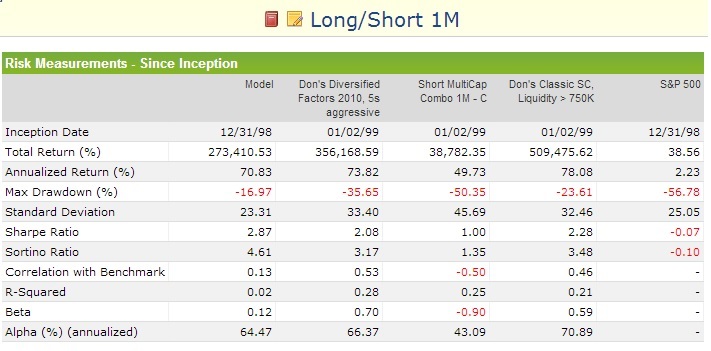
Per the screen shot below I have a short strategy that makes about 50% annually with stocks that trade over $1M/day. I’ve done much better the past few years with real money with a more aggressive variation. While the short DD looks big you can see when combined with the long strategy it is better than any market timing (that I’ve seen). This run of the book is 66% Don’s Diversified Factors 2010, 5s aggressive and 34% the short model. Using both long models with the short strategy gets the Sortino ratio to over 5.5! (and these are liquid stocks).

Well I can’t speak for most people, but moving average crossovers are pretty popular. See my earlier posts where I mentioned a few. I like ema(10) > ema(50) or ema(10) > ema(200). There are no magic numbers, but the benefit of this approach is that it has a bias to the long side.

Don


[quote]
Per the screen shot below I have a short strategy that makes about 50% annually with stocks that trade over $1M/day.

Don[quote]
That is amazing! Can you give a few hints. What turnover does it have? Do you use any technicals in the buy and sell rules? Do you use stop and/or profit targets? Any market timing within the short portfolio? What is the win/loss ratio and % of winners? Just trying to figure what type of system to start looking for.

Thanks

Not sure how I mucked up the quote thing - just ignore the boxes

Sell strength, buy weakness. Very high turnover.

Don

Don,

That is cool! Good to know what is possible.

Thanks.

Jim

Thanks Don! I will add the buy conditions in my simulations and see what I get. I am assuming you are saying buy when ema(10)> ema(50)

How about sell?

I am suggesting buy/hold when the following is true for the benchmark: ema(10) > ema(50) OR ema(10) > ema(200), otherwise sell.

Don

thanks!!