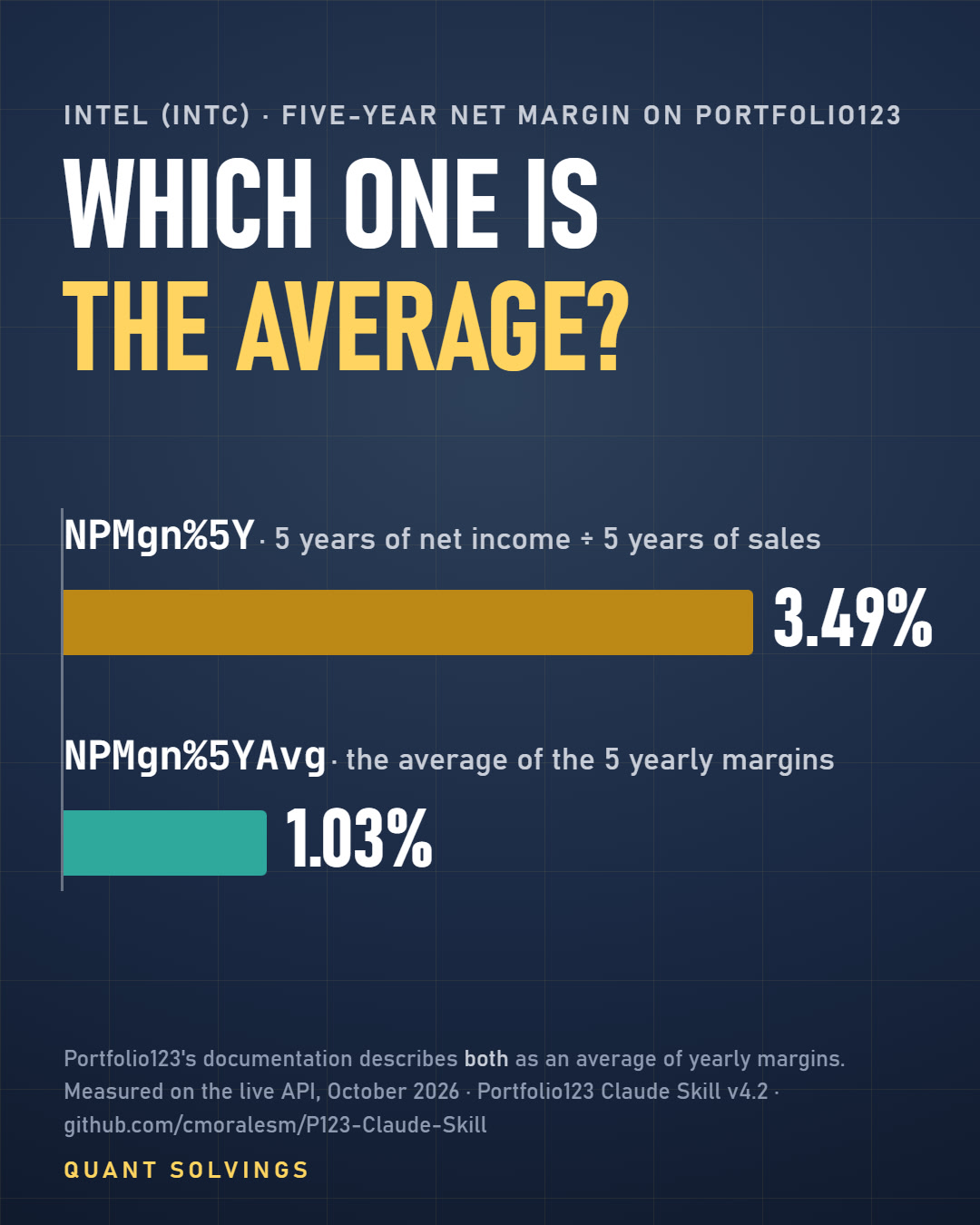
Ask Portfolio123 for Intel's five-year net margin and you can get 3.49% or 1.03%, depending on which factor you pick. The documentation describes both as the same average, and a forum member was the first to notice that only one of them is.
Most of us treat a factor's detail page as its definition, because that is what the page is written to be. The member had spotted that NPMgn%5Y is not the average of five yearly margins at all. It divides five years of net income by five years of sales, so each year counts by the size of its sales instead of getting one vote. The real average is its twin, NPMgn%5YAvg, and six sibling factors behave the same way.
The Portfolio123 Claude Skill had repeated that page word for word. So instead of fixing one factor, version 4.2 checked every formula and description the skill restates against the live API, on IBM, Intel and Microsoft. The audit came back with a dozen findings, and two of them sit inside screens that many people run. FCFYield is already a percentage, which makes a rule like FCFYield > 0.05 about a hundred times looser than it reads. And Ret%Chg(252, 21), the formula most of us reach for as 12-1 momentum, actually covers thirteen months.
The page describes, but the API decides. Every finding is now in the skill with the numbers that prove it, so Claude checks what Portfolio123 computes before it trusts the documentation. The skill stays free and open source under the MIT licence.
If you run a Portfolio123 screen, open it today and search it for a 5Y margin or an FCFYield rule. The page describes, but the API decides, and two minutes are enough to see whether your screen asks for the 3.49% or the 1.03% you meant.