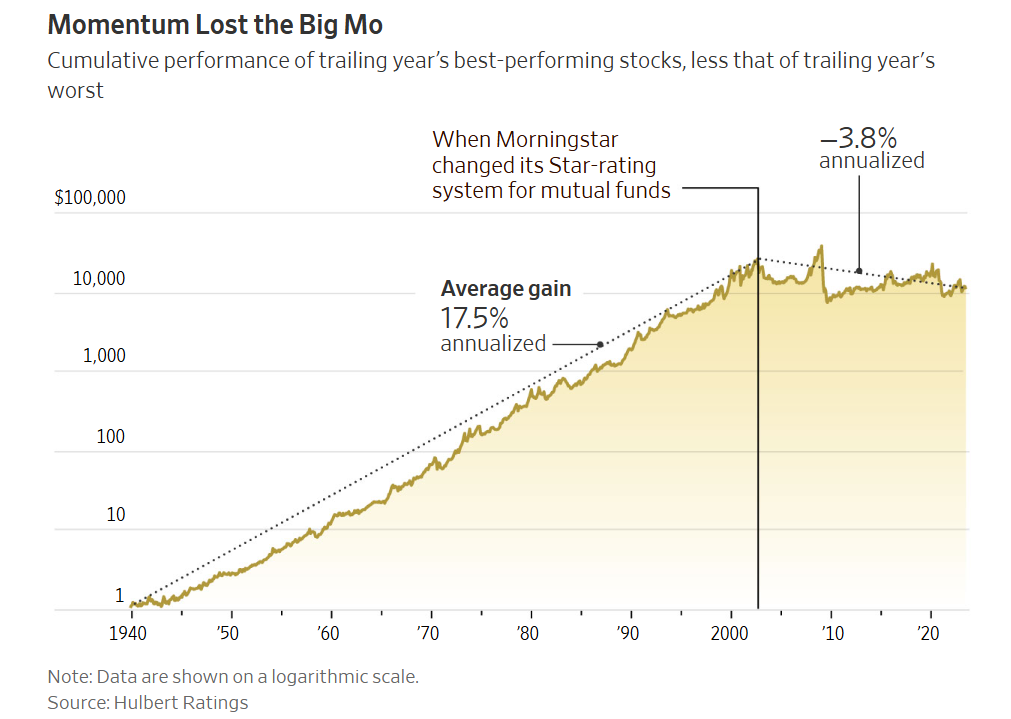
I have bookmark this WSJ article a while ago.
It maybe relevant to the discussion.
Momentum Investing Has Struggled for 20 Years. Here’s Why.
A mutual-funds rating company changed its methodology two decades ago, and that apparently has made all the difference
By
Mark Hulbert
Dec. 3, 2023 8:30 am ET
A change in mutual-fund ratings altered how investment dollars get allocated and is among the factors that have diminished the success of momentum strategies. Alex Nabaum
New research suggests a surprising reason why momentum-stock investing strategies have struggled over the past two decades: a seemingly innocuous change in the methodology of Morningstar’s MORN 0.84%increase; up pointing triangle mutual-fund ratings.
Momentum strategies are based on the tendency for stocks that have beaten the market over the trailing year to continue doing so for several more months, and for the laggards to continue lagging behind.
From 1940 through mid-2002, a portfolio rebalanced monthly owning the 10% of stocks with the greatest trailing-year returns, while simultaneously shorting the 10% of stocks with the trailing year’s worst returns, appreciated at an annualized pace of 17.4%, before transaction costs. Since then, this portfolio has declined at a 3.6% annualized pace. In contrast, the trend of the overall stock market remained steady throughout both periods: 11.4% annualized appreciation before mid-2002 and 10.4% thereafter.
What changed? A new study attributes the shift primarily to Morningstar in mid-2002 changing the methodology for its mutual-fund star-rating system. The researchers’ findings illustrate how sensitive once-successful investment strategies can be to seemingly insignificant changes in financial markets.
(Note that this new research doesn’t mean that momentum strategies have stopped working altogether. One momentum strategy that has promise employs certain single-industry exchange-traded funds.
Rating change
Before its mid-2002 rating-system change, Morningstar compared all U.S. stock funds with each other based on their past performance, regardless of their investment focus. The best performers got a 5-star rating and the worst ones got a 1-star rating. After 2002, Morningstar began comparing each fund only with others of the same investment style, like large-cap growth or small-cap value. This meant some funds got higher star ratings than they did under the previous system, because they were no longer being compared with funds of other styles that had higher returns.
The change in the rating methodology shifted how capital was allocated across mutual funds, according to Itzhak Ben-David, a finance professor at Ohio State University and one of the study’s authors.
Before mid-2002, Ben-David says, Morningstar primarily gave top ratings to the funds that had the best performance overall. These top-rated funds “often invested in similar stocks,” he says—such as internet stocks in the late 1990s during the internet bubble. As a result, new investments in these top-rated funds created concentrated price pressure for this small set of top-performing stocks, pushing their prices even higher and amplifying the momentum effect.
After Morningstar’s mid-2002 methodological change, mutual-fund investors still allocated new money to top-rated Morningstar funds. But because fund ratings were now based on performance relative to peers rather than absolute best historical performance, this new money was “equally spread across the entire spectrum” of mutual-fund investment styles, Ben-David says, even in styles that weren’t performing well overall. That in turn meant that this new money wasn’t concentrated in the funds holding the best-performing stocks, and therefore was distributed “too thinly to boost those stocks further,” he says.
Reality checks
John Rekenthaler, director of research for Morningstar Research Services, a Morningstar subsidiary, is skeptical. While acknowledging in an email the “logic for the argument that the change in Morningstar ratings softened the tendency of fund investors to chase recently successful investment styles,” he says that mutual funds represent only “a minority of the moneys that flow into stocks from pensions, insurance companies, foreign buyers and retail investors who buy stocks directly.” The change in Morningstar’s rating methodology therefore can’t be the sole reason why the momentum effect became less profitable over the past two decades, he says.
Ben-David says he and his co-authors aren’t saying there were no other factors at work in the lessening of the momentum effect. But he emphasizes that their argument is based on more than just the superficial correlation between the Morningstar methodology change and the momentum strategy’s deterioration. The researchers document that a Morningstar rating increase “results in a surge in mutual-fund flows, and that flow increases lead to contemporaneous stock-price appreciation,” Ben-David says. Given this, he says, it would be surprising if a change in Morningstar’s rating methodology did not lead to significant changes in the success of momentum investing.
Investment implications
The new research doesn’t mean that the momentum effect has completely disappeared; it just isn’t as strong a force as it was before because it isn’t as narrowly focused, Jiacui Li, a finance professor at the University of Utah and another of the study’s authors, said in an interview.
A broader takeaway from the new research, he says, is that “financial systems are complex” and “a small and innocuous change can have large unintended consequences on the entire system.”
When pursuing a strategy with a stellar historical record, investors are implicitly betting that nothing will change and all the complex factors that led to past performance will persist into the future. The new research reminds us that this is a risky bet.