Risk Budget

I come from a quant commodity trading background. There we sized trades based on a risk budget. That works something like this:

AUM = 10,000,000

risk/trade = 1%.

risk = dollar risk to stop loss, or alternatively can be some dollar amount of volatility

So let’s suppose I had a new entry to buy crude oil at 60 with an initial stop at 55. So the dollar value of risk is $5000/contract. My 10M acct is risking 1% so trade risk = $100,000. Therefore I will buy 100,000 / 5000 = 20 contracts. The notional value of the trade is irrelevant but it is $1,200,000. I mention notional because imagine I also have positions in copper, gold, beans, bonds, Yen, cocoa, etc, and the combined notionals are probably well over $50,000,000.

I mention all this because as far as I can tell there is no way to manage trades like this in P123, which I think is a major short coming. Any account that uses portfolio margin can easily achieve the same level of notional account size.

P123 allows either static weight or dynamic weight and regardless of which you use the results are very similar. I think on day one when using dynamic, a sim will size trades that are meaningfully different than when using static, but going forward as one trade comes off and a new one replaces, the trade sizes are nearly identical because the sizing algo always wants to make the account fully invested based on whatever margin setting you use (including of course no margin). Correct me if I’m wrong.

So basically we are sizing trades based price. Which is fine if that’s what you want, but I think it is kind of dumb. You will be sizing a trade in a super low volatility stock the same as a high vol stock which doesn’t make sense. Better would be the ability to size trades based on the risk to your stop being hit, which would also incorporate the relative vols of different stocks.

My thought is a new weighting option should be enabled called Portfolio Margin. It will have inputs like:
% of account equity to risk per trade __
risk is based on __
maximum % sector risk __
maximum % total account risk ___

Taking it a step further, adding the ability to reduce positions based on a max risk level being breached would be great (maybe a trade that was initially sized at 5% of equity now is at 25% so reduce it to 20% type thing).

I know with 100% certainty that this kind of trade sizing does a far better job of managing account volatility and would be a good improvement to P123.

Thoughts?
I believe that this can be done using custom formulas and dynamic weighting. If you can figure out exactly how you want your positions to be weighted, I (or someone else on the forum) can probably help you figure out how to do it with dynamic weights.

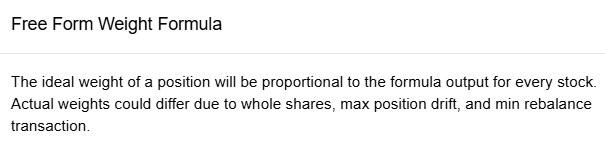
For example, let's say you want to base your trade size on the relative volatility of the stocks in your portfolio. You could use a relatively simple formula such as 1/pctdev(126,1) for that. If you wanted, instead, to base your trade size on the volatility of the stock compared to the average volatility of all stocks, you could use aggregate("pctdev(126,1)")/pctdev(126,1) as your custom formula. These could be adjusted, of course, if you find that your trades are not varying enough or are too varied. There are adjustments you might want to make to the other parameters in the Rebalance page. But in general the rebalancing framework is extraordinarily flexible if you play around with it, and we're happy to help.

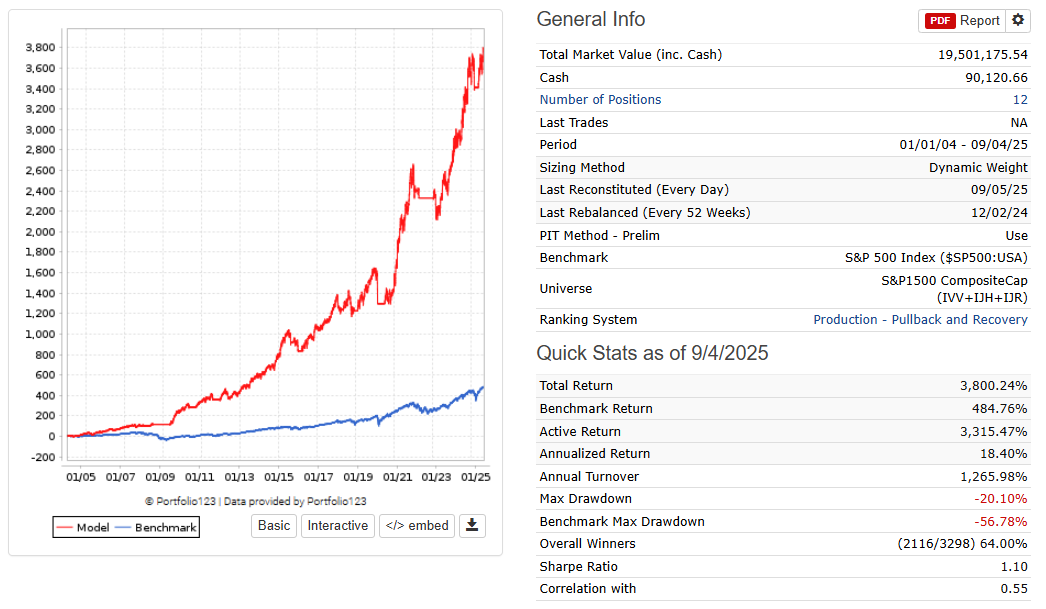
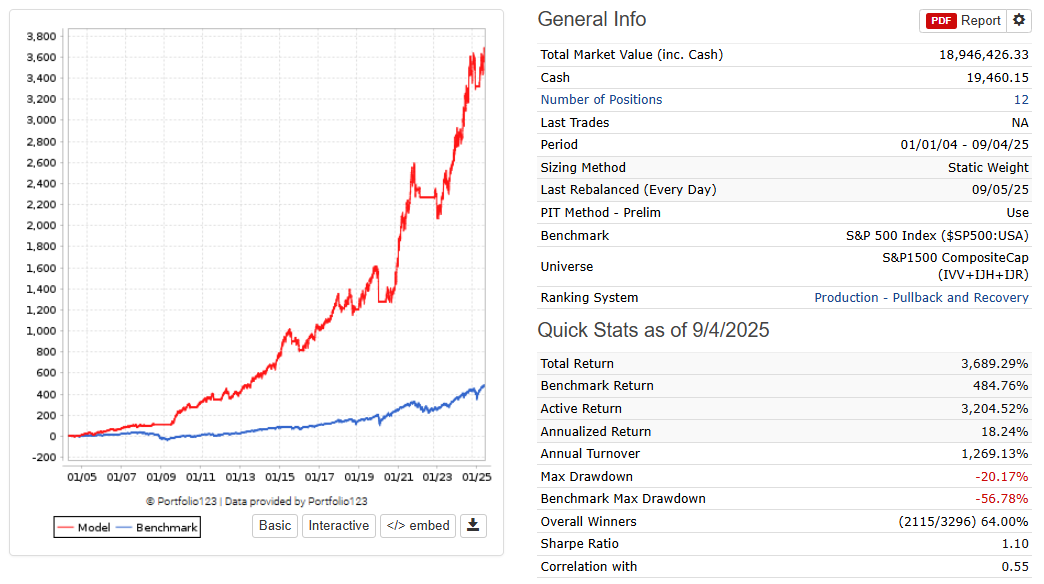
well maybe but I’ve done an awful lot of testing on this and think my POV is correct. For example, here is a sim of mine that trades SP 1500 stocks actively so we have many many opportunities to see the effect of sizing:

Static weight:

Same sim, now using dynamic weight with this custom formula:

Eval(HighVal(66) - lowVal(66)>0,(TotMktVal * .025) / (HighVal(66) - lowVal(66)),close(0))

Virtually identical.

And here’s something to note. If you change the .025 in my formula to 100, meaning you are sizing each trade to be 100% of equity, the results are identical, which to me indicates the algo is just scaling the trade to make the account fully invested.

What I want to do is not look at this in terms of being fully invested, in fact just completely throw that concept out for this. Instead we want to think in terms of risk. I want to size each trade so that their initial RISKS are identical and NEVER have any margin considerations in any way be considered.

Here’s an example. Let’s take a 1M account that buys the top 20 ranked stocks. I want to risk 2.5% on each, or $25,000. The risk will be determined by the dollar value of the recent range, let’s say it’s a $100 stock with a $10 range. So I will buy 2500 shares. Now there’s a second $100 stock that is wildly volatile and has a $50 range and I’ll only buy 500 shares. Same price, dramatically different number of shares. And so far we’ve invested $250,000 on the first and $50,000 on the second so you can imagine that by the time all 20 stocks are bought the account will have a total long market value well in excess of the 1M equity. This is easily done with portfolio margin, or one could simply change the values so the account would be less margined or even underinvested and holding some amount of cash.

Can this currently be done and if so how?

Thanks

Two observations to start with. First, you have a major oversight in your rebalance formula. HighVal(66) - LowVal(66) will give you consistent results only if all your stocks are priced the same. A stock that's selling for $3 and a stock that's selling for $75 will have very different ranges. Second, if your goal is to risk 2.5% on each stock, then you calculate all the different ranges and scale them so that you risk an average of 2.5% on each stock. You don't go into margin. What you're doing in your post is risking 25% on your first stock (I can't tell why) and then you don't scale after that. That makes no sense. Your first stock might have a tiny range compared to the others one month, and a huge range the next.

I've created a rudimentary simulation that does what I think you might want after you puzzle through these two important issues. You can see it here: https://www.portfolio123.com/port_summary.jsp?portid=1888679

1 Like

Regarding your first point, no, that’s not an oversight, that’s very much the intent. Maybe you are confusing ranges with risk. Using your example, let’s say the $3 stock has a range of 30 cents and the $75 stock a range of $10. Using the Dynamic formula with TotMktVal = 1M:

stock 1 shares = (1,000,000 * .025) / .3 = 83,333

stock 2 shares = (1,000,000 * .025) /10 = 2,500

Very different numbers of shares but IDENTICAL risk of $25,000. Again, risk is the dollar value of the distance between entry and my stop loss. So as you can see, this formula self adjusts to each stock regardless of price and range.

In this case, the $75 stock is the more volatile one and I would want to account for that by having fewer shares of it relative to a less volatile stock which is exactly what the formula does.

Maybe this will help explain it; assume we have the number of stocks set to 10. So the Static weight method would invest $100,000 in each. Stock 1 would have 33,333 shares and stock 2 would have 1,333 shares. There is no accounting of risk even though it is very likely their risks to a downside move are likely quite different. The ratio of shares between them is 25:1. Comparing this to the Dynamic method, the ratio is 33.33:1 so my formula is sizing the more volatile stock smaller relative to the lower volatility one.

I think the formula you use in the sim you made is flawed. It reads Price / (HighVal(65) - LowVal(65)). Again, my formula explicitly does not use Price. This has no relationship to risk. You need to think “I’m going to risk X% of my portfolio on each trade” knowing that if the stock declines so that the loss = that X% your exit rule will cause you will exit.

I’m not sure how P123 determines shares in your example. In the case of CPA (bought 5 days ago) your formula would solve as ($100,000 / 20) / (124.8 / (128 - 106)) = 882 shares, the ($100,000 / 20) bit being the money available for each of the 20 stocks). CRUS, also bought 5 days ago works out to ($100,000 / 20) / (126.15 / (128 - 97) = 1229 shares. I could be completely wrong about how your formula solves, please correct any error. But looking at your positions they are instead 60 and 35 shares respectively and that makes me think the number of shares is derived from some sort of scaling. The day these were bought, 4 other stocks were bought at a total cost of $36,809, so it appears that the actual numbers of shares was scaling derived in order to be fully invested. You have margin allowed but leverage set at 1 so I assume this actually means no margin. Along the scaling line, this has always been cryptic to me:

I read this to mean that new positions will be sized in such a way that they will be scaled amongst themselves so that the dollars available to invest will be weighted according to where in the list each stocks formula value lies. Correct?

This is exactly what I don’t want to do. I want to simply allocate a set amount of risk to each trade. No proportioning.

There is one error in your sim, not your fault I should have mentioned this. You are Rebalancing every time you are Reconstituting. I never ever want to rebalance. Obviously, enabling that option allows the entire portfolio to be modified so that scaling ratios can be maintained. I am not a fan of rebalancing and using your sim, and making it 5 years instead of 1, the non-rebalanced return is 30.5% higher and drawdown is 2.3% lower.

Regarding your second point, I don’t think you understand what I am saying when you typed: “What you are doing in your post is risking 25% on your first stock (I can’t tell why) and then you don’t scale after that". No, I am risking 2.5% on EVERY stock. The 25% you refer to is the notional value of the position which is not at all the same thing. Ignore the notional value, but this is where margin comes in, in the event I want to use it, as brokers do care about margin. I could of course decide to size risk at 0.001% which in a million years would never get you remotely close to fully invested, your account would be pretty much all cash. And again, I want absolutely no scaling at all. Your comment that a stock might have a tiny range one month and a huge range the next doesn’t apply; we are simply using this method to initially size a trade and have no way of knowing what ranges or prices lie ahead.

Again, and I can’t emphasize this enough, my goal is to set an X dollar amount of risk I am willing to take on a trade, and using that as the numerator, divide that by some measure of volatility to determine the number of shares to buy. This may help to understand it better. There are 2 types of risk: 1) the Portfolio level risk which is the dollar risk I am willing to take on each trade, in the case of our example this is the 0.025 value, and 2) the trade risk difference between the entry price and the stop loss.

Can this be done?

Thanks

I think one of the critical posts that needs to be made here is that volatility does not stay consistent over time and many funds blow up assuming it does and oversizing. Not that you are doing this, but worth noting for unsuspecting readers

1 Like

Sure, leverage definitely increases risk. One of my favorite Buffett quotes about leverage: "If you're smart you don't need it and if you're dumb you shouldn't be using it."

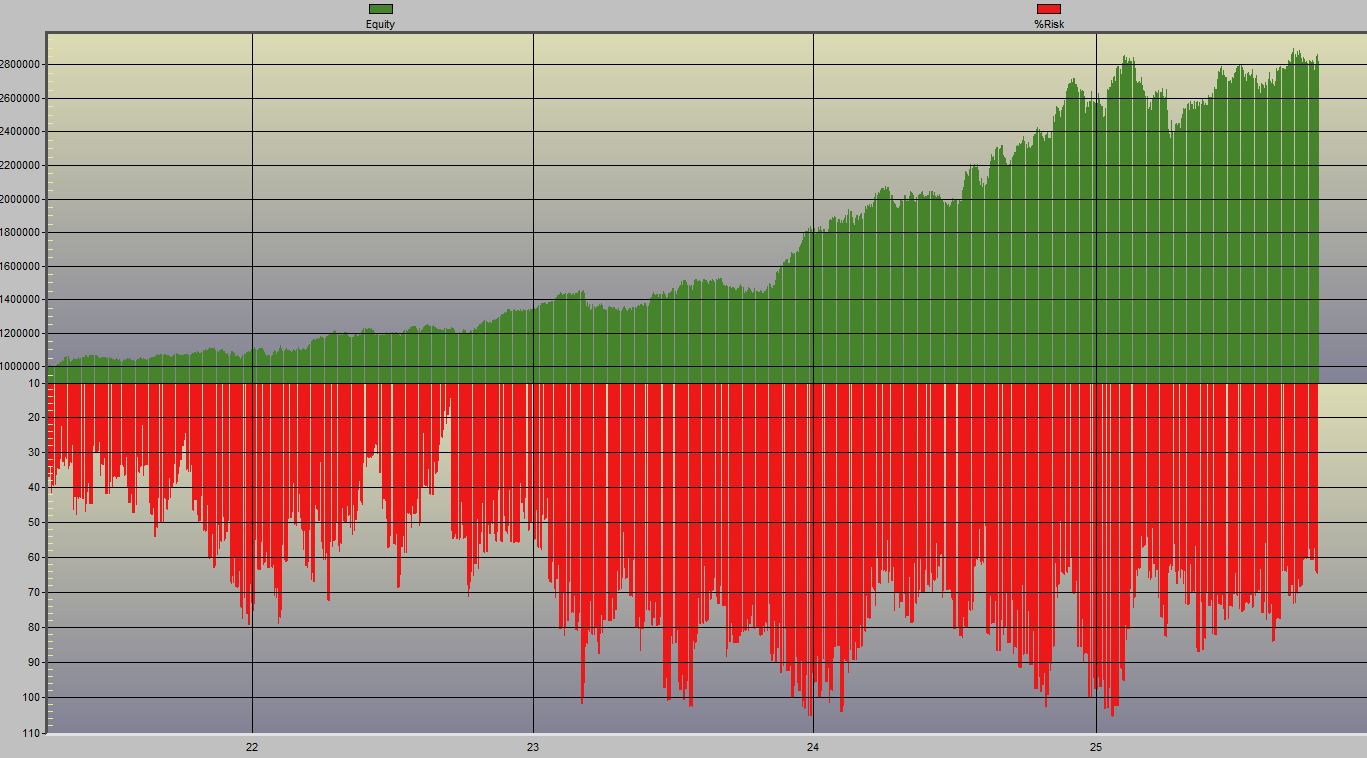
Anyway, you might find this interesting. I take P123 rankings into my software which has exceptional risk mgmt capabilities. The code processes and orders are generated. The entry signals are almost entirely based on the rank, exits and risk have a number of rules.

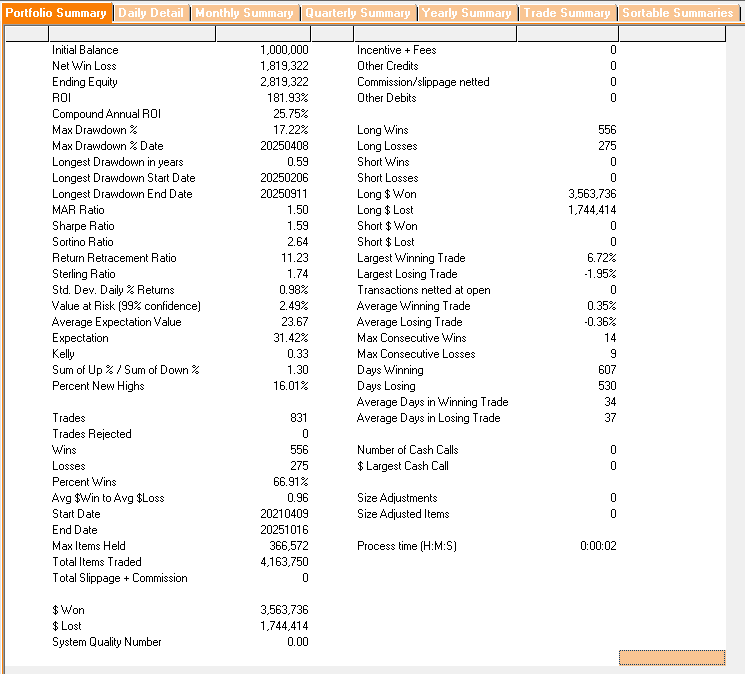
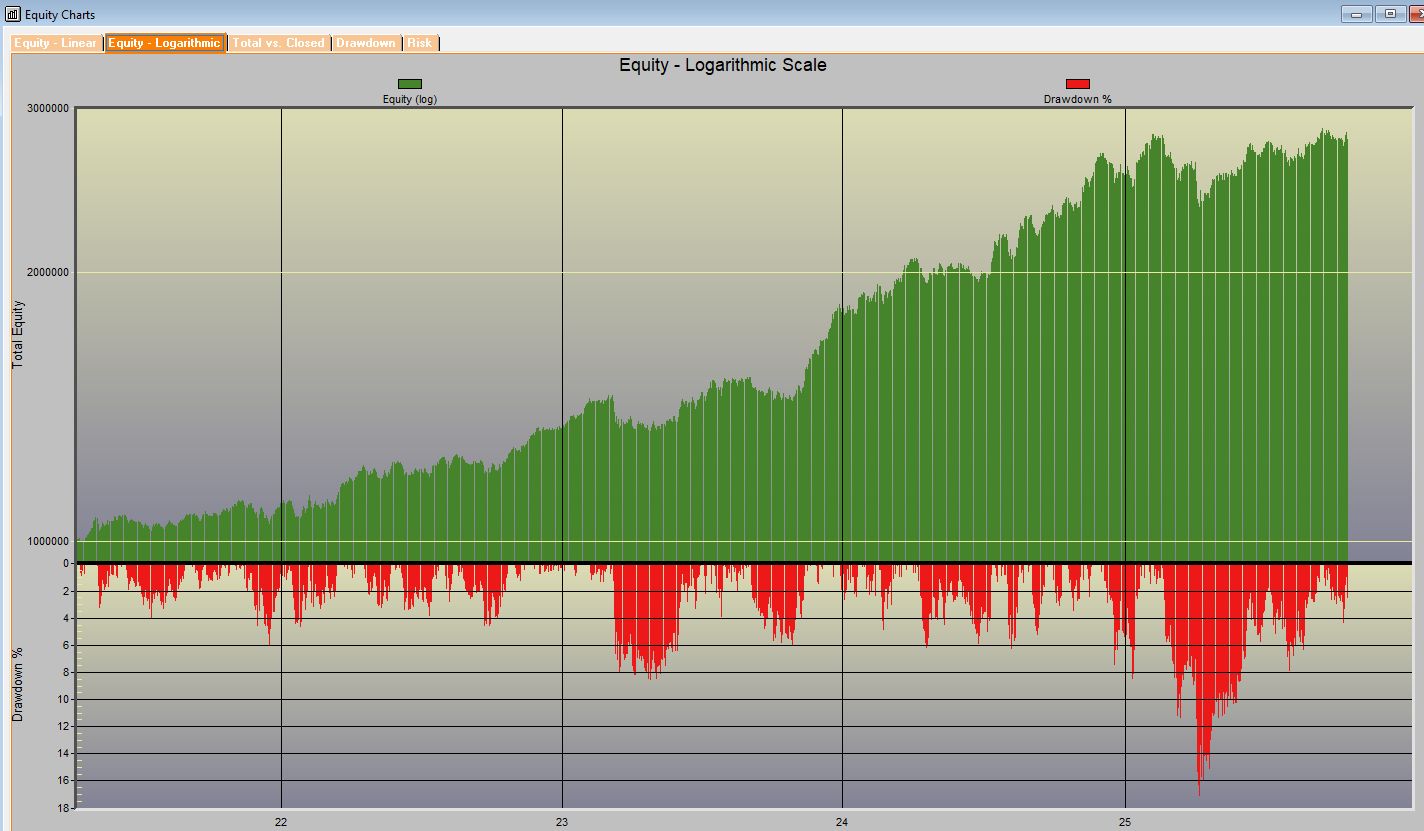
This is the system sizing trades based on the closing price:

In this chart I am forcing it to display the Total Long Mkt Value (the sum of the value of all open positions) as a percentage of account equity in the bottom panel (it says %risk but I’m forcing it to display TLMV):

So the model was almost always less than fully invested, probably averaging about 70%.

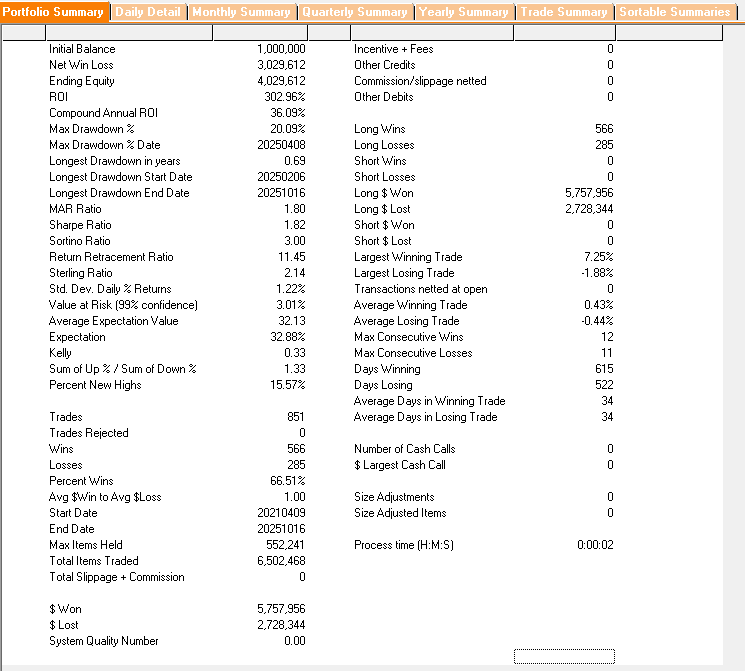
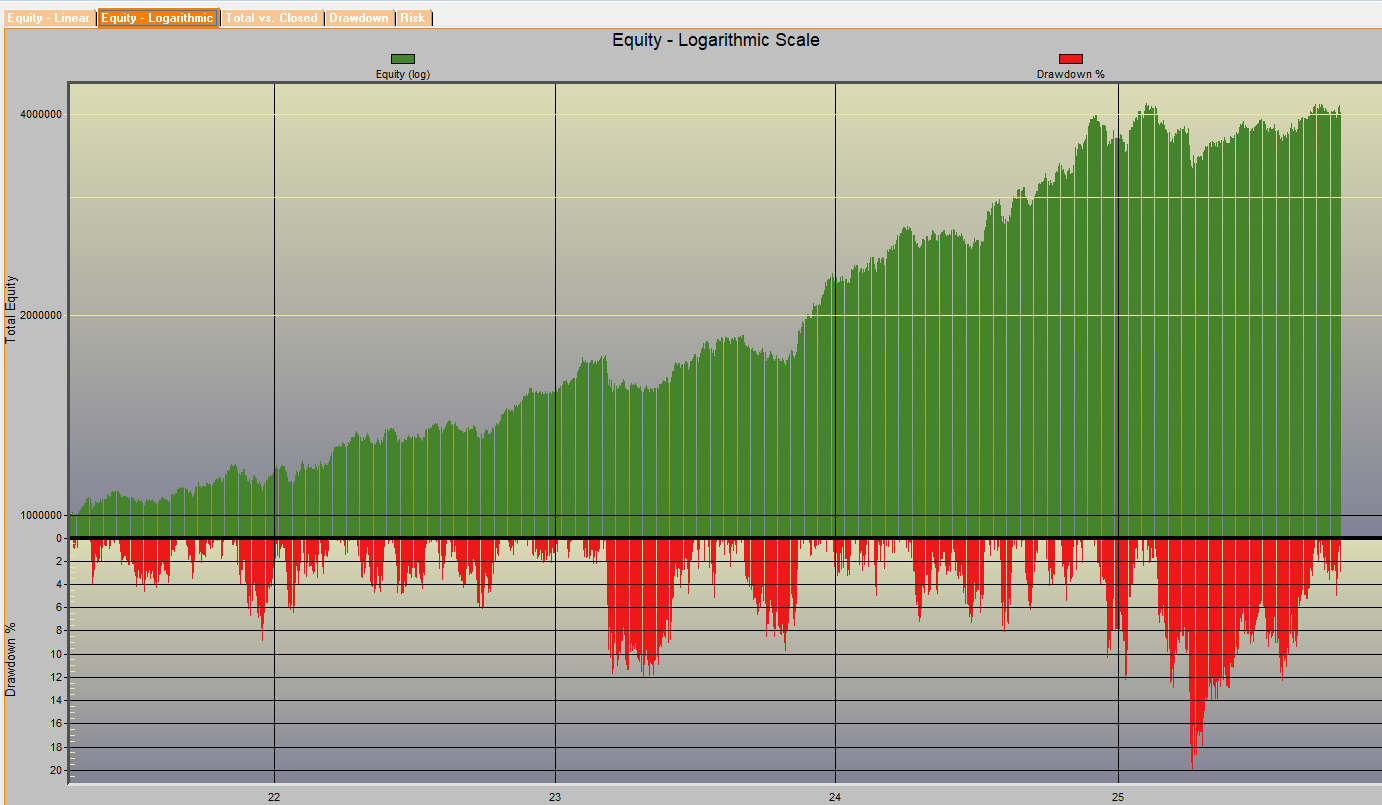
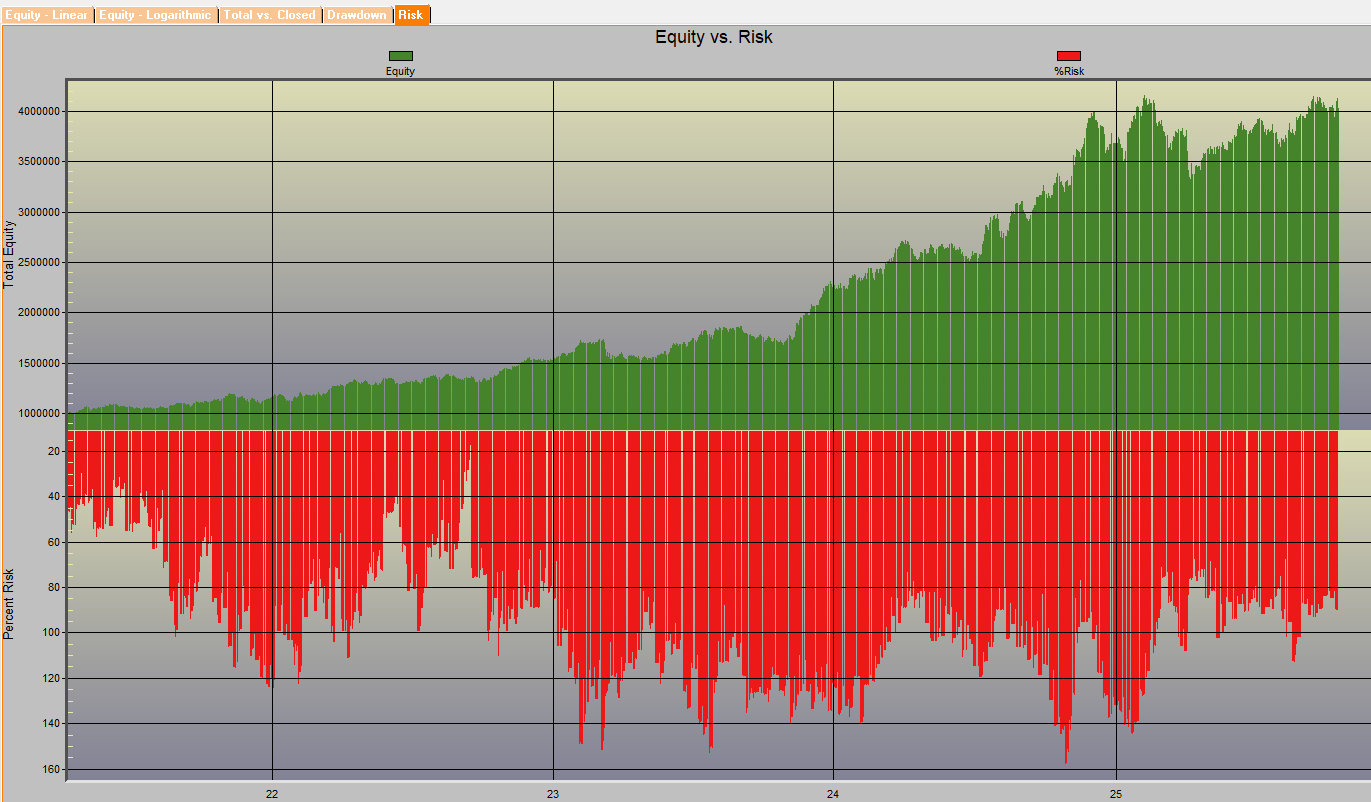
Now here’s the same set of charts but now I’m sizing based on the 33 day range instead of the closing price and risk is set at 1% of equity, with a stop loss placed at that level:

So the return went from 25.75% up to 36%. Max drawdown went from 17.2% to 20%. TLMV went from about 70% to about 95%. So proportionally, a big gain in return for a small increase in drawdown.

To make an apples to apples comparison, I reduce the amount of risk down from 1% until the drawdown of this method equals that of the one based on the close, and I get a return of 30%, max drawdown of 17.29%, and TLMV of about 80%.

So again, sizing based on volatility increases the return with no increase in drawdown.

1 Like

You can't write a formula for the number of shares in Portfolio123. What we're dealing with is a formula for the RELATIVE WEIGHT of the position. If you're writing a formula for weight, then you have to take price into account. And your example makes no sense. You're buying $250,000 worth of stock 1 and $187,500 worth of stock 2, leaving you only $562,500 for your other eighteen positions.

I use price in order to determine weight. Yes, it has nothing to do with risk, but it's essential to counterbalance the high-low difference to determine portfolio weighting. Let's use that same example: a $3 stock with a range of 30 cents and a $75 stock with a range of $10. Without using price, you'd end up with a huge weight for the $3 stock and a tiny weight for the $75 stock since 30 cents and $10 are so disproportionate.

No, the formula for the # of shares would be weight times amount to invest divided by price. So in the case of CPA it would be ($100,000/20) * (124.8 / (128-106)) / 124.8 = 227. But that would only be the case if the proportion of CPA's range to its price were the same as the other 20 stocks. If CPA was much more volatile than other stocks, the number of shares would be lower; if CPA was much less volatile, it would be higher.

I made a mistake in the trading system. I should have set the ideal number of positions much higher and limited the number of stocks with the buy rule. I've corrected it and now the positions are much more in line with the calculations and the margin use is much more flexible (see the charts).

I have now fixed this too. Rebalancing is enabled (since if it weren't dynamic weighting wouldn't work) but not actually performed.

Please note that this simulation always holds the top twenty stocks. If you want looser rules than that you can change the buy and sell rules, and if you need help doing so, let me know. Dynamic weighting is rather difficult to get right.

1 Like

It blows my mind that I’ve been a P123 member since 2015.

What did first-time callers to radio shows used to say? “Long-time listener, first-time caller—great topics, love the show.” Well, that’s me. While this is my first post, I’m deeply grateful for everything I’ve been able to read and learn from all of you over the years.

This particular post hits at my core.

I’m an entrepreneur who found myself living off my assets—and figuring out a new “career”—much earlier than I expected.

As an entrepreneur, my life revolved around one question: How can I give my company as many chances at unlimited upside while controlling downside risk as tightly as possible? Naturally, my foray into trading followed the same principle.

I’ve got well-worn copies of every book on risk and position sizing I could find. My “holy grail” trade was a stock breaking out from a justifiably tight stop—something that allowed for a meaningful position size while risking only a fraction of a percent of portfolio value. If I was wrong, capital wasn’t tied up long. If I was right, I was happy to have it tied up. One large “right” made up for many small “wrongs”.

When I first came to P123, I was looking for ways to automate what I’d been doing manually—finding setups, adjusting stops, and, at times, wrestling with my own discretion. But when I arrived here…

It felt like walking into the Star Wars cantina scene.

Who were these people? I was used to tight stops and risk-based sizing. Here were people designing models holding 30 stocks with no stops, not sizing based on risk, and showing 40–50% drawdowns. It was disorienting to me.

Yet the conviction in these methods was off the charts. And that conviction—belief backed by evidence—is a quality I deeply value in people.

So I asked myself: Do I believe in these systems? The answer became yes. Then came the harder question: How can I incorporate them into my own framework—especially since I’m living off my portfolio and have a low tolerance for large drawdowns?

The obvious answer is to blend aggressive models with more muted ones. I also layer in multiple hedging methods. I need enough offense to pay for my defense. My hedging is lumpy and expensive, but I believe it’s additive over time–so I need high-upside models on the offensive end.

I debated for a while whether to build my own models or lean on trusted designers. For those I’ve peppered with questions and conversation over the years—Yuval, Victor, Andreas, Santiago, Walter, Kurtis, Stephane, and others—please accept both my thanks and apologies. I’m grateful for all of you.

I’m not trying to steer Portfoliologic away from his or her goal (in fact, I’d love to trade such a system). But this post brought me back to when I stood in nearly the same spot and chose a different path, even though it took me years to convince myself to do so.

One semi-related “sizing” idea I’ve long wished for: instead of separate sleeves for low- and high-liquidity models, it’d be great to have one that intelligently scales and backfills as portfolio size changes—adjusting the number of positions and liquidity thresholds dynamically. As portfolios grow, you either need more highly ranked low-liquidity names and/or a way to backfill into larger ones. Only moving up the liquidity scale when lower liquidity options are exhausted. Today, that’s something I manage manually by layering models. Maybe models are already doing this, and I’m unaware. There’s still a lot to learn on my end.

Anyway—thank you again to everyone in this community. I’m still learning every day, and I truly value the change you’ve helped bring to my life.

4 Likes

No, my example makes perfect sense. Maybe you are thinking the account can only hold 1M worth of stocks which is not at all the case. The other 18 positions would be sized with ZERO regard to the other positions up to the level that portfolio margin permits. I haven’t checked in years but I think my accounts have PM of 700%. I’ve never come remotely close to that, I think my high was around 250% and I’m sure I had offsetting short positions to bring my net exposure way down. . The user can decide for themselves how much, if any, margin they wish to use by simply changing the multiplier (the 0.025 number we’ve been using in this discussion). If the number was instead something like 0.005 a 20 stock portfolio would rarely if ever be fully invested.

The key concept here is again, that each position is sized with zero regard to the other positions, but I think you are thinking in terms of RELATIVE WEIGHT, which seems to be the only way P123 can currently size dynamic trades. I’m suggesting this change and a new option appears on the General tab where Margin is set called Portfolio Margin. The user would input the ceiling (the upper limit to how much margin is used, and this number could be < 1 meaning the account would be forced to hold some cash), the Multiplier (as described), and Risk (the formula the defines risk, we’ve been using the range here).

And adding this makes a HUGE amount of sense! Consider a situation with a 20 stock portfolio, using P123’s current Dynamic sizing. It is fully invested and today an order to sell one and buy a new one appears. Maybe I am wrong but won’t the new stock be sized to make the account fully invested regardless of any free form formula used? So basically Static sizing. Correct me if wrong. There is a ton of value to be gained by NOT sizing using price and instead some measure of vol. When you think about it, how does it make sense to size a high vol stock like NVDA so that it has the same portfolio weight as a low vol utility stock?

Portfoliologic is coming from exactly where I was coming from—and my instinct and experience as a trader tell me he’s right, even if I can’t quantify it.

For years, the P123 models I traded felt primarily like one component of a complete trading system: universe selection. I wanted to take my models’ picks, and take a quick look at a chart of each to confirm they were safe to buy, find a safe exit / stop loss, use that to determine how much I could buy based on my uniform risk-per-position formula—same as PL describes. Some stocks wouldn’t even prove worth buying at all since other similarly highly ranked stocks would prove to be better risk:reward candidates. It all but killed me to “just buy” what showed up in my inbox each Monday morning.

Position sizing—something even many professional traders overlook or misunderstand—can have a stunning impact on results. Yet I never knew how to introduce it properly into my process, especially since the models I traded didn’t use stop-losses (which alone took some effort to accept) and I wasn’t the author of the models I trade.

That led me to find other ways to control risk. But, crucially, position sizing isn’t only about controlling risk—it’s what ultimately determines the balance between downside protection and upside potential.

I’ve long believed that even blending in a few technical elements that are difficult to quantify would help. For example, if I took the stocks my models select and then focused only on those with a rising ADX and +DI > -DI—ideally with a strong-looking ADX/DI chart (easily identifiable by eye, perhaps challenging to turn into rules)–something that was non-negotiable in my discretionary days—I strongly believe it would add value. But I don’t know how to translate that conviction into a concrete rule within P123. And, who knows, maybe at the end of the day it would prove just to be a “pet indicator” I had a false sense of security with.

The more I’ve wanted to merge my trading experience into this process, the more cautious I’ve become—because without the technical skill to test and validate my ideas in P123 properly, I worry I’d slip back toward discretionary trading, which I don’t want to do.

Van Tharp, in his Definitive Guide to Position Sizing, has a quote that stood with me when he mentions that you might even want to think of position sizing as a separate system, overlaid upon your primary system, which is designed to help meet your objectives. That line of thought feels relevant to this discussion.

1 Like

And just a quick note of clarification — by “right,” I didn’t mean to imply anyone was wrong. I just meant that I can see ways to further optimize a portfolio beyond even a comprehensive, intelligent ranking system.

For me, though, it started getting beyond my technical capabilities and made me worry I’d drift back into being a discretionary trader.

Ok, with that disclaimer, maybe it’s time for another ten-year forum hiatus : )

Thanks for your kind words. I was also an intermittent poster until recently. There are a lot of skilled users to learn from

1 Like

I agree for the most part as long as one keeps in mind a low vol utility stock can become a high vol disaster overnight like Hawaiian electric. That was my point about volatility no being a fixed thing and a stop requires a bid you might not find in a gap down. It does make sense to me to size low vol opportunities relatively larger. I myself size more speculative bets smaller so in a way I use some of the same principles.

1 Like

I think one way to do this would be to put in your buy rules something like BuyAmount < 0.05*MedianDailyTot(60). This guarantees that as your portfolio increases in size, its liquidity limit increases proportionally, so that you never buy more than 5% of the daily dollar volume of a stock. This doesn't eliminate low-liquidity buys, but it keeps them modest, and you can then buy more the next week. If you want to eliminate low-liquidity buys altogether, this buy rule should work: MedianDailyTot(60) > TotMktVal. This would eliminate any stock whose median daily dollar volume is less than the market value of your portfolio, so as your portfolio grows, more and more low-liquidity stocks get eliminated.

1 Like

I can't imagine how, practically, one could possibly determine how many shares of a stock one would buy using this logic.

Basically, you have three criteria for determining position size: the volatility of each stock, "the level that portfolio margin permits," and the fixed number of positions.

In order to determine how many shares you want to buy of each stock, you take into account all three of those factors. Let's call them v (volatility), p (maximum dollar amount that portfolio margin permits), and n (number of stocks). You want to buy more shares of low-volatility stocks, so that's 1/v. You want to divide p into n portions, so that's p/n. Now how are you going to put those two together? The conventional way to do it is to multiply them, so the formula for how many shares you want to buy is p/vn. I think we agree on everything so far, because I've seen you use precisely this logic in your posts.

Now in order to make this work, the average of all the v's HAS TO BE greater than 1. If the average v is less than 1, the n stocks will add up to more than p. So v HAS TO BE scaled in some fashion. You can't just have a bunch of v's that land anywhere they choose. P and n are fixed, v is the variable. Depending on how you measure v, it could be anything from 0.0001 to 1,000,000. If it's very high, you're going to have a bunch of very tiny amounts of stocks, and if it's very low, you're going to have such huge positions that you won't be able to have 20 stocks in your portfolio. It has to be scaled.

What portfolio weighting does is to scale v according to p and n. If you don't scale it according to p and n, at some point you'll get fewer than 20 positions or face a margin call or have a portfolio that's 90% cash.

In my simulation I set p as equal to the value of the portfolio (desired margin = 1), but you can easily change that to 3X or 7X. But there's no way that I can see to invest in a fixed number of positions without some sort of scaling.

Thank you, Yuval.

I should spend time learning how to build models on P123 as I have a lot of ideas and theories I’d love to test.

The issue I have is I don’t trust my ability on the design/creation front. Given what’s at stake, I’ve tried to hone in on who I trust the most to build ranking systems or models I use. I know, I know, I could paper trade or fund a small account–I just don’t trust myself to do those things! But, maybe it’s time.

I have used some external ranking sources that I trust and used AI to help create rules to build intelligent systems – i.e. prioritizing highly ranked low-liquidity names and moving up the liquidity scale and increasing the # of positions as necessary, capping allocations as a max % of daily dollar volume, finding the more easily tradeable of the low MDV names, etc.

The problems I run into are two-fold:

  1. I’m not sure what my target for % of MDV should be (which of course is related to how much care and what parameters or algos one uses execute trades or even buying over multiple days). From some past discussions it seems I worry about this more than others who I know are more experienced trading microcaps. So maybe I should worry less.

  2. Doing it this way (using external rankings and having AI help me build out a weekly portfolio) – I have no good way to backtest anything. I have to just rely on the fact that I’m buying highly ranked stocks and from rankings I implicitly trust and that it should work out. Always feels better to see a backtest, of course.

You can do this with Portfolio123. For the first part, it's ADX(14,0) > ADX(14,10). The second would require nested custom formulas if you want smoothed values (which are conventional).

I agree wholeheartedly. You might be interested in my approach to portfolio management, which I tried to outline here: How to Manage Your Portfolio to Maximize Your Returns - Portfolio123 Blog

1 Like

Portfolio123 has people who can help you out with this. I believe that if you just need an hour's worth, it's free, and if you need more, there's a charge, but it's not huge. Write to danp@portfolio123.com if you're interested.

Not necessarily! I worry about this a huge amount, and take notes on my trades and executions. The article I just referred you to has a lot to say about this.

1 Like

My mind gets a little blurry in that I’m not sure what all a ranking system can or should include. So you could argue that some of these things should be rolled into the ranking system itself.

However, as one example: I trade a muted ETF system that consists of a universe of 12 assets. History shows that the next month return for the top 6 highest momentum assets consistently and substantially outpaces next month return of the lowest 6 momentum assets, which of course makes sense.

However, within the top 6 for this strategy, returns aren’t necessarily what you’d expect. #1 isn’t the best and #5, #4, and #3 are each better than #1 and #2.

So, in lieu of simply picking the top 3 to trade, the system builds the most diversified (least correlated) portfolio of 3 to hold for the next month, which, given the info above, understandably works better than just picking the top 3.

My guess is that if you have a very solid stock ranking system, you can likely build portfolios that are more robust and better-performing if you stick with super highly ranked stocks, but get more creative than simply buying the highest ranked stocks.

I know some of these things could be rolled into the rankings themselves (i.e. perhaps a tradability score), so there is certainly room for debate as to what can or should be counted in the rankings themselves. One could try to enforce some semblance of diversification in terms of sectors, geographies, etc. Favoring the more easily fillable low MDV names, etc. Maybe you guys are already doing these things.

I am incredibly judicious with any use of margin, so I’m not going there. I am also not one to punish volatility as upside volatility can be beautiful.

But tying together intelligent position-sizing based on the approximated size of a potential loss, utilizing directional movement and just cutting losses (learn to love small losses) seems to make sense. What I love about directional movement is you can start to hone in on how strongly a particular stock is moving and, crucially, which direction that strength is. You’re not wasting time in stocks not moving or moving the wrong way. With reasonable stops, you can simply get into another highly ranked opportunity moving strongly in the right direction. Aside from transactional friction, there’s no downside or reason to believe your original stopped out stock is any more likely to do well than your similarly ranked (but technically stronger) replacement.

Some, of course, will gap down away from you, but with a sufficient # of holdings, that should be inconsequential in the end.

Anyway, I better stop rambling before I become a degenerate swing trader again.

1 Like