SEBI reports on futures & options trading in India (the largest derivatives market globally)

Dear all,

Here is something interesting.

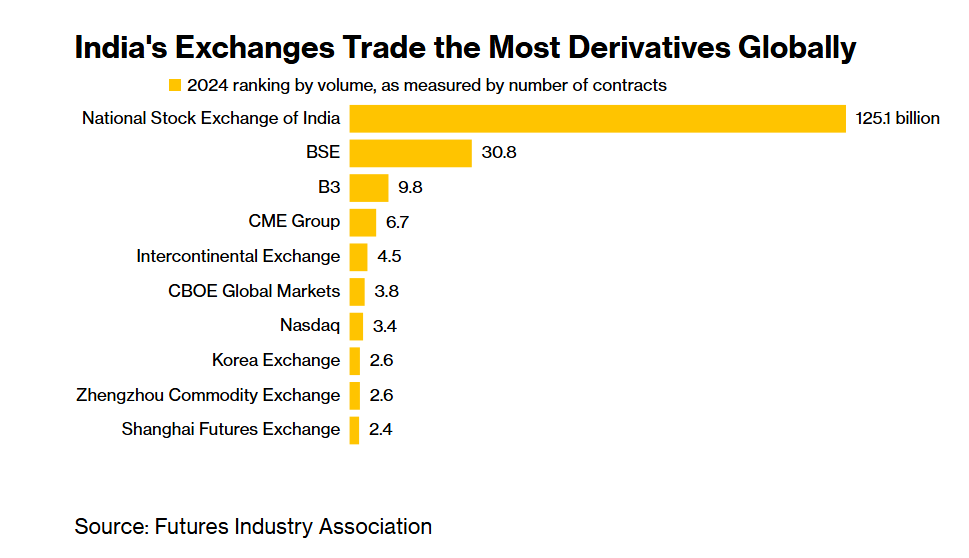
India is currently the largest derivatives market in the world by far.
According to SEBI (the market regulator in India), over 90% of futures and options traders lose money. Among the small percentage of traders who were profitable, profits were highly concentrated. The top 1% of profit-making traders takes approximately 51% of the profits while the top 5% received approximately 75% of the total net profits respectively.

The study also finds that large algorithm-based traders running proprietary desks and foreign firms are big winners while individuals who trade using algorithms lost money (the losses are less than non-algorithms individuals).
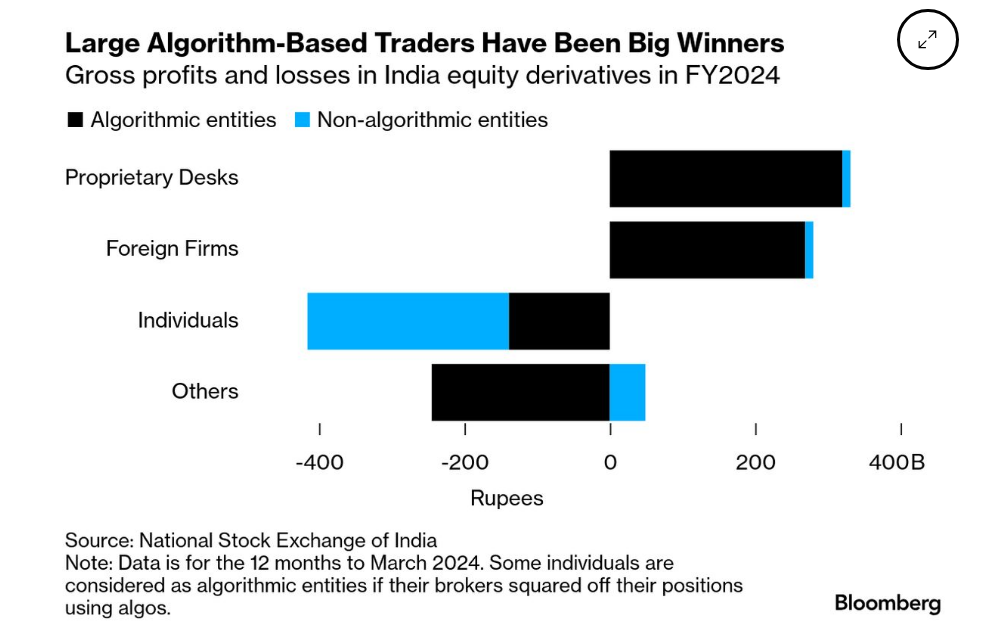
It shows that it is necessarily to be in the top of the game in order to make money in futures & options. (the same applies to perpetual futures in cryptos). Unless you are at the very top, it is probably a better idea to pay someone else to run the books than trading by yourself in futures & options.

Regards

James

Judge,

I saw your post on X about the 95% traders.

Just want to emphassis that my post is about futures & options which are zero sum games (the profit you make comes from someone else’s pocket) and don’t apply to stocks which is a positive sum game.

Regards

James

I am profitable in this space , but I do not consider myself part of the “top 10%.” Large institutions dominate the options market, while smaller participants can still exploit localized inefficiencies. Many studies also fail to specify whether results are based on buying, selling, or both sides of options—an important distinction in a zero-sum framework

One practical edge is that realized volatility is often lower than implied volatility , particularly when selling covered calls and cash-secured puts . Additionally, options markets strongly reflect support and resistance levels due to positioning and hedging flows.

Thanks for sharing the study—interesting and worth discussing.

2 Likes

Space,

Selling covered calls to earn premium should be considered a form of hedging and to improve the performance for the portfolio. Most fund managers/PM do that.

I think the SEBI study is about investors taking naked positions in options and futures.

And maybe you already in the top 10% of option investors without knowing it.:slightly_smiling_face:

Regards

James

EDIT : Judge, glad to hear your view.

1 Like

One nuance that matters is timeframe and context.

Futures and options may be zero-sum at the trade level, but that doesn’t mean every participant is trying to maximize standalone P&L from each position. In many portfolios, options are deliberately run as a persistent drag (e.g., insurance or volatility dampeners) in order to enable greater exposure elsewhere.

Studies like this are likely capturing directional, self-contained F&O trading, and may not fully separate portfolio-level uses where losses on options are an expected cost rather than a failure.

In practice, many hedging structures would still be classified as “naked” in trade-level datasets simply because portfolio context isn’t observable.

2 Likes

Here are the links.

Pls let me know if you want to see the full Bloomberg article and can’t access it. I will try to copy/paste but it is very long.

Regards

James

https://www.bloomberg.com/news/features/2025-07-06/india-gets-tough-on-high-frequency-trading-with-jane-street-crackdown

1 Like

Yes and you do not even need cash to sell the puts. Margin capacity takes care of a shortfall if any for some margin accounts depending on the broker. i.e. “naked” selling. Of course your assets and margin capacity have to be there for the purchase

1 Like

SZ,

Good point about the margin.

However, I don’t recommend selling naked puts especially for retail investors. It is like similar to “Captain Condor” selling iron condors in one of my post earlier from Bloomberg.

Selling naked puts is like picking pennies in front of a rolling train. The premium earned from selling an uncovered put option is typically small relative to the potential loss from a sharp unexpected drop in the underlying.

I am also not sure the risk-reward is there for retail investors who can’t move the price of the stock (for stock options) like institutions/market markets.

Regards

James

Yes options in general do require specific knowhow and the risks are clear from your quoted statistics. Would not be the first thing I teach a retail investor either. I do sell puts but for very large premia often giving me less risk than simply buying the stock. It also serves as float to invest

1 Like

Hi,

Thanks for sharing your perspectives. I agree that selling naked puts is not a strategy to be used lightly, and it can be dangerous if done without discipline or understanding.

That said, I would argue that selling naked puts can be a deliberate and intelligent way to enter a stock at a predefined price, provided the investor has done deep homework. This requires strong knowledge of the sector, the specific company, and a clear view of intrinsic value using tools such as DCF analysis, reasonable valuation multiples, and balance sheet strength.

In addition, risk management is critical. One should closely analyze option market dynamics such as put and call open interest, volatility skew, momentum of the underlying stock, and avoid major binary events like earnings releases while the position is open. When these elements are combined thoughtfully, the investor is effectively positioning themselves to benefit from the gap between expected (implied) volatility and realized volatility.

A good example of this was Hims over the last two years, where short interest exceeded 30% at times. For investors who understood the business fundamentals and sentiment dynamics, selling puts at attractive strikes offered a favorable entry mechanism rather than pure speculation.

Similarly, selling covered calls can be a smart way to plan an exit at predetermined price levels, as the investor gets paid while waiting. The trade-off, of course, is the potential to miss out on a sharp upside move if the stock rallies aggressively. Like selling puts, it works best when used intentionally within a broader portfolio and valuation framework.

It’s certainly not easy, and it’s not suitable for everyone. But with time, patience, and proper analysis, these strategies can be manageable

1 Like

At the end of the day selling a put is no riskier than buying 100 shares with no stop at the strike price. The max loss is the intrinsic loss away from the strike minus the premium so because of the premium the max loss is less than buying a stock at the strike. Many investors do get greedy or reckless and sell more puts than what a normal/small position would be paving the way to catastrophic losses because of the leverage. I agree it can be pretty dangerous just like a person off the street piloting a plane can be dangerous- you need a pilot otherwise it is way more dangerous than a car

2 Likes

SZ,

I actually like your response more than Space.

However, there is one point about the risk/reward. As we all know, the comparison is that you get the complete upside when buying the underlying while only getting /limited to the premium if you sell a naked put.

Regards

James

1 Like

Yes assuming the stock goes up. The premium plus what you can do with that premium in terms or returns

1 Like