Systematically avoiding risk is definitely my thing. That's why I invest in low-volatility stocks. That's why I use shorts. That's why I diversify internationally. That's why I use hundreds of factors--to make sure that every stock I buy is as risk-free as possible. That's why I screen out stocks with a high likelihood of earnings manipulation. It's all systematic and it's all about risk. If I were convinced that one could lessen risk and improve returns by moving into and out of stocks based on macroeconomic data, I'd do so. Over the past ten or twelve years I've spent countless hours thinking about and experimenting with this and similar ideas to lessen risk. But when it comes to timing, it's all been in vain. So many times I thought I'd found something, only to have it fail. So now I systematically avoid risk without engaging in timing. It's all a question of what tools you choose to use and what tools you've found simply don't work. If you can't depend on timing to reduce risk, figure out what you can depend on.
It's probably not worth arguing; I know there are strong views on both sides, and many ways to invest successfully.
I've said before that I don't want to die on the market-timing hill. Financially speaking, I don't want to die on any hill. I'm trying not to die.
To me, that argues for a diverse mix of tools, including a timing component, but I understand that's not for everyone.
ars7777,
I just want to post a quick reminder that Yuval currently manages a small hedge fund and has always been transparent about the size of his AUM and current/past performance.
Based on my previous work experience as PM, he is a definitely a pro based on his high quality posts and recommendations in the forum to other P123 users. We should not just regard him as the market (millions of other investors). On the contrary, I think he is one of the minority who has deliver solid performance year after year for over a decade.
He has a website for his hedge fund if you are interested to check it out (with performance before/after setting up the hedge fund). Here is the link
I apologize if anything came across wrong, as it appears must be the case.
I understand Yuval is a pro, and I trade his models. He has my trust and highest regard.
I only meant that 50% of timing models failing doesn't invalidate timing as a concept, just as 50% of factor models failing doesn't invalidate factor investing.
The main thing I was countering earlier is that "studies" show all kinds of things. "Studies" can show that stock picking doesn't work, even though we know it can. The Sharpe example that Yuval shared clearly doesn't make the case against timing, as I explained above.
Bogle not knowing anyone who can time the market... I doubt he knew anyone getting Yuval's returns on microcaps, either.
I think these studies are like statistics or backtests and can show whatever we want them to. The key with any of this is careful implementation.
Anyway, if any disrespect came across, none was intended.
Excellent points, Yuval. You have a different approach than me or others in this thread. As I said before, that's what makes a market. You may be buying the issues I'm selling and that's great. We all have idiosyncratic expectations, sensitivities to risk, and various approaches towards solving those issues.
Also worth mentioning: any "debating" I do here is never meant to convince anyone else that I'm right. It's aimed at determining whether and where I'm wrong or what I can improve in my process. If anyone can convince me to drop timing, it'd probably be Yuval, which is why I enjoy the dialogue.
I've already learned and implemented a lot of change from others' knowledge and willingness to share. Charles's TZA work led me to implement a permanent M2K hedge, which allowed me to reduce my reliance on timing.
It also helped me justify expressing the first many % of my timing hedge as an additional M2K short, which is crucial for controlling friction and slippage.
Victor's comment that the index as a whole is reasonably representative of fairly low-ranked stocks, according to his ranking methods, gave me further confidence in this approach relative to shorting individual stocks.
I've used various forms of timing for as long as I can remember, but when the methods ran into the friction and slippage of microcap trading, I had to make adjustments. It's been very helpful to blend some of what works for others into my methods.
ars7777 - I believe you have identified a critical point in the discussions heretofore on this page. If I’m understanding correctly, you were you were satisfied with the market timing approach you used when investing in larger companies, but when you began trading microcaps (and maybe small caps?), you had to make changes because your established timing was less effective. (Let me know if I’m misunderstanding.)
I think that may be the key difference between what you and I have been discussing and the approach Yuval is taking. For me, I generally focus on large-cap stocks and ETFs, where timing and risk mitigation work very well.
Based on most of Yuval’s strategies, ranking systems, and other content on Portfolio 123 that I’ve seen, my impression is that he focuses primarily on small-cap and micro-cap stocks. Am I wrong, Yuval?
If accurate, it makes perfect sense that the timing/risk mitigation we’re discussing would not work for him with small caps because they are a different animal. And now I agree with you 100%, Yuval — I also couldn't get my market-based risk management methods to work effectively with small caps.
Maybe I’m slow, but I just realized that’s why we’re probably having a lively discussion about two different approaches to investing. We’re not investing in the same assets, generally speaking!
Do you gentlemen agree with that take?
Not exactly.
I have a reasonable amount of confidence in my methods, largely because I'm not asking them to do too much. What I apply them to doesn't seem to matter other than they ding CAGR a touch, so starting with higher-performing models helps.
The switch to smaller caps needed only minor adjustments. The most noteworthy is that the trend leg is now IWC-based. Otherwise, the signals are the same.
What I meant by the comment you asked about is that when I traded large caps, calling risk-off to cash was no problem. Friction, slippage, and execution weren't even on my radar. With microcaps, they obviously are.
So now the first many percent of risk-off is expressed as additional M2K short exposure, on top of a permanent tranche I run. That lets me modulate exposure on a dime, cheaply. A pleasant surprise: the results are also better (for whatever the backtests are worth), because shorting the index removes the beta while keeping whatever spread the models have over it during risk-off — and they often do have one. Selling the stocks forfeits both.
If enough signals align, I do eventually have to endure stock sales, but the whipsaw-iest stretches are when only one or two signals have tripped, so handling those with futures helps quite a lot — in performance and in freeing up time for long forum rants : )
To some degree. My long portfolio is primarily microcaps and small caps, though I do invest in a few mid caps and large caps too. My short portfolio, on the other hand, is primarily mid caps and large caps, and that's where I've been concentrating most of my market timing efforts, with unsatisfactory results. If I could identify periods during which I should stop shorting or double my shorts, that would be amazing. But so far all my attempts have simply produced horrendous whiplash. There's another Portfolio123 client who has been working for years with various timing systems for shorting, and he's been very frustrated too. He keeps finding things that seem to work only to have them blow up in real time.
Yuval - There's another Portfolio123 client who has been working for years with various timing systems for shorting, and he's been very frustrated too.
I will make an effort to make one or two of my indicators that work well on large-cap stocks or ETFs available publicly. They won't be complete Risk-Management systems by any means, but they can be used as valuable individual indicators or utilized in a composite with other indicators. At the very least, they can be used to inspire ideas by other Portfolio 123 users.
I'm working on some other projects right now, but in the next few weeks, I will put this on my to-do list. I would appreciate getting your comments, Yuval. And also from ars7777, Jim Rinne, and anyone else who wants to get in on the discussion. I'll start a new post in the forum when I have them ready.
ars7777 - "That lets me modulate exposure on a dime, cheaply."
Nice approach that's obviously well thought out. Proven with real-world results. Excellent!
Thanks—though to be clear, all I'm claiming is that shorting/covering futures is much simpler than sizing microcap holdings up/down.
I'm very new to microcap stocks and learning as I go. As much as I believe in my timing methods (those I've used for years), I am always looking to make my portfolio and methods more robust. Overreliance on timing is certainly on my radar. I've already reduced my timing exposure based on work Charles shared.
I'd also like to test one of Yuval's methods—shorting a mid- to large-cap book of bad stocks—to further reduce my reliance on timing. I will have to see whether that's in my wheelhouse to put together.
In my experience, timing is not a viable tool for very fast drawdowns. I use highly convex puts for those.
Asking for timing to handle only certain, fairly rare use cases (the slow, grinding kind) and accepting the inherent trade-offs make it a more approachable endeavor, in my view.
Instead of shorting stocks ,did you try with shorting indexes ?has the same negative results ?
have you try the Dual Momentum from Antonacci?
I short a combination of highly liquid stocks and index ETFs, all of which pay rebates.
Yes, I experimented with the Dual Momentum approach when his book first was published, but with unimpressive results. It's a really simplistic approach imo. Or maybe I was not implementing it properly (wouldn't be the first time). YMMV...
Antonacci’s Dual Momentum has had an annual return of only 4.2% post discovery from Oct 2014 as tracked by Allocate Smartly.
Antonacci's models are a useful example of why "timing doesn't work" is a reasonable conclusion from the record, and what that conclusion can miss.
As @bobmc states, his Composite Dual Momentum has tracked about 4.2% per annum on AS since late 2014. Traditional Dual Momentum did better at about 7.7% p.a., and AS's dynamic bond variant about 8.2% p.a. SPY did roughly 13.7% over the same stretch, so the skepticism is earned.
But a model's return and its signal are two different things. The composite's 4% is mostly a statement about what it holds (three of its four slices are credit, REITs, and gold/Treasuries), not about when it is risk-on. To separate the two, I rebuilt the monthly risk-on share from his published rules and applied it to a simulated mix of stock models: unhedged vs. hedged with his signal vs. fixed cash at the signal's average level (about 21%). Shown are the full period and the period since publication:
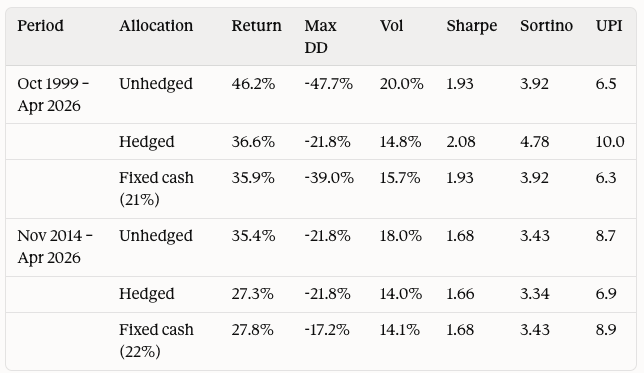
The fair comparison here is Hedged vs. Fixed cash. Over the full period, it almost halved drawdown at essentially no CAGR cost. Since publication, it's roughly par, with a somewhat deeper drawdown.
Two caveats before anyone else raises them. Nearly all of the full-period benefit comes from 2008–09; in every other stretch it ran a little behind fixed cash. That is what insurance often looks like: small premiums for years, one large claim. And his single-leg equity signal, run through the same test, did worse than fixed cash. The diversified four-leg version held up.
I'm not defending Antonacci's work, nor is this is a hedge I would use. Allocate Smartly explores several signals that are well explained on their site and further backed by research papers. Trend and relative momentum are about as well documented as anomalies can be.
The keys to applying signals in a composite hedge are similar to the keys to applying factors in a composite ranking system: diversify, cover various domains, try not to overfit, acknowledge you're probably overfitting even if you try not to, and set safeguards and expectations accordingly.
Again, this is just a cartoon example, and not that great of one. The stock returns are simulated; my rebuild only matches AS closely from 2008 on, and one episode carries the result. There are many ways to improve this concept and make it more robust.
Has anyone tested this out? It could be used in conjunction with a standard stock strategy to assess which sectors should be given extra weight in certain periods. Even though it will result in somewhat more turnover, this is the best strategy in the last 30 years from Allocatingsmartly.
Taming the Wildcard: David Varadi's "Inflation Compass" - Allocate Smartly
I like this line of thought. I think there’s room to explore synergies between tactical ETF strategies and factor-based strategies, or portfolios of strategies. I use that approach to modulate my exposure, but your idea of weighting sectors is intriguing, too.
Another interesting example is Optimum3. It takes the top half of ETFs by momentum and then builds the most diversified portfolio it can from those qualifiers rather than selecting the highest ranked ETFs. Could we do something similar with stocks: rather than simply buying the top-ranked names, build the most diversified portfolio from among those ranked highly enough?
Caveats about Varadi’s strategy include:
-
It’s new. It was published this summer; its key input goes back only to 2003, and most of its record covers the same period it was designed for. I wouldn't necessarily call it the best strategy on backtested performance alone.
-
It’s sensitive to the trade day. In Varadi’s own testing, shifting trades by a single day costs a meaningful share of the return. When an edge is that sensitive to the calendar, I’d want to know how much is valid and how much is timing luck.
-
It’s concentrated. It usually holds a single sector at a time, and Allocate Smartly calls it extremely volatile, so it’s better suited to a tilt or a sleeve than to a whole portfolio.
A few habits help with any regime or timing signal, this one included:
-
Avoid pinning everything on one day or one parameter. Spread the execution and average across a range of settings.
-
Scale in and out gradually rather than flipping a switch.
-
Test nearby variations; if the result disappears when you nudge the inputs, that tells you something.
-
Give it live time before sizing up.
Hi, thanks for the insightful post! I’m wondering whether this risk can be applied to any time series as a timing signal—for example, the composite return of a basket of my choice—or whether it’s specific to SPY.