P123 Community Sentiment Indicator

There's no question that we have some very talented subscribers who did not suffer much in the recent crash. I know this because I spoke to some of you. Some used puts, others a hedge, or simply gone to cash. But for most, this crash has been painful.

I think we can do something about this by leveraging the collective knowledge. What do you think of adding a P123 Risk-On/Risk-Off (RORO) sentiment indicator? Something that could potentially alert you to take some action. And for most "taking action" is quite simple: put on a hedge, buy some puts, all relatively easy for individual accounts.

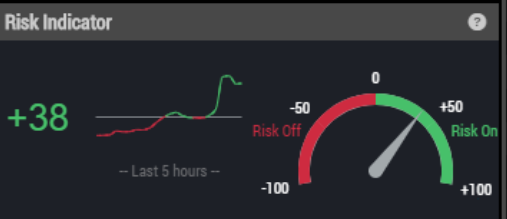
The risk index could be shown like like this in the dashboard, with more detailed data in a separate page.

P123 users could update their risk anytime, and optionally provide more details about their allocation changes. See below for a potential form that users could fill out.

It would need to be something simple and quick to fill out. It would be anonymous, and we could do all sorts of things to come up with the "official P123 community sentiment". Perhaps weight the responses based on several factors like: accuracy, membership level, years as a subscriber, etc.

What do you think?

And more importantly, will you fill this out?

Thanks!

Sample Risk Update Form

Sentiment Update

My Risk Index (-100 to 100): 70

Allocation (optional)

Risk On % Risk OFF %
Stocks 60% Safe Stocks
Smallcaps Bonds
ETFs Gold 25%
Emerging Cash or Equiv 15%
Crypto

Comments (optional)

8 Likes

I like this idea and I would participate, FWIW.
Need to indicate the number of subscribers voting as well.

1 Like

Interesting concept. One would also a need to age opinions as one today is worth more than one from 100 days ago.

Asking that the opinion being different from your default view. My policy cash holding is 15% and it is any significant increase from that is needs to be captured.

Also the content of the holdings matter as my strategies currently have me 24% in gold miners and not just an occasional one. So, no decrease in equity allocation, but a definite change in content.

Cheers,

Rich

First of all I think the Risk Index range should normally be from 0 to 100 , not -100 to 100 like I showed before. With 0 being fully in cash for example, and 100 being fully invested in risky assets.

The traditional Risk On Risk Off indicator is typically the allocation of the long portfolio: the proportion of risky-assets (stocks, etc) vs. safe assets (bonds/gold/cash). So in your case @rwbattyaz your risk index is 61 (100 -24 -15). In other words with a slight risk-on.

So far so good. I'm struggling to come up with a more flexible interface for users that use other methods like hedging, shorting, and options.

For example what's the Risk Index for someone that has 50% in stocks, 50% in gold and has a 30% short positions in some ETF or the equivalent in options? This could be someone with a cash account that does not want to realize any gains, and simply wants to shift to a more defensive position.

Looks to me that the Risk Index is simply 50 - 30 = 20. In other words pretty conservative.

And what if their hedge is 60% of their portfolio with only 50% in risky assets? Then their Risk Index would be 50 - 60 = -10 , which doesn't make too much sense since shorting the market is quite risky. Perhaps the Risk Index should be the absolute value , or 10 in this case.

And for someone that is 100% long and 100% short the Risk Index would be 0, which does make sense.

So here's my revised interface. Let me know what you think

Thanks!

Risk Index Form

Enter you Long allocation (must add to 100%)
Risky Assets (ex: stocks, etfs, crypto): 60%
Safe Assets (ex: bonds, gold, cash): 40%

Enter you Hedge (0 - 100%)
Short exposure: 30%

Your Risk Index is: 30 (conservative)
The formula is Risky Assets - Hedge

Allocation Details (optional)

Risk On % Risk OFF %
Stocks 60% Safe Stocks
Smallcaps Bonds
ETFs Gold 25%
Emerging Cash or Equiv 15%
Crypto

PS. you could argue that placing a hedge is "market timing" and therefore is not really what a Risk Index is all about. But changing your asset allocation irrespective of a birthday is also market timing.

1 Like

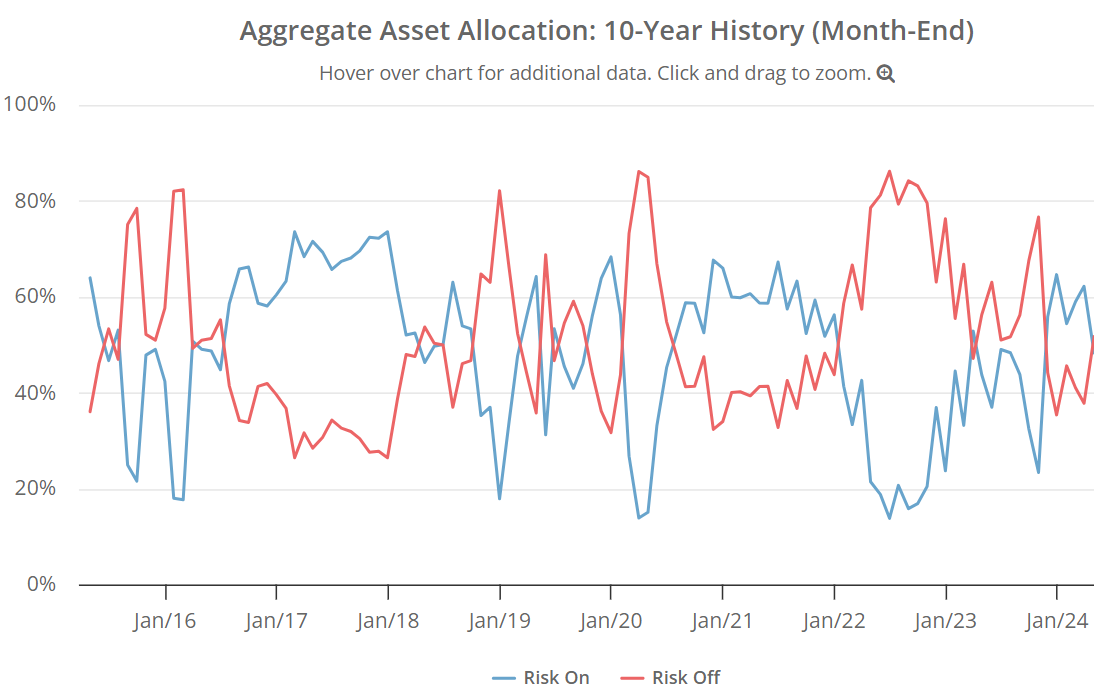
You might take a look at The AllocateSmartly’s Risk On/Risk Off 1 year daily and 10 years month-end.
It is based on the Aggregate Asset Allocation of all their Tactical Asset Allocation Strategies. The positive of their approach is that it includes a variety of different methods which have historically been better than random at predating risk on/off. This includes methods like Philosophical Economics Growth-Trend Timing, several that measure the momentum ratios of different risk vs safe sectors, Dual momentum, what some call canary indicators and Risk Parity.
Here is a screenshot of their monthly chat. I didn’t want to post their proprietary data so I’m only posting thru April of last year.

1 Like

What a small world. One of the strategies there "Piard" is from one of our users. He wrote this book too, which is essentially a guide to P123

Quantitative Investing: Strategies to exploit stock market anomalies for all investors

I believe that this is an example of market timing and that it would be counterproductive. I believe in using a hedge that is a fixed percentage of your portfolio, particularly if you're using leverage, and that trying to increase or decrease it as sentiment or conditions change will be far more expensive than simply adjusting it as your percentage shrinks and grows. I use put options as a hedge but going short might work too: a short-based hedge is not nearly as effective during major market moves but it bleeds less during calmer conditions.

Moving to "risk on" is relatively easy. Moving to "risk off" is where you get slaughtered.

See this piece that I wrote in 2019. I stand by everything in it.

1 Like

But even if you're not timing the market, I wonder if the person on the other side of your hedge is. Especially with options—someone might be adjusting based on implied volatility, sentiment, or regime shifts.

I wonder if timing is working for her. If so, that would suggest timing can work for some.

That said, I do note that option market makers are typically pricing volatility, not directional trend. And I actually agree—trying to predict market direction alone usually doesn’t work. More importantly, those who try often place bets that are too large when they think they’re right. Your constant hedge avoids this, and I think that’s probably a big part of why it’s worked well for you.

Specifically, even if there is some trend signal, going all-in, all-out, or short tends to underperform in the long run. The issue isn’t necessarily the signal—it’s the bet size, which often overwhelms any modest informational edge.

So maybe the real question isn’t whether to time, but how precisely—and how modestly—you do it.

Personally, I use volatility signals rather than trend. I’ve found they can reduce risk effectively, especially when applied carefully within position sizing.

Pairs traders use volatility or beta weighting—so do most fund managers. And of course, options market makers use volatility signals. Risk-aware timing is embedded in much of professional practice.

I agree that trend is a weak signal. Weak enough that I don’t bother with it anymore—mainly because, in my view, the change in bet size based on its signal strength just isn’t worth it. But I wouldn’t go so far as to say there’s no signal at all.

And I think it’s generally a mistake to look at trend in isolation—options market makers certainly don’t.
The person on the other side of your hedge likely agrees that trend alone isn’t enough—but they are market timing in how they set the price. And you’re still implicitly timing by agreeing to that price, which is itself a reflection of changing market conditions. In other words, you’re willing to pay more for your hedge under certain market conditions.

I actually think this could either turn out to be an okay idea, or a very bad one.

First, most investors who try to time the market end up with returns lower than the market (usually also on a risk-adjusted basis).

Second, if you are indeed going to engage in market timing, you’d want to do it structurally and systematically. If the community’s judgment is based on the average recommendation entered manually over time, I don’t think that would be a systematic approach, and it likely wouldn’t lead to better returns. On the other hand, if, for example, the average multi-asset portfolio on the designer marketplace were taken as an input, that would make more sense to me—at least for people who are into multi-asset portfolios (tactical asset allocation). That way, there’s some sort of system behind it, it offers a point of reference, and it would be automatically updated.

Now for the okay part: even though it is probabilistically better to stay clear of market timing in terms of returns, and even though new users would probably do better with a stock-only portfolio (especially with sub-million portfolios) without any hedging, it could still interest new users.

I do use TAA, which is different to market timing as I understand it.

I classify bonds and cash as "risk off". Everything else (including gold) is "risk on".

I just take the "risk off" percentage and apply it to my stocks.

e.g. now the risk off % is 30%, so I'm selling this week (despite the market going up) because my TAA models are highlight market risk to me. The risk:reward isn't there.

So am running 70% gross. Note that I can't hold shorts in my tax-advantaged portfolios.

I find it significantly emotionally easier this way (vs 100% long all the time) to deal with the market gyrations and thought of a market crash.

As regards this community sentiment indicator, no harm to try.

Pretty much my feeling.

I think I know why so many experts want to convince you that market timing doesn't work. It doesn't work because it's hard to stick with for most people. Not because one cannot foresee tops or bottoms. After all Trump is doing exactly what he said he would do. You say: "but the tariff number was unexpectedly high". To which I say: "Any number he said would have caused a huge drop since the CPI was high to start with". In other words, there was nothing too difficult to predict that we were near the top a few months ago. But wishful thinking and FOMO keep you from hedging.

I have experienced this many times:

  • I have the right intuition and I place a hedge.
  • I'm always too early and my hedge starts losing money as the market goes higher.
  • Little hedge losses pile in, FOMO sets in, and I exit the hedge.
  • Almost instantly the market turns proving that my original intuition was correct, even if it was too early.
  • I then try to over correct, leading to a cycle of errors.

When your portfolio drops with the market a feeling of resignation sets in. It's easier in a sense than dealing with FOMO. Taking many small hedge losses will make you super nervous, exit too soon, and miss out on the big drop that would have made up 10x the little losses.

I think the key for hedging (market timing, TAA, whatever) is therefore:

  • Automation using stop/losses
  • Quality subjective data
  • Quality quantitative data.

Quality subjective data would come from P123 users. If you've been a member for 5+ years, you are in the top 1% talent wise.

After a few years perhaps we can train an ML model to weight the opinion of the contributors, the quantitative signals from some macro data, etc.

Sounds worth it to me.

3 Likes

Dear all,

Bluecrest capital (a family office pod shop Michael Platt) manage to make money from the recent downturn while other quant hedge funds lost money (including Man Group and RIEF/RIDA from Renaissance Technologiges - not Medallion).
Pls see the updates from Bloomberg and Reuters.

Regards
James

Michael Platt’s BlueCrest Gains 20% on Trump Tariff Volatility

By Gillian Tan and Nishant Kumar

April 8, 2025 at 8:50 PM GMT+8

Hedge fund billionaire Michael Platt’s private investment firm has netted major gains navigating the market turmoil sparked by President Donald Trump’s move to impose tariffs on allies and rivals.

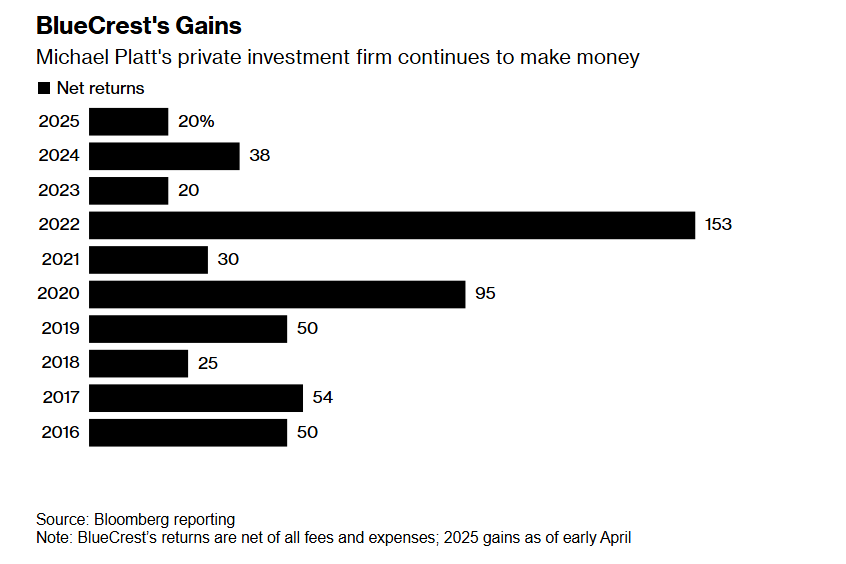
BlueCrest Capital Management is up 20% so far this year, people with knowledge of the matter said. The returns are on invested capital and net of all fees and expenses, one of the people added, asking not to be identified because the details are private.

A spokesperson for BlueCrest declined to comment.

Platt, who returned capital to outside investors in 2016, has used a heavy dose of leverage to supercharge returns at his firm. As a result BlueCrest, which now solely manages the wealth of Platt and his partners, has delivered some of the best trading profits in the world.

BlueCrest's Gains

Michael Platt's private investment firm continues to make money

Source: Bloomberg reporting

Note: BlueCrest’s returns are net of all fees and expenses; 2025 gains as of early April

Hedge funds have been battling to shield their portfolios from market chaos sparked by Trump’s expansive tariffs. The MSCI World Index tumbled 9.3% on Thursday and Friday, the biggest two-day decline since March 2020. Goldman Sachs Group Inc.’s global fundamental long-short hedge fund clients were down 4.7% over two days.

Multistrategy hedge funds that spread bets across trading teams and asset classes have [fared better] with Schonfeld Strategic Advisors making money this month through Friday, while Citadel lost about 0.35% and Millennium Management declining 0.7%, Bloomberg reported.

It’s not clear how much money Platt’s investment firm manages now, but a court document from 2022 described BlueCrest running $3.9 billion and allocating $15 billion in trading power to its managers.

Man Group Hedge Funds Losing Up To 15% This Year Show Quant Pain

Even the trading machines can’t keep up with President Donald Trump’s tariff barrage, which has muddled algorithms that are supposed to anticipate the direction of markets.

The four main quant money pools run by Man Group Plc, the world’s biggest publicly listed hedge fund firm, lost as much as 7.8% this month through April 9, according to the firm’s website. The declines, which pile more pain on the funds after first-quarter losses, came as their models struggled to change direction quickly enough to avoid market routs.

Three of them are trend followers — strategies that ride momentum across futures markets — and have been whipsawed by rapid reversals this month.

Man Group is not alone in worsening losses. Transtrend’s DTP - Enhanced Risk Composite fund slumped 18.2% through April 10 this year, while Aspect Diversified Trends was down almost 11% through April 9.

A Societe Generale index of commodity trading advisers, a group of many such algorithm-driven funds, shows that the three trading days after Trump’s April 2 tariff announcement were the worst run in two years. The group has now wiped out all gains since March 2022.

Positions across stocks, bonds, currencies and commodities built up over the past 100 to 200 days have all suffered together as those trends sharply reversed in April, Abhijeet Gaikwad, chief investment officer for ADG Capital Management’s Quant Multi-Strategy fund, said.

“They tend to have holding periods of a few months which makes it difficult despite their blend of models,” Gaikwad, who previously worked for Man Group, said. “Their size becomes their enemy.”

A representative for Man Group declined to comment.

Fund Strategy April YTD
AHL Diversified Programme Trend -7.83% -15.15%
AHL Alpha Programme Trend -5.12 -9.35
AHL Evolution Programme Trend -3.84 -8.30
AHL Dimension Programme Multi-strategy -4.89 -6.88
Man Strategies 1783 Multi-strategy -1.55 1.96
SG Trend Index - -6.37 -10.74
SG CTA Index - -5.87 -8.24
Source: Man Group website; Data through April 9, 2025

Great perspectives from everyone on whether P123 members can time the market and how to do it. I’ll certainly be considering what I can change to reduce drawdowns and capture most of the upside after reading these posts.

When it comes to competing against institutional investors it would be nice to have had a news reader when the NASDAQ popped over 10% on news that Trump had changed his tariff policy (for a moment). That’s just one day and one tool. Maybe I won’t consider what institutions can do as a standard for my investing.

I think that's too much ask unless you are glued to your computer, or you've set up some incredible system that competes real time with institutions. If you hedged months ago, and you were still hedged on that 10% day, you'd still be happy.

Another possibility is that you had already exited the hedge based on some backtests. You could have determined that not being a hog after a 20% gain on your hedge is the sweet spot, and be already out, having weathered the worst of the storm. Hard to do for a human, easy to do for a machine.

Let's see ....

  • Valuations were high
  • Most gains coming from few stocks
  • Our FED Model was flashing red after 20 years
  • High Inflation
  • High rates
  • Gold making new highs
  • Trump
  • Tariffs are coming

Anything else? Surely that's not normal.

Why didn't I hedge in time?

I was a hog, that's all.

2 Likes

I agree—that’s too much to ask. I meant it more as an example of what we can’t reasonably be expected to do when competing against institutions. I’m hesitant to give too many other examples, but perhaps firms like Citadel have advantages like access to order flows or even informal insight into what CEOs might do about things like tariffs.

There are simply things retail investors can’t replicate, and much of that isn’t likely to change anytime soon.

I was trying to agree.

Regarding sentiment: what you’re suggesting sounds a bit like crowdsourcing, which tends to work best when people make predictions without knowing what others think. Maybe participants could submit predictions over the weekend, and the results or visualizations aren’t revealed until Monday morning.

It might also help to include a small incentive—even something like forum credit for the best predictor. Crowdsourcing tends to work better when people are at least mildly motivated.

I think a lot of members believe in the value of crowdsourcing and prediction markets. Many would probably welcome some form of crowdsourcing—especially if it’s not labor-intensive for P123.

I started to hedge in the middle of March but with not too much short position and still got much drawdown. Then come back to think, if you are confident for your portfolio to beat RUS 2000 easily meaning alpha is good enough, why not keep 1:1 hedge there i.e. with RUS 2000 future, the annualized return of RUS 2000 is around 7%, this can make the overall portfolio's sharp ratio increased significantly, and good sleep for ever.

We can create two types of indicators:

  • P123 Community Sentiment
  • P123 Quant Sentiment

We have one good quant model, provided by @hemmerling. I have also few that works 'ok'. Each quant model could have standardised output (1-5 or 1 to 10). All models would be private (formulas) but the output is public for all users. Then, one model managed by p123 somehow aggregate the results into one model and show aggregate sentiment to all users.

Every year, 12 users who deliver the "best" model will be awarded % discount worth between 1-12 months for next the subscription.

3 Likes

TL;DR: Not so hard to aggregate "Expert Advice" with one of number of Expert Advice algorithms.

For aggregating model results in stock market prediction, “Expert Advice” algorithms are simple to implement—often just a spreadsheet is enough. These approaches gradually shift more weight toward better-performing models over time.
• For continuous forecasts (e.g., predicting 1-week returns), the Hedge algorithm works well. It exponentially weights each model based on past error, allowing high-performing models to dominate gradually.
• For directional (up/down) predictions, the Weighted Majority Algorithm is a classic choice, giving more voting power to models with higher directional accuracy.

BTW, P123 could probably apply a Hedge algorithm to an aggregated ranking system—adjusting the weights of different ranking strategies over time. One could even create a “grand” P123 model: a weighted aggregate of contributing designer ranking systems, where participating designers are compensated based on the weight assigned to their ranking system by the algorithm.

I'm against it.

P123 and its users have rarely, if ever, thrived on any sort of market timing or tactical asset allocation. There's good, solid science behind that fact: nobody else has either. I think that offering it would tarnish our reputation as a fact-based and reliable source for factor-based stock-picking. It would be like an astronomy website offering an astrology service. There are plenty of other websites that offer this kind of thing. If individual users want to dig into market timing and TAA, that's great, but P123 shouldn't offer any such service ourselves. This very short piece, written by a market-timing guru, is definitely worth reading.

Building good ranking systems, having a diverse portfolio, and using a small hedge (and trimming or adding to it to keep it at a constant percentage) will do the trick in most circumstances. My hedge fund is up 1.9% so far this April and 9.1% this year.

7 Likes