Georg, do you offer it for free?..
Jim/Scott,
For your information.
Regards
James
Barron’s
16m
The stock market is down—a lot, but it was institutional money, not retail traders, that helped the major indexes turn around on Monday.
Professional traders and investors were emerged in droves to scoop up beaten-down shares. As of 12:30 p.m., when stock indexes were deeply in the red, traders had placed nearly $8 billion more sell orders than buy orders, according to JPMorgan data looking at trading across the market, rather than just via the bank.
But by the end of Monday, when the indexes had moved into positive territory, the dollar tally of buy orders for the day exceeded sell orders by almost $10 billion. The majority of the buying was from institutional investors—not retail traders like those on popular platforms like Robinhood
Just remember that on Wednesday, the Federal Reserve will detail the results of a policy meeting now under way. If the central bank delivers worse news than expected, the stock market isn’t going to be happy.
Thank you James.
Jim,
It seems that we are not the only ones who have switched to GLD since last Fri.
Regards
James
WSJ Markets
3h
The SPDR Gold Shares exchange-traded fund on Friday notched its largest single day of inflows on record
EDIT: I am risk-off and 100% in GLD right now and will swtich back to XLK or XLF when VIX drops back (based on my risk-on/risk-off strategy.)
No, this is a subscription model.
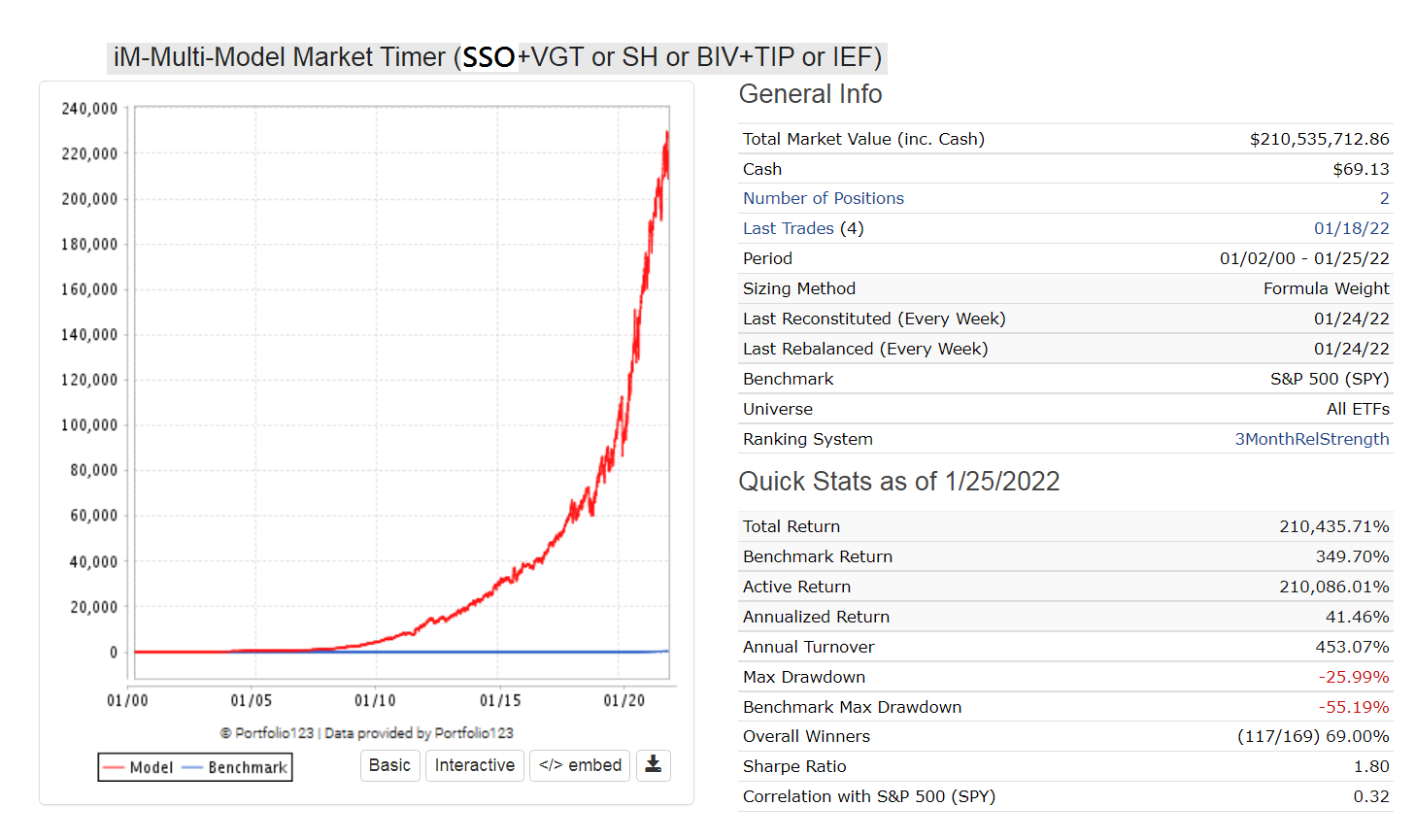
But here are the buy and sell rules. They look simple, but they are not. This model uses almost all P123 resources for ETFs.
You have to figure your own Conditions A and B.
[Buy1] SetVar(@riskON,ticker(“VGT,RSP,IEF”))
[Buy2] SetVar(@riskOFF,ticker(“SH”))
[Buy3] SetVar(@riskNEUTRAL,ticker(“TIP,BIV”))
[Buy4] eval($ConditionA, @riskON,@riskOFF) | eval($ConditionA & $ConditionB, @riskNEUTRAL,0)
[Buy5] eval($ConditionB, @riskOFF,eval($ConditionA, @riskON,@riskOFF)) | eval($ConditionA & $ConditionB,@riskNEUTRAL,0)
[Sell1] nodays>12
These rules ensure that this is not a binary model. A valid signal is obtained when both conditions A and B return the same risk signal (either risk-on or risk-off), otherwise the signal is riskNEUTRAL.
If I set SetVar(@riskON,ticker(“VGT,SSO,IEF”)) the annualized return becomes 41% with a max D/D= -26% and the initial investment of $100,000 grows to $210-million as one can see from attached screenshot.
This model seems to hit all the “sweet spots” of the SP500.
James,
It is correct that I bought some gold for one of my strategies: an adaptive allocation strategy. And I also hold it at a fixed (regularly rebalanced) percentage of a professionally managed strategy if I read the disclosures correctly.
And Wow about us not being the only ones.
Best,
Jim
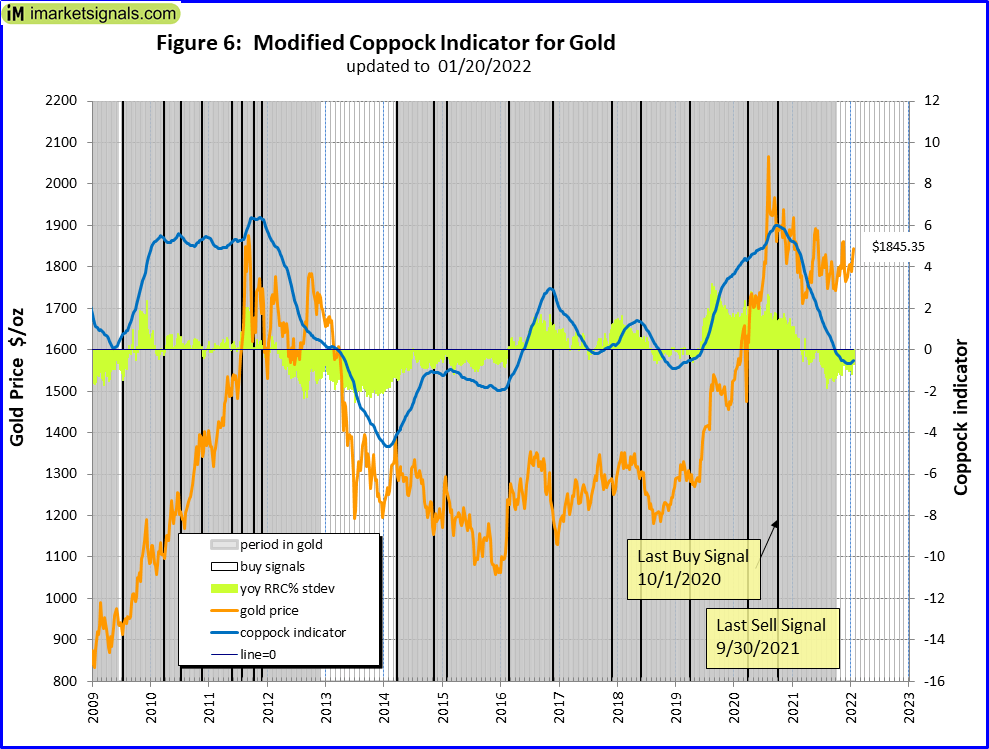
I have been following Gold since 1967 when I bought 1 oz Kruger Rands for about $35.
We have always been advised that it is a good hedge against inflation and the price will sky-rocket when inflation takes off.
I am thoroughly disillusioned with the performance of gold. I think the big banks are manipulating the price. When the price goes up by about $100 it always comes back. How much longer must we wait for it to get back to $2,000? If not now, then when?
Hi Georg,
Is there a better metal (e.g., Palladium) or perhaps a commodity? Maybe bitcoin? Something less controlled by the banks possibly?
Best,
Jim
Bloomberg
15m
U.S. stocks briefly erase losses
In case you were wondering, since at least 1984, the S&P 500 has never erased 2%+ declines and finished higher two days in a row.
Regards
James
So today Gold is up 0.3%.
We have the perfect storm which should take Gold well over $2,000. Inflation at 7% and a possible war in Europe with Russia (which investors seem to ignore).
Platinum and palladium are also no good because of cars going electric, no need for catalytic converters.
Georg, Nice analysis! Thank you. -Jim
Palladium is likely the best hedge against a conflict in Ukraine. It worked quite well in 2014, then it came down when tensions eased. Russia is #1 Pd producer with over 40% of worldwide output. Moreover, commercial hedgers are net long since October for the 1st time in 20 years. Maybe they know something we don’t know. However, it’s a small market, even easier to manipulate than gold and silver.
Disclosure: long PALL (reasonable position size)
Thank you James. I’ll interpret that as massive indecision
Jim,
Thank you for the graphic. Is that a risk parity algorithm? I read a bunch of papers about volatility increases being predictive of more volatility but haven’t been able to use the vix effectively in models (I’m sure it can be done). I’m a bit leery about using TLT as the sole risk reduction mechanism for draw downs because in an inflationary state bonds can draw down with stocks. To answer your first question I was referring to increasing or decreasing my equity exposure to decrease my short term risk or draw downs. To answer your second question I find commodities to be most responsive to unexpected inflation. Bitcoin corrected and gold was flat while the CPI increased.
George,
Thank you for sharing the framework for that model.
Fred,
Thanks for the suggestion on palladium
Scott,
I agree 100% on this. What I showed you was only meant to be a small modification for anyone already using SPY (or VTI) and TLT (or VGMT etc) in anything like a 60/40 stock/bond model. In the above model the drawdowns are controlled not just by adjusting the weight of TLT but also XLP, XLU and XLV which can be very effective in controlling any drawdown. It is risk parity using recent volatility metrics.
Obviously GLD and other assets can be helpful too: see Georg’s post above. The bottom line is I am not using this model or recommending it as a complete solution for anyone.
I do have an adaptive allocation model that will buy VGLT at times but I mostly use something different for my bond fund holdings. VGLT is not a constant holding. My constant (and rebalanced) bond fund holdings are a bit more complex to say the least (professionally managed).
I definitely get your point about inflation and its effect on bond funds as well as your general point about there being better things than TLT.
Best,
Jim
WSJ Markets
3h
Stock Futures Edge Up Ahead of Fed Decision
Regards
James
EDIT : Set your clocks - 2pm EST today. That’s when J Powell will hold a press conference. Expect volatile conditions…
The FOMC statement is released at 2PM ET, Powell’s presser starts at 2:30PM ET
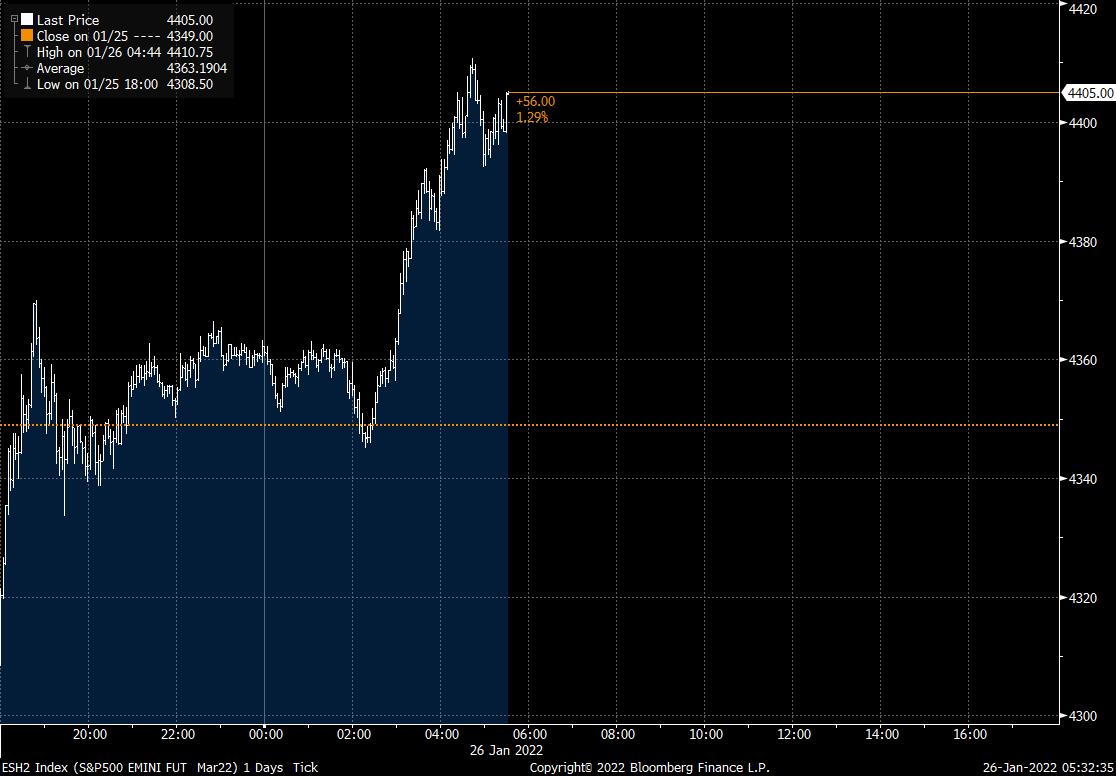
Jim/Scott,
The Fed signaled intentions to raise interest rates in mid-March, the strongest sign yet that it’s moving toward removing stimulus to bring down inflation
Will update again after the press conference.
Regards
James
Bloomberg Economics
7m
BREAKING: The Fed signals it will start raising interest rates “soon," moving toward ending ultra-easy pandemic support to fight inflation.
Markets
Economics
-Fed Signals Liftoff ‘Soon,’ Sees Asset-Reduction Start Afterward
- FOMC says interest-rate hike will ‘soon be appropriate’
- Balance-sheet reduction to commence after liftoff begins
The Federal Reserve signaled it will start raising interest rates “soon” and shrink its bond holdings after liftoff has begun, moving toward ending ultra-easy pandemic support to fight the hottest inflation in a generation.
“With inflation well above 2% and a strong labor market, the committee expects it will soon be appropriate to raise the target range for the federal funds rate,” the Federal Open Market Committee said in a statement Wednesday following a two-day policy meeting. In a separate statement, the Fed said it expects the process of balance-sheet reduction “will commence after the process of increasing the target range for the federal funds rate has begun.”
James, Thank you. It was volatile after the announcement. -Jim
Jim,
Here is an update.
The S&P is down on the day and down almost 3.5% since Powell started talking.
Interest rates are surging.
I don’t think Powell lines that “we have not had those discussion” and “we have not made those decisions” are playing well in the market.
Regards
James
Bloomberg Markets
Powell Backs March Liftoff, Won’t Rule Out Hike Every Meeting
Federal Reserve Chair Jerome Powell said the central bank was ready to raise interest rates in March and didn’t rule out moving at every meeting to tackle the highest inflation in a generation.
“The committee is of a mind to raise the Fed funds rate at the March meeting” if conditions are there to do so, Powell told a virtual press conference on Wednesday.
James,
Thank you for the update.
Scott
Bloomberg
Markets
U.S. Stock Index Futures Fall as Bonds Tumble Across Asia
- Rising rates may keep pressuring highly valued stocks
- Nasdaq 100 futures erase earlier gain, slide as much as 1.9%
U.S. stock index futures fell, erasing earlier gains, as government bonds tumbled across Asia on Thursday after Federal Reserve Chairman Jerome Powell’s latest hawkish comments.
March futures tracking the Nasdaq 100 Index slid as much as 1.9%, while contracts on the S&P 500 and Dow Jones dropped 1.5% and 1.3%, respectively. New Zealand’s 10-year yield reached the highest since November 2018 as its Australian counterpart surged toward the peak of the country’s October bond market meltdown. Yields also moved higher in China, Japan and South Korea.
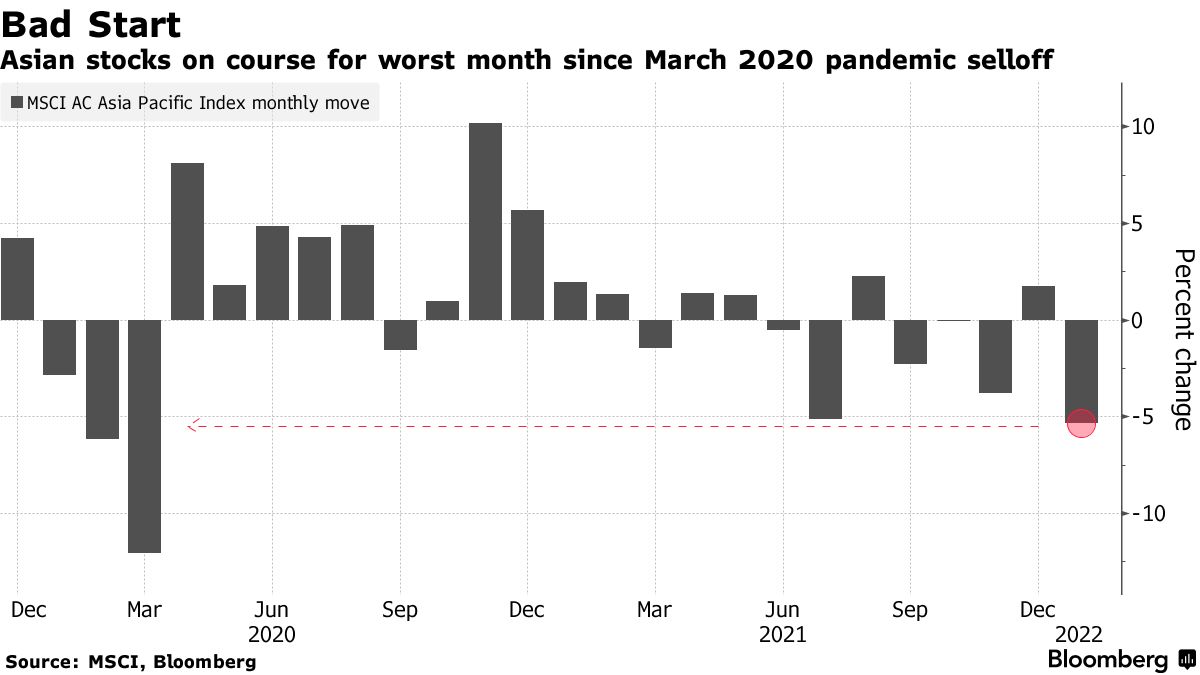
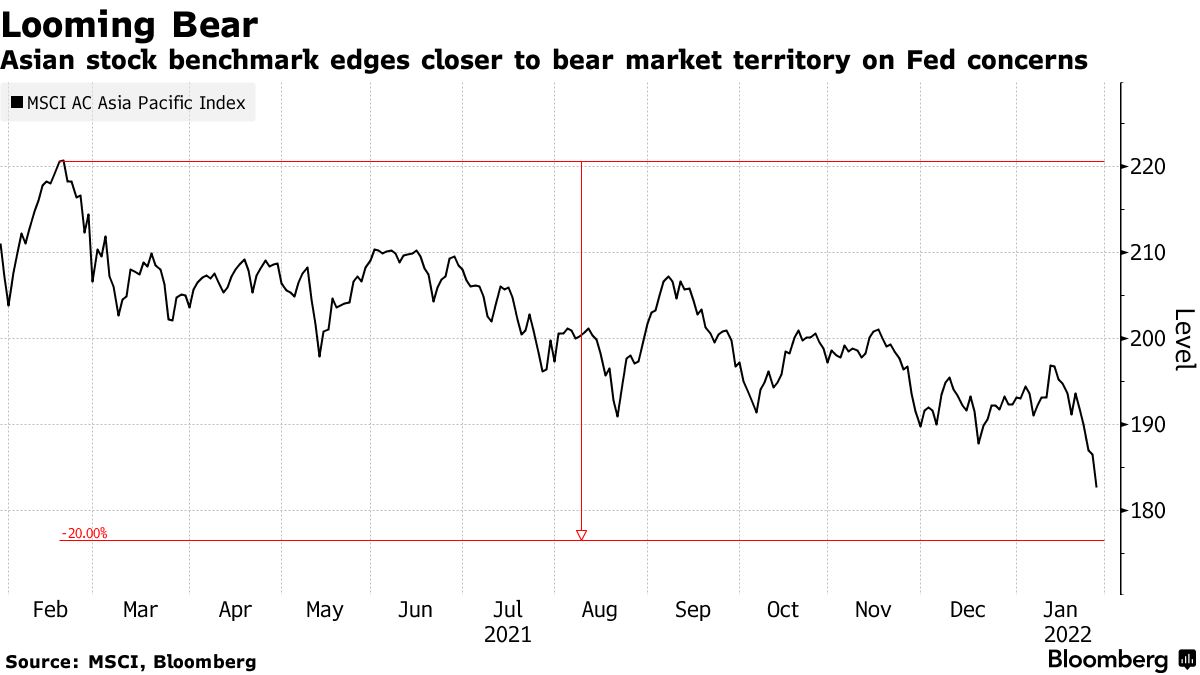
Asian stocks dropped by the most in over a month as hawkish remarks by U.S. Fed Chairman Jerome Powell sparked selling in the region’s technology giants.
The MSCI Asia Pacific Index slid as much as 2.6% Thursday, pushing it down more than 17% from its recent high, after Fed Chair Jerome Powell signaled a March lift-off for interest rates.