Fair point. But I still think there’s a difference between capital market assumptions, which incorporate historical and current data, and past performance (including backtests).
And I was not endorsing Research Affiliates (nor do I endorse any shop), but their data is easily available to the public, and their assumptions for long Treasuries versus core bonds are directionally similar to others. As an example, below is a link to BlackRock’s assumptions:
On Research Affiliates, I like very much their approach, but what they disclose is probably only a small part of their multifactor model to estimate expected returns. They surely can do better than the bunch of equations they put in their white papers. Macro mutual funds use that kind of stuff and long term bets on valuations are a good trade. And it is not about only looking at historical data (unfortunately we don’t have data from the future!), but how those data interact with each other over a long period.
Many kinds of inquiry can be and are fine – even use of backtesting, heavens know we all use that a heck of a lot – me too. What makes an approach sound or unsound is whether it’s done naively (always bad) or thoughtfully (better).
Naive capital market assumptions can be disastrous, and this is why MPT has fallen into disrepute among practitioners. Thoughtful use of backtesting can be game changing in a good way. When I say “thoughtful,” what I’m referring to is an honest understanding of why the results were what they were and how relevant the answers are likely to be when projecting into the future. Often in SA, we’ve seen naive use of backtesting.
RA is an example of a firm that is very thoughtful about its approach to developing Capital Market assumptions.
Since R2G and SA begin 3 years ago there have been many warnings on the Forum about how TLT will fail as a hedge when the FED starts raising rates. The FED’s 12/17/2015 0.25% increase had no real effect on the market since it was so long anticipated. That was 6 months ago, and TLT has increased 15% since then while remaining negatively correlated with the S&P 500. It is hard to ask for a better hedge. TLT will remain a good hedge until which time the FED ACTUALLY raises interest rates. I will adjust my position if and when that occurs.
The Fed has little control over LT interest rates. I’ll exit my TLT/EDV holdings when I see some change in world wide inflation expectations. Currently we’re still on the disinflation/deflationary path. As for the US, I don’t expect the Fed to do anything prior to the November election. After that, since both candidates are proposing new infrastructure spending, I’ll look at that as a possible catalyst for inflation. Maybe fiscal policy will do what monetary policy hasn’t.
I don’t think anyone is advocating that TLT or treasuries in general are going to perform as they has in the past 20-30 years. Most here use TLT as a hedge or to dampen volatility. I think it will continue to do that in times of stress (as it did during Brexit). It remains a hedge that has Negative correlation to equities during times of extreme stress and still has a positive return expectancy on it own. Compared to holding inverse equity ETFs as a hedge this seems like a good alternative. TLT may go down with stocks in the future, but holding an inverse ETFs as a hedge will most certainly be a huge drag on performance in the long run.
Lately I have been using TOTL. It also has risks but I am hoping an expert like Jeffrey Gundlach will be able to better navigate the fixed income market than me.
David thanks for mentioning Gold I like it as a Hedge since it is uncorrelated with SPY. Just holding TLT, GLD and SPY over the last 20 years beats the market. Add in some market timing to SPY and use a constant Hedge of TLT and GLD and the results are really good.
Does anyone have any theory on what happens to Gold if their is a bond Bubble? Does it make since to Hedge with both TLT and GLD?
Both GLD and TLT will go down with rising interest rates. UUP (bullish USD) will go up but I don’t think it or currencies show up in the hedging module. FXY (Yen) will go up with falling stock market as it is a risk off play. The problem with the Yen is that Japan will ultimately require significant currency devaluation to fix their problems.
Steve
Q’s
When will the Fed end these purchases? What effect will the end of purchases have on treasury prices?
Worthy of note
The drop in treasury interest rates since 1981 has been highly correlated to a global drop in treasury rates. There is a reason for this. When the interest rates are imbalanced between countries, it creates effects on the currency exchange rates which in turn creates changes in imports and exports. When rates go up it can cause the U.S. dollar to strengthen. A stronger dollar means cheaper imports but expensive exports. Therefore a stronger dollar benefits consumers but hurts workers. So the market pushes interest rates to be similar between countries.
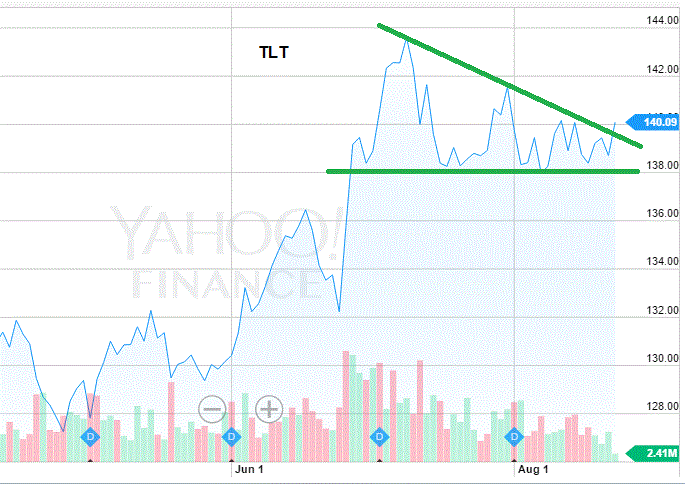
For the bold… TLT has settled down above the floor and looks ready to proceed upward again. The Fed hawks has not been effective with their “jawbone” tactics.