Dear all,
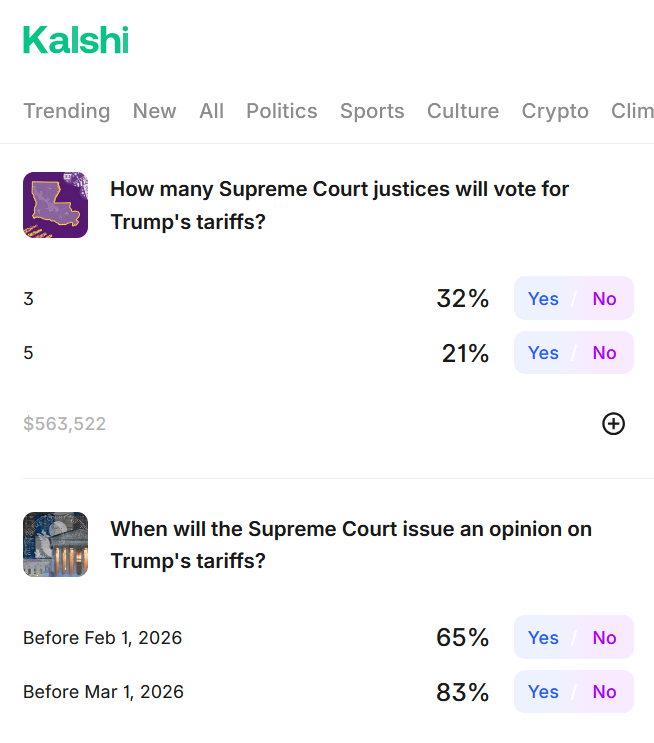
This was just announced in the last hour (48 hours before the market expects Supreme Court to release its ruling on tariffs).
What is going on in the White House?
Regards
James
Dear all,
This was just announced in the last hour (48 hours before the market expects Supreme Court to release its ruling on tariffs).
What is going on in the White House?
Regards
James
I don’t see anything new from Bloomberg beyond info in the CNN link.
However, this video clip just released from Brian Tyler Cohen may explain the chaos which is currently happening in the White House. (unless White House got a tip from one of the justices that the market doesn’t know yet)
Breaking : SUPREME COURT DOESN'T RULE ON TRUMP'S TARIFFS WEDNESDAY
Here we go again. This just happened in the last hour.
The US-EU trade war just escalated to a whole new level.
President Trump just doubled down Greenland. Not only did President Trump announce a new 10% on Denmark, but it also includes Norway, Sweden, France, Germany, the UK, Netherlands, and Finland. Under these new tariffs, we estimate that ~$1.2 TRILLION worth of annual bilateral trade will be impacted.
And, these tariffs will increase to 25% on June 1st and WILL NOT be lifted until a deal is reached on Greenland.
This deal MUST be a "complete and total purchase of Greenland," according to Trump.
It is estimated that an acquisition of Greenland would cost the US ~$700 billion.
Trump's top strategic focus is now clearly Greenland.
Okay?!
What are you guys doing now? Is this another March where everything calms down in the end, or will this just escalate from one conflict to the next?
PS: By the way, I saw that Norway was also affected this time, just because we signed a declaration that "Greenland's fate must be determined by the Greenlandic people and the Danish Kingdom". Are there people in the US that supports this?
Whycliffes,
There is MAGA.
If I remember correctly, there is at least one MAGA P123 subscriber who is a Trump fan and support his tariffs who is a registered investment adviser.
This is how they will get the money to buy it 
Once the funds are ready congress needs to approve the acquisition
Supreme Court could throw a wrench on using tariffs this way though
Shorting US defense stocks while longing EU military suppliers will likely be a smart move over the coming years. NATO allies are unlikely to continue relying on US contractors after Washington's pivot against an ally. Despite the new tariffs, Norway and Sweden stand to become major winners, given that they lead the world in weapon sales per capita.
TARIFFS HIT AMERICANS, NOT FOREIGNERS
New research shows U.S. consumers and businesses—not foreign exporters—are paying almost the entire cost of tariffs.
A study of $4 trillion in trade found that foreigners absorbed just 4% of the burden, while Americans paid 96% through higher prices and costs.
The findings contradict President Trump’s claim that tariffs are paid by other countries (this is one of the main reason I am not a Trump fan). Instead, tariffs act like a tax on U.S. consumption and are likely to push inflation higher over time. While European exporters have been hurt by reduced trade volumes, the economic cost inside the U.S. has been far larger.
Economists warn that if tariffs rise further, the financial burden on American households will grow.
Regards
James
By
Updated Jan. 19, 2026 10:27 am ET
FRANKFURT—Americans, not foreigners, are bearing almost the entire cost of U.S. tariffs, according to new research that contradicts a key claim by President Trump and suggests he might have a weaker hand in a reemerging trade war with Europe.
Trump has repeatedly claimed that his historic tariffs, deployed aggressively over the past year as both a revenue-raising and foreign-policy tool, will be paid for by foreigners. Such assertions helped to reinforce the president’s bargaining power and encourage foreign governments to do deals with the U.S.
Trump’s claims have been supported by the resilience of the U.S. economy, which recorded relatively brisk growth and moderate inflation last year, even as growth in Europe and other advanced economies remained sluggish.
The new research, published Monday by the Kiel Institute for the World Economy, a well-regarded German think tank, suggests that the impact of tariffs is likely to show up over time in the form of higher U.S. consumer prices.
The findings don’t mean that the tariffs are a win for Europe—on the contrary. German exports to the U.S., which have rocketed in recent years, have contracted sharply in the past year.
The German research echoes recent reports by the Budget Lab at Yale and economists at Harvard Business School, finding that only a small fraction of the tariff costs were being borne by foreign producers.
By analyzing $4 trillion of shipments between January 2024 and November 2025, the Kiel Institute researchers found that foreign exporters absorbed only about 4% of the burden of last year’s U.S. tariff increases by lowering their prices, while American consumers and importers absorbed 96%.
The tariffs had a significant effect on trade volumes: Facing higher U.S. tariffs, Indian exporters maintained their prices but reduced the volume of shipments to the U.S. by 18%-24% relative to the European Union, Canada and Australia, the report found.
Rather than acting as a tax on foreign producers, the tariffs functioned as a consumption tax on Americans, the report said.
“There is no such thing as foreigners transferring wealth to the U.S. in the form of tariffs,” said Julian Hinz, an economics professor at Germany’s Bielefeld University who co-authored the study.
The $200 billion in additional U.S. tariff revenue last year “was paid almost exclusively by Americans,” Hinz said. That is likely to fuel higher U.S. inflation over time, he said.
U.S. inflation remains moderate even after Trump last year raised tariffs at the most aggressive pace for decades. The Harvard Business School research suggests that only around 20% of the tariffs had fed into higher consumer prices six months after their introduction, with the bulk eaten by U.S. importers and retailers.
The economic impact of Trump’s trade policy is proving critical again as the U.S. president uses the threat of higher tariffs on Europe as leverage to push through an annexation of Greenland. The threatened tariffs, if applied, could lower economic output in the eurozone by between 0.2% and 0.5%, according to a report published on Monday by Capital Economics.
Why haven’t foreign producers cut their prices to sell more goods in the lucrative U.S. market? The German researchers suggest several possible reasons: The exporters might have found buyers in other countries, or they might think final tariff levels will change and they will maintain price levels in the meantime.
The scale of tariffs, at 50% or more in places, might mean it is better not to sell at all given the impact on profit margins. U.S. importers might also have longstanding relationships with foreign suppliers that they can’t change quickly.
Who bears the cost of U.S. tariffs could change over time, however. Overseas exporters might absorb more of the tab as U.S. companies find new competing sources of products, Hinz said.
Write to Tom Fairless at tom.fairless@wsj.com
This gets crazier every single day. Let’s see if the Supreme Court make its decision on the tariffs case after the market opens today.
Pls see the article below from NYT.
In a text, President Trump told Norway’s prime minister that he no longer felt obliged to “think purely of Peace” and that the U.S. needed the island for global security.
By Jeffrey Gettleman and Henrik Pryser Libell
Jan. 19, 2026
President Trump is now claiming that one reason he is pushing to acquire Greenland is that he didn’t win the Nobel Peace Prize, according to a text message he sent to Norway’s prime minister over the weekend.
Jonas Gahr Store, Norway’s leader, received the text message on Sunday, an official in the prime minister’s office said on Monday.
“Considering your Country decided not to give me the Nobel Peace Prize for having stopped 8 Wars PLUS, I no longer feel an obligation to think purely of Peace, although it will always be predominant, but can now think about what is good and proper for the United States of America,” Mr. Trump wrote in the message, which was first published by PBS.
Mr. Trump also questioned Denmark’s claim to Greenland, saying, “There are no written documents,” and adding, “The World is not secure unless we have Complete and Total Control of Greenland. Thank you!”
The tensions over Greenland have sharply escalated in the last week, and the message injected a new level of uncertainty into Mr. Trump’s thinking and his campaign to gain control of the island.
Greenland has been part of the Danish Kingdom for more than 300 years, and world leaders have condemned Mr. Trump’s insistence that the United States take over the territory, a giant icebound island in the Arctic region.
According to copies of the messages provided by the Norwegian prime minister’s office, Mr. Trump’s message was a response to one that Mr. Store sent Mr. Trump on Sunday. It was co-signed by the president of Finland, Alexander Stubb, a leader with whom Mr. Trump is close.
The European leaders asked to speak to Mr. Trump about Greenland and his threat of using tariffs to pressure Denmark into selling it, which Denmark has refused to do. They asked for a phone call and struck a collaborative tone, writing, “We believe we all should work to take this down and de-escalate — so much is happening around us where we need to stand together.”
After Mr. Trump’s response, Mr. Store said in a statement, “As regards the Nobel Peace Prize, I have on several occasions clearly explained to Trump what is well known, namely that it is an independent Nobel Committee, and not the Norwegian government, that awards the prize,” Mr. Store said.
The White House did not respond to requests for comment.
Mr. Trump has repeatedly challenged Denmark’s claims to Greenland, but in decades-old agreements that the United States has signed with Denmark, the United States has recognized Denmark’s close connection to the island.
A 2004 amendment to an older defense pact between Denmark and the United States, which grants the United States broad military access, explicitly recognizes Greenland as “an equal part of the Kingdom of Denmark.”
And in 1916, Denmark sold what are now the U.S. Virgin Islands to the United States for $25 million in gold. In the treaty for that deal, a clause reads, “The United States of America will not object to the Danish Government extending their political and economic interests to the whole of Greenland.”
In the past year, as Mr. Trump has repeatedly vowed to “get” Greenland, Denmark has repeatedly rebuffed him. Denmark’s position is that it does not have the authority to sell the self-governing territory and that Greenland’s 57,000 inhabitants will decide their own fate. Polls and interviews show that an overwhelming majority of Greenlanders strongly oppose joining the United States.
On Saturday, Greenlanders staged the biggest protest of recent months. Hundreds marched through the snowy streets of Nuuk, the capital, chanting, “No means no,” “Greenland is already great” and “Yankee, go home!”
In the past few days, Denmark and other European countries have sent more military forces to the island. Small groups of Danish soldiers dressed in green camouflage and dark woolen hats have been walking through downtown Nuuk. Beyond the harbor, a 200-foot-long Danish warship capable of breaking through ice has been patrolling the shoreline.
A much-anticipated three-way meeting last week of the United States, Denmark and Greenland, hosted by Vice President JD Vance in Washington, did not produce any breakthroughs and seemed to instead create misunderstandings.
It was the first time Greenland had been included in such high-level discussions, and the Danish and Greenlandic officials left saying that a working group had been formed to explore possibilities for a solution. But the Trump administration said afterwards that the two sides would begin “technical talks on the acquisition of Greenland,” a statement that raised even more concern in Greenland, in Denmark and across Europe.
Patrick Kingsley, Jeanna Smialek and Steven Erlanger contributed reporting.
Jeffrey Gettleman is an international correspondent based in London covering global events. He has worked for The Times for more than 20 years.
Delivering a new low every week. If no one constrains him we’re headed for the cliff.
I think Denmark should remind Trump that 43 Danish soldiers fought and died supporting the US in Afghanistan after 9/11. That represents a casualty rate per million population of 7.82, which is similar rate to that suffered by the US itself. Its the same story for the UK.
Another delay:
BREAKING : SUPREME COURT WILL NOT ISSUE DECISION ON TARIFFS TODAY - CNBC
SZ and all,
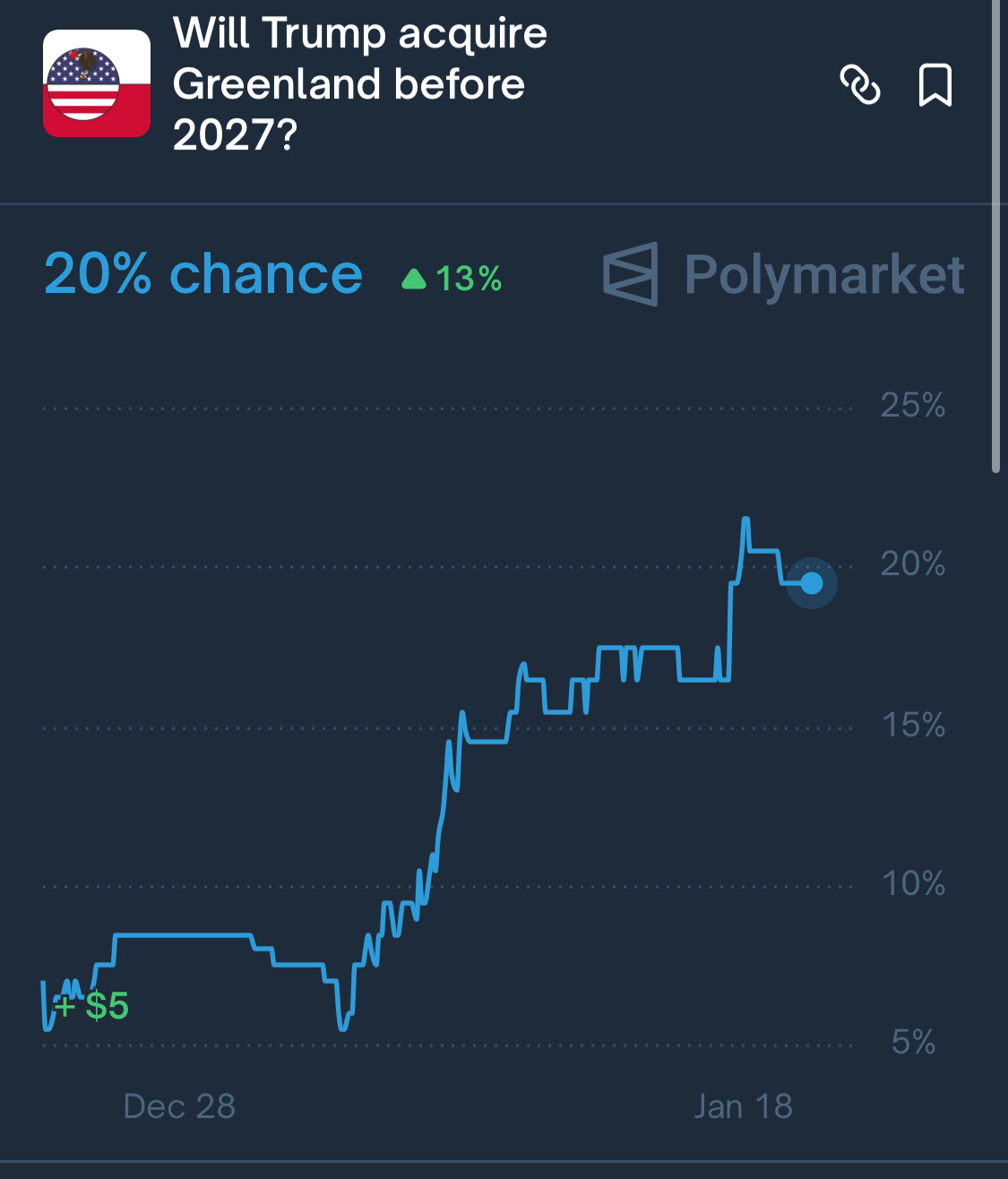
It is not good that there is currently 1/5 chance that Greenland will go to US (not about national security and more about the land including minerals/oil in my opinion).
I hope the prediction market (both Polymarket and Kalshi) is wrong this time. (the odds are always moving)
Regards
James
EDIT
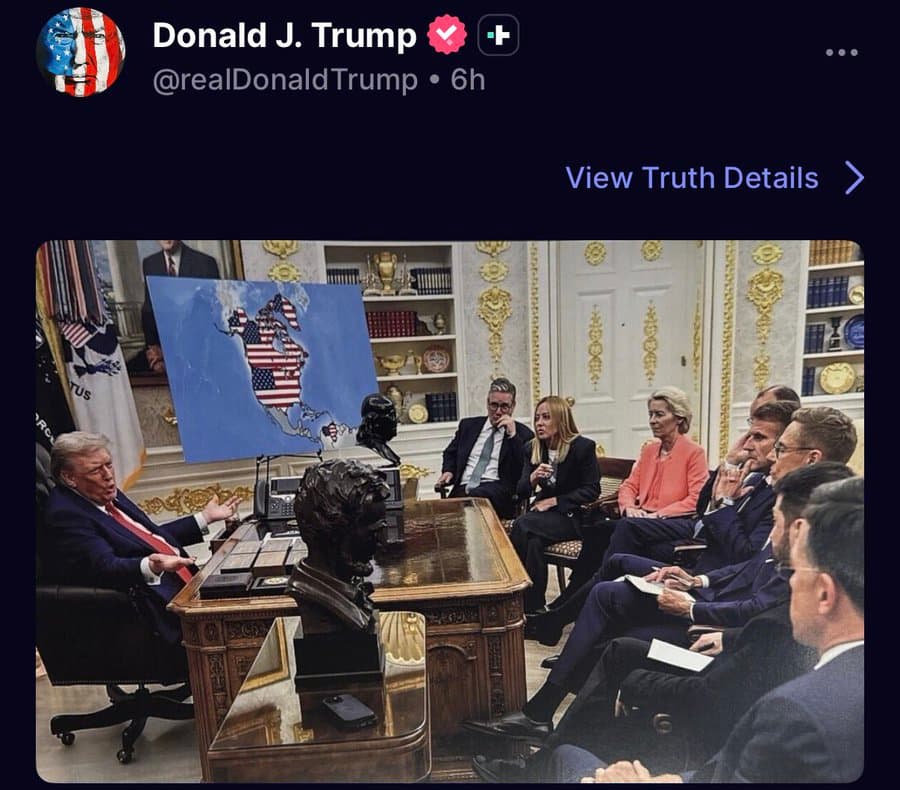
Trump posts a picture of map with Canada, Greenland, and Venezuela all part of the United States.
And US talks about the risk of China invading Taiwan. The plan to Annex Canada and Greenland is worse, even China is now pushing back.
CHINA TELLS US TO DROP “CHINA THREAT” CLAIMS OVER GREENLAND
China rejected U.S. claims that it poses a threat to Greenland, urging Washington to stop using the “China threat” as a pretext for geopolitical gains. The response follows President Trump’s statement that the U.S. needs Greenland to counter Chinese and Russian influence in the Arctic.
China said international law and the UN Charter must guide decisions on Greenland.
and gold goes higher and higher
I don’t think there is any chance whatsoever of Denmark voluntarily trading away Greenland, the only way to gain control would be with military action.
Georg,
My wife bought 200oz of real silver plates from the bank (for fun) around Christmas last year. It was so heavy we need help to bring it back home.
It now turns out to be the best investment she has made in less than 1 month.
Regards
James