Using ETFs to Protect Your P123 Stock Portfolios

Hello to all,

In another thread, Steve from StockMarketStudent spoke to his worry about feeling like a bit of “sitting duck” in stocks, and was wondering how he could diversify risk with ETFs, thinking about…

And he put it another way…

Two sides of a similar coin…

  1. Those of us who are 100% invested in optimal ETF strategies could probably do better by replacing their U.S. equity ETF allocations by using P123. Individuals can outperform the funds by going where the managers can’t.

  2. And those who focus 100% on stocks would probably do better, in the LONG run, by building in some ETF-diversified protection against the “next 2008.” If you are not diversified beyond equity, into other completely different Asset Classes, you have a high degree of exposure.

Given the amount of systemic risk that is built into today’s environment, it’s a topic that is probably more relevant now than ever. Some serious pros even say that it’s wise to diversify beyond the world of finance - to actually own “real-world” apartment buildings or egg-laying farms, for example, or even gold overseas.

Maybe extreme, maybe not. We’ll see. The point is the need to diversify to the well-informed level that you feel is best for you, given a full understanding of the cost/benefit of doing so.

On the subject of asset allocation and true diversification in that same thread, Marc Gerstein said…

I know of one that has worked in real-time for 40 years. And there are proponents of others. Before getting to that, though…

I italicized “true” (above) to call out the fact that many people think of diversification as being, say, American value equity, European midcap stocks (i.e., varying equity geography, style, size), along with some U.S. investment-grade corporate bonds and, to “spice it up,” high yield (junk) bonds.

In fact, there’s very little true diversification in a portfolio like that. Almost all of it rises and falls on the basis of the same economic drivers.

As a new user to P123, I arrived here primarily interested in building optimal customized strategies for ETFs, using findings from academic papers. While I’m way out of my depth here in discussing P123, I have studied the subject of Asset Allocation and diversification.

I hope that I can give back a little to the community (for your help and for not laughing sometimes :wink: ) by helping out on this topic raised by Steve and supported by Marc, splitting the subject into this new thread. As a brief bit of personal background…

I have had 3 successful businesses, while letting others invest for me with so-so results. My best results have actually come from the buying of non-financial assets, opportunities discovered by serendipity that worked out well.

Now, as I have more time, I decided to finally learn about the wonderful world of investing, not all of it, of course. I was just hoping to find a niche to focus upon that would enable long-term, low-risk, steady-growth of my family’s net worth.

It’s only been 3 months that I have been exploring, which I add as a caveat to you. Although I believe I have a good grasp of what I’ve learned about this topic, it’s not based on lifelong professional experience. (And, contrary to my original vision, I’m getting deeper than planned, which is why I find myself here. :slight_smile: )

Once I discovered ETFs, I settled pretty quickly on the concept of building an optimal, buy-and-hold diversification of various Asset Classes that would take me through just about any major macro upheaval.

Studying diversification and asset allocation is the necessary first step for that. As Steve noted, ETFs fit my original goal well because many of the well-managed, passive ones serve as tight-tracking proxies for so many classes.

They also make it easy to test ETF strategies even if you do not ultimately decide to “fill” a class with an ETF. For example, you may decide to buy Long Treasuries directly or on the market, instead of in the TLT or EDV wrapper.

I’ll cover some basics and then hope that Scott drops by – I’ve learned quite a lot from his work. He mentioned P123 on his blog, and now I’m trying to get up to speed with it. :slight_smile:

While most folks here seem to be equity-focused and use P123 to build an ideal equity portfolio, there’s a lot more that you can do with P123 and ETFs to do even better than “passive diversification” of an optimal mix of Asset Classes.

“Passive” (buy-and-hold) alone will be a big help, which is where I’ll start. The bottom line reason for diversification is simple…

Even the best stock-pickers will take a hit when the “next 2008” slams again (and it will happen, perhaps quite a bit harder). Good PASSIVE diversification blunts that. Good ACTIVE diversification (dynamic rules-based strategies) does even better.

Actually, skilled active investing in ETFs can do so well that they outperform the best equity ETFs while significantly reducing risk. Scott can demonstrate that if he happens by.

Getting familiar with these concepts should increase your overall returns while reducing risk. They’ll also bring a stronger, more well-rounded perspective. Finally, when well diversified, you’ll be much less likely to panic during the next big market crash since your overall portfolio will, in the worst case (barring total financial Armageddon), be losing much less.

To diversify well, you need to blend non- and negatively-correlated Asset Classes (where the correlation of two classes is 0 if price movements relative to each other are random, -1 if they always act inversely, +1 if they follow each other in the same direction lockstep). One problem to be aware of…

As Marc also mentioned earlier in a different thread, we have seen correlations between some sub-classes converge in recent years. Nowadays, you need to go to the Frontier Market ETFs (like FM or FRN or or some specific country ETFs) before you see Correlation matrix numbers drop below 0.8.

While convergence within a major class has been happening, the “macro-basics” have not changed. To test that, try the Asset Correlation tool at this nice little free site (I have no relationship to any URL that I may post) to see what I mean…

http://www.portfoliovisualizer.com/ViewCorrelations

Enter SPY (S&P500), VEA (Developed markets, ex-US), VWO (Emerging) and FRN (Frontier) to see what I mean. Just copy and past “SPY VEA VWO FRN” into “Symbols for Tickers” and click on “View Correlation”. You’ll get…

  1. Correlation Matrix – so much for Emerging Markets, let alone the developed “rest of world,” adding a lot of diversification.

  2. Rolling Correlations – the fluctuations are interesting, as are longer-term trends. The number you see in the “matrix” fluctuates, but does ballpark number does separate groups when the differences are large enough.

But even diversifying into FRN won’t keep you from PAIN during the next big crash. You can eyeball what I’m talking about at this Total Returns chart of the 4 ETFs…

Staying in the general Asset Class of Stocks, there is no way to reduce MaxDD significantly. Even moving to so-called defensive sectors has minor effect compared to moving into totally different Asset Classes. To see that…

Now try the same thing with “VTI TLT IAU SHV” (stocks, long treasuries, gold, cash). You’ll see an enormous difference.

So if you really want to maximally diversify, you do have to go “out of class.” Some people seem to feel that they’re diversifying just because a hedge fund ETF, say, doesn’t correlate with anything else. I feel, though, that not only should assets not (or negatively) correlate, adding them to the mix should address the prime economic DRIVERS of risk and reward.

You have two basic choices, passive or active…

I) Passive – buy-and-hold-and-rebalance-annually across non- and negatively-correlated Asset Classes. This was my original intent that developed as I got a little deeper.

I did an extensive review and I sort of agree with Marc when he says that asset allocation/diversification is “pretty poor for real-world use.” That assertion holds best in his context of this group, people who are very stocks-oriented and generally more risk-tolerant than those who focus on asset allocation.

My guess is that few here would be willing to accept much of a reduction in CAGR in return for decreased MaxDD and Volatility. That’s our special challenge here. :slight_smile:

But, for those primarily interested in optimal diversification, first, and then building a strong equities portfolio, there are indeed “approaches that really work under real-world conditions,” meaning significant drops in Max DD and Volatility, but with only mild decrease in CAGR.

And I think that I’ve got one, even for those who don’t want to give up too much.

A classic diversification plan, my favorite, comes from Harry Brown, the libertarian author. I can remember reading, 40 years ago(!), Harry Browne proposing that a 25% allocations to each of U.S. stocks, gold, long-term treasuries and cash would deliver optimal risk-adjusted returns.

I read his newsletter for his libertarian thinking and was still a student then, had no money, so wasn’t much interested in investing advice. But I do remember how it made good macro-economic sense back then, and it was so “Occam’s razor-simple.”

It addressed all of the major drivers of risk/reward with as few classes as possible.

I had forgotten all about it when I started out. But I soon rediscovered Harry Browne and his “Permanent Portfolio,” that same 25-25-25-25 allocation. He had published a short book about it a little later.

Meanwhile, something interesting had happened since I first read that article. It has had 40 years of “real-time forward-testing,” delivering near-equity level returns but at a fraction of the Volatility and MaxDD. This page keeps an up-to-date set of charts on it…

http://www.stableinvesting.com/p/long-term-performance.html

And explains how 4 very different Asset Classes combine so well…

http://www.stableinvesting.com/2011/02/statistical-analysis.html

Another excellent source…

http://www.crawlingroad.com/blog/2008/12/22/permanent-portfolio-historical-returns/

The annual rebalancing part is important. In my own back-testing (with ETFreplay, which I also use), it added an amazing 2% CAGR while ALSO reducing the risk parameters.

That free lunch come from how uncorrelated they are. The more correlated x classes, the less you’ll get out of simple rebalancing back to your starting weights. If forces you to take some winnings and buy more of what’s “on sale,” which are often counter-intuitive actions.

So, if you wanted to keep it as simple as possible, a passive P123 Portfolio would have…

  • 25% in your P123 stocks portfolio (instead of a strong, all-round U.S. stocks ETF, such as VTI)*

  • 25% in long-term treasury bonds (EDV, TLT or actual long-term treasuries)**

  • 25% in gold (little-known PHYS is probably the best bet ETF since it actually allocates gold and trades at a slight discount now, but goes to a premium when gold is hot; IAU or GLD are the most popular with the nod to IAU due to its lower Expense Ratio of 0.25% - or of course, physical gold stored and allocated according to your “world worry” level)

  • 25% in cash (SHV or SHY if you want to chase a minimal amount of yield, or rolling actual 1-year t-bills).

  • Those looking to build a 100%-passive ETF portfolio would be willing to accept more risk and “diversify” among strong concepts like VBR (value, small) and RSP (equal-weight the S&P).

** Again, ETFers-only may choose the more extreme EDV. The Permanent Portfolio Concept is so well balanced that it doesn’t seem “bothered” by more extreme volatility in its components.

Just how well-balanced is it? Below are the results of “PP2x” vs “PPclassic” from Jan 2010 (the date of inception of one of the 2x ETFs) to today. The PP can even deal with 2x-leveraged ETFs of each class, delivering CAGRs that aren’t far off from double, with Sharpe staying close to the same…

CAGR Sharpe MaxDD Volatility

  • 7.7% 1.08 -8.00% 6.5% (Classic)
    +14.2% 1.04 -14.81% 12.3% (2x)

Or for 2010 alone…

CAGR Sharpe MaxDD Volatility
+13.7% 1.72 -3.12 % 6.9%
+25.3% 1.61 -6.44 % 13%.0%

For such volatile ETFs (the 2x’s rebalance daily, with notorious instability that are NOT supposed to be held for weeks, let alone years), that’s pretty decent diversification of risk.

Problems with PP

I’d bet that many here would be strongly against having 25% in cash. Cash was Harry’s ultimate safety net - a severe tight-money recession/depression hedge and one that also delivered high-interest rates when inflation raged (albeit not keeping up with inflation).

Nowadays, especially, it seems like holding 25% in cash woulds be a real waste. And long-term bonds certainly seems like a losing bet. And gold is scary.

But the fact is that regardless of where you are in the business cycle, there are almost always 1 or 2 classes that seem to be bad plays, and gold has always been speculative in the short-medium run.

I’ve read many old threads about the PP, where people were afraid to enter because 1 or more classes seemed like “such sure losers”…

So why not cheat a little, they’d ask, wanting to do what everyone else thinks. The herd instinct is one of the behavioral traits that define the sub-optimal investor. It’s part of the same intuitive human judgment that leads even doctors to diagnose appendicitis less accurately than a rules-based protocol.

Human instincts are what lead typical investors into selling stock low and buying high. Another of those trait is “overconfidence,” so we’re all sure that “I” have none of those traits. :wink:

Rules-based algorithms beat human judgment (when the rules have been well-researched and designed). As much as experts rebel against evidence-based systems of all kind (feeling un-needed), countless studies show that we underperform “best practice” rules-based decision-making. Even if we have access to such systems as guidance (with discretion to over-ride), humans do less well.

Yes, sometimes 2 or even 3 classes may do poorly, yielding rare bad years. Usually, though, year in and year out, one “sick class” turns out to lose while the other surprises. And more often than on the downside, the stars align to give some very happy results.

Overall, the buy-hold-rebalance approach of the PP flattens all the huge ups and downs. Over the past 40 years, it’s had years with 20%+ returns but never any large losses. It flattened both 2008 and 2013 while turning in near-equity returns with very low risk numbers over the long run.

Other Passive Diversification Schemes

There are many other passive approaches, as outlined here…

The PP does well against the many others that have come along (this study may not be quite as unbiased as it claims, structured in way that would seem to favor the system that is being promoted, but it’s still a good quick overview of other diversification systems).

Risk Parity is a model that also makes sense, but not the same kind of sense. It ties allocations to level of volatility, which is conceptually neat, but volatility varies over time. It’s a “drivee” and not a “driver.”

No other model has the simple “macro coverage” of having one or more assets to “cover” the major drivers of prosperity/recession, inflation/deflation, liquidity and crisis. Here is one final article that touches upon the same theme, with an interesting “heat map”…
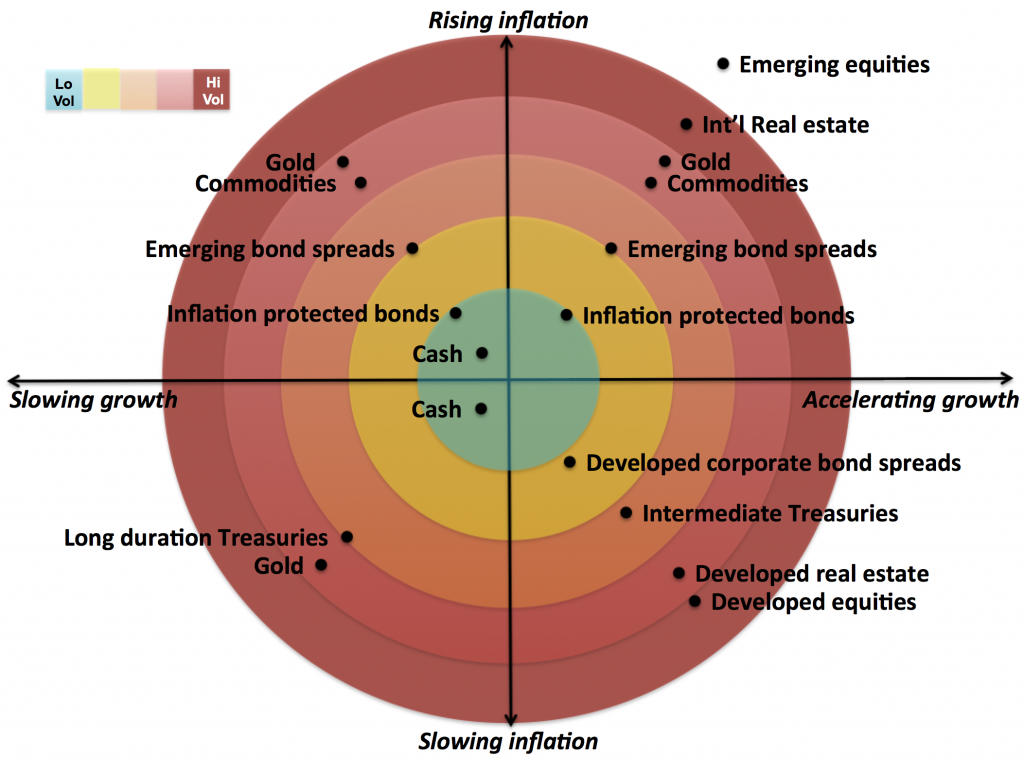
To summarize, PP has…

  1. simple macro-economic good sense

  2. highly non- and negatively-correlated Asset Classes

  3. the 40 years of “forward-testing.”

Earlier, I said there were 2 ways to diversify. The first was “passive” and now…

II) Going Active

There’s only one problem with passive diversification. Inevitably, you get drawn into going active! It has sucked me in, that’s for sure.

In the SeekingAlpha link above, you’ll note reference to the 2 systems that, as presented, are not strictly passive…

  1. IVY portfolio (conceived to passively simulate the low-equity portfolios of the major endowments), here using a 10-month moving average (making it "active’).

  2. You’ll also note reference to a “momentum” strategy.

The latter, AKA “Relative Strength,” has been called “an anomaly that is above suspicion” by Fama and French. Momentum investing has a great deal of supporting academic literature, including why this area of inefficiency has not been arbitraged away. It’s real.

At its simplest, it is nothing more than “recent Total Return,” higher being better.

If you head in this direction, you will head into a whole new use of P123, working out…

  1. optimal look-back periods - generally 3-12 months or some weighted blend

  2. optimal formula - inclusion/exclusion/quantification of volatility, most recent month and others.

And ultimately, you’ll find an approach that INCREASES Total Return while keeping risk low.

I try to maintain the PP theme by building “mini-portfolios” around each Asset Class, choosing the “Top 2” out of each. Each PP goes to cash when nothing in the mini-portfolio is stronger than SHY - this cuts out much of the downside of major regime changes.

And recently, an exciting new development, changing a binary decision into a probabilistic one…

https://www.google.com/search?num=100&site=&source=hp&q="probabilistic+momentum"

I still have NO idea how to turn this into rules in P123 for back-testing (have to walk before I run), but this seems to be a big and recent step forward.

Anyway, the bottom line is beware of what you wish for. :wink:

You may end up doing way more than you thought as you attempt to get more than what you wanted.

Steve, you wanted to tweak the stocks ETFs and/or use non-stock ETFs to diversify the raw risk of being in one Asset Class. Passive ETFs will do that. Active ETF-investing should go you one better and give you the best of both worlds.

Marc, I hope this is what you were looking for.

And I do hope that this helps someone.

Hopefully, too, Scott will pop by. He knows 100x more about this than I do and can show you what a smart Active Allocator can do!

All the best,
Ken

P.S. Gad, didn’t mean to go so long. Sorry about that.

P.P.S. I put this in “General” instead of “ETFs” forum since the topic is more about diversification. ETFs were “just” the vehicle. I hope it’s the right spot.

Ken / Marc - you guys are going to kill me with word overdose :slight_smile:

Ken - you have brought up some very interesting possibilities. I really like the Probabilistic Momentum strategy. I would add one additional flavor to the strategy. That is to employ multiple lookback periods and use the results to determine the percentage of the asset to hold. In other words, if you employ four lookback periods and three say “buy” then you would allocate 3/4 of maximum potential allotment.

When you started talking about active management of ETFs, I originally thought you meant ETFs with an active manager (which exist). But I presume you mean strategies for choosing/holding ETFs, whether they be passive or active.

The passive asset allocation idea 25-25-25-25 is a clear example of a strategy that could be employed at the top level. The Probabilistic Momentum strategy could be employed at the top level or, depending on the target ETFs or indices, could be at the top level, or used as a substitution for a particular asset class. For example, you could replace a US equities index with style (Growth/Value/Income) and/or MarketCap (Large/Medium/Small) ETFs based on Probabilistic Momentum.

Marc - I don’t think you need a specific allocation strategy. The point is that asset allocation is plausible as Ken has pointed out. The beauty of P123 is in giving members the flexibility to create their own portfolios, this is what many of us love (at least I do). P123s job would be to give us the ability to research and design our own strategies.

I kind of view this as a separate product, something that should stand alone in terms of costs versus revenue generated.

Steve

If you want to explore passive diversification, then you should visit the Bogleheads forum because they are passive investors and their only risk control tool is diversification, so some are pretty good at it. At this link is a spreadsheet with at least 40 years of annual data on a number of asset classes. A number of interesting portfolio’s are available in the spreadsheet including Harry Browne’s Permanent Portfolio. Also included are 40+ years of annual correlations between asset classes.

Don

I like the idea of the permanent portfolio but there was some luck involved with the past returns which may not repeat itself in the near future.

The majority of the cited returns occurred over a 30 year bond bull market. If the meat of the returns occurred during a bond bear market then they would be lower. Do you think that we are closer to a bond bull or bear market?

This portfolio holds US stocks and bonds. If Harry Browne was Japanese or from another country that had lower stock returns than the US then the returns would be lower. Will the US stock market continue to outperform?

Scott

Ken wow great post. I had once taken a look at PP but had forgotten about it and how good it is. Also, I never used it because there are always valid arguments against owning at least one or more of the four asset classes at any given time; often for valid reasons. Your system of combining the four asset classes with rules may be a little easier to swallow.

It seems that you are knowledgeable about the Permanent Portfolio so perhaps you can address my theoretical concern with it. It is true that in certain ways the past forty years is a good sample period for the Permanent Portfolio because it covers many of the common situations including inflation, deflation, growth and recessions. However, most of the period was a secular bull market in bonds. Also (thankfully) here in the US it did not cover rare but more severe risks such as the hyperinflations of countries such as Germany Argentina and Zimbabwe, or the severe deflation of Japan, or sovereign defaults. I would guess that theoretical investors in Argentina using the PP system would have lost close to 100% of their money in stocks, bonds and cash during it’s hyperinflation which is 3 of the 4 asset classes or a 75% loss. Not to mention theoretical investors in Zimbabwe. The gains that they would have gotten in gold would have just have kept the last 25% from losing value in inflation adjusted money. (Although I would like to see the actual numbers before forming a concrete opinion on this.) Does anyone address these concerns theoretically and do the backtests for hyperinflations?

(Of course the past forty years in the US certainly doesn’t cover the even more unusual but more severe risks of a government confiscation of all assets like what Communist Russia and Communist China did, or the destruction to the economy caused by losing a war on home soil–although to be fair that is not what asset classes are for.)

P.S. I assume that Scott goes by the username sgmd01 here. What’s his blog?

You’re looking for the other Scott, username oyenscot

Ken,

I’m anxious to delve into the material you cited, but am probably a bit time constrained for the most of next week. So don’t take any meaning from a bit of radio silence from me on this important issue. I will get to it!

Is it possible that P123 could finally allow inverse ETF’s to be integrated with equity portfolios? Its been requested many times to no avail.

During a bond bear market, long term bonds lost money each year from 1977 to 1980. During those 4 years the Permanent Portfolio gained 87%. During those 4 years Long term bonds lost a total of 2% (total return). I think that Harry Browne believed strongly in the US economy specifically, but there is no reason it could not be modified with an international flavor, with a P123 strategy as the equity component, or in other ways.

Don
Source - Asset Class spreadsheet that I linked earlier in the thread.

Don, That is a good point. However in those 4 years gold returned between 15 and 126% year. The correlation of gold to stocks and treasuries varies over time so gold may not always be a dependable hedge in a year when bonds are declining. Look at 2013, where the permanent portfolio lost 2 percent despite a 30% US stock rally. This was due to both long term treasuries (lost 15%) and gold (lost 29%) declining together. Since the returns from the PP are cited since 1970 which predominantly has been a bond bull market there is not enough historical data to determine whether gold will rally enough to offset any losses from long term bonds once we enter a prolonged bond bear market (I have no idea when this transition will occur). I like your idea of an international flavor to the PP, particularly since the US currently is one of the more expensive stock markets.

Scott

Ken / All,

I’ve been doing this type of thing with modest results - but results within my expectations - for a while. I’ve been using global asset class rotation with hard asset class constraints for about 6 years now with a combination of P123 and excel.

Personally, I wouldn’t touch gold or long-term bonds at a static 25% each of my portfolio. I think that’s a recipe for a lot of potential pain and volatility. I would trade them (and do) at much lower weights with rules.

Minor note. I also think your numbers may be off some. I set up a ‘book’ of four subsystems for the permanent portfolio. I used SHY (short term US bonds) instead of cash. SHY shows a -1.98% peak DD over past 10 years with a 2% annual return. So, it’s a fair proxy for ‘cash.’

With these 4, P123 shows a -13.8% peak DD in the trailing 10 years (using SPY, GLD, TLT, GLD). And a 7.4% AR.

I then created 4 universes (SPY-SHY, TLT-SHY, GLD-SHY, SHY-IEF). And a simple 3 factor ranking that mirrors some of the underlying philosophy of the ‘probabilistic momentum’. Without T-distributions. I reran the system. It works quite well.

I then substituted a more bond specific, US bond rotation system that looks at yield curve steepness and yield (also allowing JNK). And an SPY-SH switching system (my R2G). Results then get a lot better. More importantly, they are much more likely to avoid major market pain in many of the sub-markets. Additional trend filters and slightly more advanced ranking rules can be added to increase likely stability out-of-sample. (I use them often).

I am currently running versions of all of these (apart from Gold, which I have traded, but really don’t like to trade at all except in huge up momentum times).

For some slides to ‘stir the creative pot’, see:
https://docs.google.com/presentation/d/1q1tAR0SU3Abk7Fwn39-OgT4SBdozhxtZNrPRnkRg7xI/pub?start=false&loop=false&delayms=3000

Some of the main features needed to start using this more easily in P123 and R2G are:

  1. Ability to specify a custom ETF universe in a stock sim (or hedge) and then use a specified ETF rating on that specific universe only as a timing signal. For example, SPY-SH universe and rank using SPY-SH rating(“SPY”)>50, 1,0). I have posted feature requests on this in the past.

A. Better cash management tools in books (allowing the system to reallocate unused funds or funds in SHY for example…if a subsystem has chosen that ETF)…and…
B. Dynamic rule based, sub-system weighting options with books…to allow for things like risk-parity adaptations.
I have posted feature requests on these in the past.
3. Ability to offer books as R2G’s.

This was pretty good site on probabilistic momentum:
http://cssanalytics.wordpress.com/2014/03/03/probabilistic-absolute-momentum-pam/

Best,
Tom

Tom,

Your post opens up some excellent ideas. Each part can be created in a separate Sim and then Summed into a book. It can’t be offered in a R2G yet, but will work great for a member’s personal use. I need to brush off some of my old ETF Sims where I played with different switching methods from 2 or more ETFs and put them together in a book.

Thanks!
Denny :sunglasses:

Denny and Tom,

Gary Antonacci wrote a couple papers using permanant portfolio like momentum strategies that are similar to Tom’s ideas above. They might be a useful read.

Tom,

“1. Ability to specify a custom ETF universe in a stock sim (or hedge) and then use a specified ETF rating on that specific universe only as a timing signal.” I would love to see this implemented.

Scott

Hi to all,

I am so glad (and relieved) that some found this useful. I don’t think I’m going to start any more threads, though. The replies are so interesting that I feel compelled to answer each. This may take a while.

Some replies…

Steve, re “word overdose” – sorry about that, it’s always hard to know how deep to go. I tend to err on the side of “too much.” I’m glad you found it useful, though. By the way, are you from Stittsville near Ottawa? Someone from there used to work for me, a great guy! Although we live in Anguilla now, we lived not far from you - Montreal.

And yes, by “passive diversification” I meant the one-time, set-and-forget, buy-and-hold-and-rebalance-annually “non-action” of a mix of optimally diversified Asset Classes. This alone de-risks your stock portfolio (large improvement in Sharpe, Sortino and Max DD) with little loss of CAGR.

“Active diversification” is really only a term that I used in the context of what you are looking to do, which is interesting. Knowing how folks here are natural optimizers, you can “actively” diversify using formula-based strategies (most commonly Relative Strength, aka Momentum) to improve overall portfolio results.

In other words you are actively changing the mix.

By “active,” I did NOT mean, as you surmised, that actively-managed ETFs were being used. Quite the opposite, actually. In passive diversification, you want well-managed ETFs that tightly track their indices (which should be reflective of the major Asset Classes in your approach) passively.

“Active” (here) means that you only reassess your mix of Asset Classes yearly and adjust according to your screen (ex., a Momentum screen). Basically, with “active diversification,” you figure out how to do better-than-passive by applying a P123 screen that optimizes the Momentum effect (or whatever else you may find)…

That might involve picking a “rules-based” ETF to achieve a certain purpose. Those are known as “smart beta” ETFs (terminology and the exact definition of “smart beta” are an area of controversy). Or you could pick truly active ETFs. These typically have NO index against which they measure themselves (some controversy here, too, over what’s “active”) and they are designated as “active” by the SEC.

Both ETF.com and ETFdb.com have terrific screeners which allow you to download data, even on the entire universe of ETFs and ETNs, by the way! I find it quicker to find a particular subset of ETFs client-side, using Filemaker, which contains a ton of data from those two sites, as well as notes that I make along the way from analysis at those and other sites.

Re “Probabilistic Momentum” – you’re already working on pushing its boundaries, while I have no idea how to turn it into rules. Arggh, I’m jealous! I’ll be interested to hear your backtesting results compared to “regular” Momentum strategies.

It’s early days on it, so be careful. The academics will normally be following this discovery with a series of interesting papers on this. I hope so. Their studies typically cover 30-40 years and are statistically rigorous.

This is another example of how access to historical index data (covering many asset classes) would let this community push far ahead, and quickly. 40-year studies of the various asset classes (which requires index data since ETFs don’t have that history) would confirm that this refinement works across all classes (as “regular” momentum does), and could then be further refined (per the ideas that you outlined) quite quickly by some of the incredibly smart people here.

Imagine a combination of academia and practitioners, all under the same roof. Some folks here would blow the roof off!

I’d be less confident with a test that does not cover at least one full business cycle. The most we could get out of this would be about 10 years by keeping it simple and testing refinements of Absolute Momentum “pairs” for each of SPY, TLT and GLD (i.e., each vs. SHY). Those cover the 4 elements of the PP and have been around since 2004 (last inception date).

Not ideal.

You end up with a reasonable “active” approximation of the PP (purists would argue with me on that, since there will be some distortions, so a 30-40 year duration study is all the more important when we do things that start bending the basics of what made it so successful for 40).

Still, once you have a 10-year baseline of the classic approach of Absolute Momentum, repeat with “Probabilistic Momentum” using the same pairs of ETFs. That alone would be an interesting, and probably valid, study. Gary Antonacci has done some good work in this area, showing the power of this approach.

And on a sidenote, this speaks to my request for ETF users to be able to choose any ETF as their own baseline or, ideally any screen as a baseline. Having that type of side-by-side comparison ability would be extremely helpful.

The key point, though is how strong ETFs can be for those who use P123 to build their high-performing stock portfolios. Blending other classes in “actively” should yield even higher CAGRs while reducing risk.

I wish I had your command of P123, Steve. Its abilities to develop and test ETF strategies are why I subscribed, inspired by Scott’s work. I’m getting there, but too slowly. I tend to get distracted into the academic stuff, or so many other articles that cover areas I’ve not yet learned.

There are several strong concepts in the academic papers (re Momentum) that, as far as I can see, have not been studied at the “ETF-blogger” level, nor are they in any momentum ETF prospectuses. Testing their integration will hopefully reveal superior results.

I’m dying to get there.

So I’ve loads of ideas, can’t wait to get at them, but I really need to settle down and get through the rest of A-Z Guide. And of course, the rest of “life” gets in the way! :wink:

Nothing else (that I know of, anyway) does what P123 does. Yes, ETFreplay is much simpler - but that comes with a tradeoff. You can only take it so far - you can only create “formulas” (sort of) by choosing from drop-downs, but you can’t go beyond those limits to really customize academically-demonstrated strong concepts.

It’s rare to see someone publish a step forward like “Probabilistic” in a field that’s been studied as well as Momentum investing. Leaps like that take a while to cross-over into the “mass” audience (ex., SeekingAlpha). I’m pretty sure it will be Scott who makes this more digestible for folks like me.

It wouldn’t surprise me if this were to be his next big article.

I’d love to hear how your work on this goes, Steve!

Don, re that URL you gave for the spreadsheet with 40 years of data…

http://www.bogleheads.org/forum/viewtopic.php?p=29219#p29219

Just in case anyone misses it, the most recent release in that post is not “rev11a” as mentioned there. It’s being maintained and updated by “serbeer” since January/2014. Rev 13c is at…

http://www.bogleheads.org/forum/viewtopic.php?p=1912664#p1912664

Background info wiki URL…

http://www.bogleheads.org/wiki/Simba's_backtesting_spreadsheet

One of the contributors to that thread, pvguy, is the person behind portfoliovisualizer.com, which provided the correlation data in my post. This tool is basically that spreadsheet online, per his post at…

http://www.bogleheads.org/forum/viewtopic.php?p=1810269#p1810269

All the tools there are useful. I should have specifically mentioned that you can backtest your own static allocations (going all the way back to 1972) at…

http://portfoliovisualizer.com/ViewHistoricalReturns

The 3- and 4-factor tools show you where an ETF gets its mojo from (beta, size, value and/or momentum).

If you peruse the various sheets of the client-side spreadsheet, you can see how the author/programmer has translated the functionality to the Web. Quite a resource!

It uses mutual funds (since they have the history that ETFs don’t), but this has 2 drawbacks…

  1. some, though, don’t track an Asset Class very well. The right index pretty much IS the asset class.

  2. it’s still static diversification. It’s probably possible to develop formulas within Excel and test them, but I’ve not noticed that anyone has done that.

P.S. I’ve started one of my programmers working on R, to find sources of index data, to develop an index-tester to optimize Momentum with long-term studies. If this looks do-able in a relatively short period of time, I’ll ask for testers to play with it if that’s OK?

Scott, re “luck involved” with the PP. I don’t think so. It’s been “lucky”/remarkably stable for 40 years. It’s quite amazing to see how this simple systems damps down 3 highly volatile classes, even 2x-leveraged high volatility classes.

Your point about a 30-year bond-bull market raises the question of how long is long enough and what other major trends have we been in. Since the USD was taken off the gold standard, some make the case that we’ve been in a 40-year gold bull (albeit with some major drawdowns) - barring a complete deflationary collapse (which the Fed is determined to never let happen), few could argue that gold will not continue to go up over the long run and that cash will most likely continue to lose its value.

But so what? In the same way that gold handles the short- and medium-term reversals in various classes, when bonds DO start a new LONG-term bear, the underlying dynamics would result in the other three continuing along in their well-diversified way to “make up the difference, plus.”

Its solid macro-fundamentals do NOT guarantee that it can’t have 5 bad years (although it’s never had a rolling 5-year loss). That said, 2 of its 4 classes give us reason to worry in the near-term.

It’s the type of approach though that is almost sure to worry you. And yet, the real-time results certainly seem to keep on standing up well.

ADDENDUM: More on this, later - I noticed Don speaks to this, too.

Chipper 6, thanks very much. I was hoping to give something back here. Everyone is so far ahead of me and it’s such a helpful, positive community, that I wanted to give something back. Steve provided the opportunity. :slight_smile:

Your “armageddon question” is great. Craig Rowland answers it very well in his book on PP…

No one survives Armageddon scenarios, except those whose eyes are wide open and actually prepare for it. Unfortunately, preparing for it is very inconvenient. And most of us don’t want to see it or go through all the bother even if we do.

As a simple example, I’d bet that few, if any, here actually owns his stocks.

Your broker merely OWES them to you since you most likely hold your stock in “Street Form,” which ultimately tracks to the actual owner being a federal agency.

So in the event of a collapse that makes 2008 look like a small dip, when gov’t insurance won’t come close to covering the chain of collapses, we’ll end up getting a small % back. Of course, you CAN protect yourself in 2 ways…

  1. direct registration via the Web – now you ARE the registered owner. It’s a bit of a pain and will slow down your trades. But in the event of calamity, you should get your money back after the dust settles. It’s probably something everyone should be doing, but I doubt if I’ll ever get to it.

  2. take physical possession of your stock certificates. Physical shares failed to scale in the mid-60’s or so, when volume “soared” from 5 to 15 million. “Runners” could not keep up!

The new system scales, but there was NO reason not to leave the real owners as the actual/legal owners instead of merely the “beneficial owner” in a brokerage’s database. But that’s not what they did. So brokers can now leverage the heck out of (not-)your stocks, even lend them to insolvent institutions.

Every area of our economy is so unstable that only confidence in the system holds it up. When that erodes to a certain critical point, what happens?

Your scenarios may be unlikely to happen in the next year or two, Chipper, but they are far from impossible. And one will play out sooner or later. It’s inevitable.

And it’s US who will get hurt.

Cash is in the same boat, as is gold. Stocks, gold, cash – they are all more secure when in physical form, clearly owned by you, untouchable by others, stored in a secure location.

The inconvenience of playing it safe keeps most of us from using those options. It’s so much easier to keep them in electronic form in way-overleveraged institutions, “guaranteed” by an insolvent government.

I hope you don’t think I’m some “doom kook.” If anything, I’m far too casual about my money. I’m just making a point that, when coming to a discussion like this, each person has to decide how secure he needs to be, then act on it.

80%? 95%? 99.99%? The more secure you want to be, the more it will cost you in effort and/or money.

The PP book covers the range of options of execution of the PP. The details would take too much time, even for my long posts! But basically, it boils down to this…

If you are worried about disaster scenarios, the PP would still do fine, but it means diversifying some percentage of your assets into non-trading, physical form.

Some would say “yeah, but how do you spend gold bars in Switzerland.”

Let’s say that you ARE worried to that degree. Well, the point would be that if your gov’t commands you to repatriate your gold, YOU will still have the power because YOU hold them, out of reach. And I’d leave any country that wants to ruin me.

In a hyperinflation, it’s gold and gold alone. So I’d never bring that home and turn it into useless fiat.

Or in the case of the absolute worst deflationary collapse, it’s ALL about cash and storing it in a secure place. When you need it, that cash will have gone up in purchasing power by several-fold, enabling you to buy real assets for pennies on the dollars.

So the PP should “hold up” in extreme circumstances, if you look at it through that lens. No one emerges unscathed, but if “extreme” means once-a-century type events, it also means extreme forms of executing it.

And only YOU can judge how much inconvenience and expense you will pay for security.

You said it perfectly when you said “to be fair that is not what asset classes are for.” Right. But, if and when you see it coming, there ARE steps you can take to protect yourself, BEFORE government seals of all the Exits (which is what the U.S. gov’t has already started to do).

However, if we keep this discussion to plus/minus 2 standards of deviation and accept our built-in vulnerability outside of those bounds, the PP should keep on doing a pretty good job.

P.S. Re “Scott” – sorry, I meant Scott Oyen (oyenscot). He has published some very interesting studies on the “active” side, beyond diversification and into the use of Momentum in trading systems.

Marc - I know you’re busy, no rush. Anxious to hear your views when you have the time, as well as feedback on that “no cost” feature.

OP - regarding your question…

OK, here’s where I’m really out of my depth. I may not be understanding, but why would you not be able to do that now? I’ve back-tested this within Relative Strength in an ETF-only portfolio.

Interestingly, SH’s net contribution ends up being slightly negative, when broken down ETF by ETF. But without it, your CAGR drops and risk increases! Even though, it will occasionally get whipsawed, overall it smooths the chart and improves returns.

So it should work the same way if you replace an EFT with your stock portfolio.

I must be missing something? OR, if you can’t actually integrate a portfolio of stocks into a mix of ETFs (if not, that would be a great feature), would a smart-beta ETF that is based on similar principles serve as a reasonable proxy? It’s not perfect, I know, but the dynamics and outcome should not be dramatically different.

Don, thanks for that extra data re the 4-year bond bear market in the U.S. and how well the PP did during that period. I didn’t know how the PP did in Japan over the past 40 years, but the concepts just seem so universal to me that it should have done just fine.

Then I had this brilliant thought… “Google it.” It’s weird how everything is on this “Internet thing.” It seems to have done just fine in Japan, the Eurozone, even Iceland…

http://europeanpermanentportfolio.blogspot.com/p/permanent-portfolio.html
(Look for “Perm Port” column in the annual tables)

And specifically about Japan, this is interesting…

http://advisorperspectives.com/dshort/guest/BP-120927-Permanent-Portfolio-Turns-Japanese.php

Skip down to the paragraph where it says…

The discussion closes with…

and…

Somehow, it always seems to toddle along, smoothing out both big win years and big loss years and delivering a CAGR only a little less than stocks in general, with much less risk. So, getting back to Steve’s original question, it’s a reasonable way to protect your P123-built portfolio.

And if you apply some “active allocation” to it, as I was sure folks here would quickly jump to, all indications are that you’ll do even better while reducing MaxDD and Volatility substantially.

Even in Japan. :wink:

Scott, you rebutted Don’s reply with “yes, but look what gold did.” That’s really the whole point of the concept. Gold’s correlation is around zero - random. Stocks and long-term treasuries are negatively correlated, and so forth. When the stars line up wrong, the PP may lose 5-10 in a year, with a long-term MaxDD of around 14%.

And there will always be a reason, when you look at any year or two, where you say, “what a fluke.”

But overall, the very concept of diversification is that in the long run, while all 4 classes will have positive returns, most don’t all go up or down in concert in any given year. In an average year, 3 VERY volatile Asset Classes churn out steady 8% gains, tamped down by cash which has its own special role to play.

It’s kind of like the golfer who keeps shooting 90-100. Every day, back in the clubhouse, I’d hear him tell his buddies, “if it wasn’t for that triple bogey on the 4th and that out-of-bounds on 12, and etc., etc.,”…

“I’d have shot 88”

The underlying fundamentals though, keep delivering the same results within a rather narrow range.

Glad I got to work golf into this. :slight_smile:

Seriously, some folks will over-analyze the year-by-year flukey numbers to death, missing the big picture of what the unit delivers.

Tom, really interesting post! A couple of quick points before getting to your main one…

I know that PP won’t appeal to traders. It’s a very different mindset. And since you have the ability to actively get in and out of Asset Classes that increase the returns beyond that of your equity portfolio, you don’t really need it to use it passively.

Harry Browne’s suggestion from the 70’s, though, stands as what is probably the most elegant example of effective, passive diversification. It has its place for those who want to focus on stocks and don’t want to get into Relative Strength.

I started on this recent journey not believing that anything in Technical Analysis was more than the reading of tea leaves. But the literature convinced me that Relative Strength actually delivers, with not a heck of a lot more effort.

“Activating” the PP is where the excitement begins.

Re my numbers being “off” – I was only running a quick sample beginning in 2010, to compare “PP Classic” vs “PP 2xLeveraged.” I was limited to that date by UBT, with a 2010 date of inception. It was to show how well the 4 Asset Classes deal with volatility (by mastering the notoriously unstable 2x ETFs, which are only supposed to be for very short-term trades).

It was from ETFreplay, where I have all sorts of experiments, passive and active, already set up based upon the PP. I am constantly amazed by how it handles volatility. For example, less dramatic than the 2x but more realistic…

If I change “PP classic” (SHY, SPY, TLT, GLD) to “PP Pumped,” where SHY is replaced by VTI (cheaper, and much deeper coverage extending into mid and small caps) and if TLT is replaced by EDV (cheaper, longer effective duration), where both replacements are MORE volatile, here are the results (start date Jan 29, 2008, always with annual rebalancing which adds around 2% of free lunchCAGR)…

	CAGR   	Sharpe	MaxDD 		Volatility

Classic +6.5% 0.66 -14.09% 7.7%
Pumped +8.0% 0.74 -13.21% 8.9%

Change to the even more volatile VBR (small caps value), let’s call is 'Roids…

'Roids +8.6% 0.76% -13.36% 9.6%

PP happily gobbles up the greater risk premium of size and value while muting the risk elements, especially MaxDD which is, in practical terms, the more important.

That was the basic point that I was trying to get across. Playing with it at this basic level gives one a great appreciation of how perfectly its 4 elements play off each other. Cash adds little most of the time. The 3 “active ingredients” (GLD SPY TLT) alone give you this…

NoCash 8.1% 0.66 -19.64% 10.3%

That’s 1.6% more CAGR than “Classic,” albeit with a proportionate increase in volatility (same Sharpe) and 39% increase in MaxDD. Purists are willing to “pay” for the stability and also the insurance policy against cash’s “speciality” discussed earlier if and when it hits.

Luckily, Tom, you don’t even need to enter that debate.

It’s fascinating to read what you did after that. The slideshow is like a work of “mind art.”

I’m learning P123 in my spare time. Building mini-portfolios around each of the three classes (diversifying a logical selection of ETFs within each class, including judicious use of short ETFs like SH), and using a simple Momentum formula, I get these numbers on P123 (no longer in ETFreplay)…

Active 15.2% 0.78 -15.7% 16.0%

I have to admit that what you’ve done with a much simpler Absolute Momentum (along the lines of Gary Antonacci, who I referred to above and earlier) and some version of Probabilistic Momentum, in about 20 minutes, is humbling. Amazing stuff, and that’s just the parts that I understand! :slight_smile:

It’s like watching a professional swing a golf club. I feel like the duffer mentioned above, who never quite gets the reason that those bad shots aren’t bad luck. When he sees the optimal economy of a truly good golf swing, he realizes why a few disaster holes are built into his game.

Simply amazing. I’m anxious to see where you push this, Tom!

All the best,
Ken

P.S. Will be gone for a few weeks, unfortunately. I have to put together a project for my company. Please don’t take my silence for disinterest. It’s just that when I even peek at this stuff in the morning, I can get lost for the day.

Sorry for the length of these. I felt like I had to answer each. Comments were just do darned interesting!

The permament portfolio held in Japanese securities from the article that you cited returned 2.95% per year between 1992 to 2012 with a max drawdown of 22% and sharpe ratio of .37.

The luck that I was referring to was not regarding the power of diversifying by holding asset classes with low to negative correlation but rather that if Harry Browne was Japanese and held a portfolio in Japanese securities he would never have gained such a large following for this strategy with these suboptimal returns.

We have no idea what the United States economy will look like in the future but I am sure that if we were in Japan 20 years ago none of us would be expecting 20 years of deflation and negative stock market returns ahead. So if the future of the US is like Japan (I am not suggesting that it will be as my crystal ball is broken and I am optimistic on the US economy) holding a static portfolio, like the permanent portfolio, can result in suboptimal returns going forward.

Gold is hard to value, has variable correlation with stocks and bonds, and it is difficult to accurately predict its direction as well as the velocity of its direction. The historic data prior to 1970 suggests a very low return for gold (1.1% per year since 1836 http://www.nber.org/papers/w18759). As such, time will tell whether gold rises enough to adequately compensate for the future potential permanent portfolio bond losses once we enter a 30 year bond bear market (I have no idea when this will be).

Scott

Scott, you are referring to this summary from that article ( http://advisorperspectives.com/dshort/guest/BP-120927-Permanent-Portfolio-Turns-Japanese.php ), I believe…

This, of course, was not a great period for Japan. It was decimated by stagflation. To draw the conclusions that you do, one must put it all into perspective, and what the intent of the author was.

You left out the author’s conclusion…

We in America would not have been pleased with those results during that time span. But is it accurate to say that we would not have been pleased if we were about to enter such a period?

First, let’s complete an apples-to-apples comparison…

Given that nationals tend to heavily overweight their domestic markets, wouldn’t the typical Japanese investor have found the results above (of the passively applied Permanent Portfolio) to be more than acceptable, given these buy-and-hold results of Japanese stocks during those times?..

You said…

The truth is that PP is a niche concept in the U.S. itself because the mass market is more impressed by shiny red balls that don’t work. And the smart people (here, for example) can do better.

And it’s fair to surmise that the Japanese may have been too depressed to take notice and make PP a national mania. :wink:

But it’s not fair to call these “suboptimal” results in the context of “mass market” investing. By that, I mean that these out-of-sample results are anything but “suboptimal.”

Heck, it’s all “out-of-sample” since Harry first proposed this in the early 1970s. This Japan test is “out-of-out-of-sample.”

Unless his chart of Nikkei returns is inaccurate, you must admit that PP delivered, in a horrible economy, a substantial apples-to-apples comparison…

  1. CAGR increased from -3.43% to 2.95%. That is a MUCH more impressive difference than the U.S. results.

  2. Sharpe is irrelevant here, given the negative, but this results was obtained with a significant improvement in MaxDD and Worst Year.

NOTE: I found his Nikkei chart in an earlier article, which was the closest comparable I could find from his site, that was as fair as possible (1993-2011). While not completely identical in dates, I believe it was close enough to conclude that the exact-date comparison would yield the same big-picture conclusion. Another Nikkei chart, from 1990-2012, is even more spectacular (CAGR of -5.92)…

These are hardly “suboptimal results,” Scott. And while I’m pretty sure that Tomyani won’t be using the PP statically in his lifetime ;-), I maintain that it’s an elegant, simple way to diversify one’s stock portfolio, with this type of scenario being an excellent example of how it may save one’s bacon.

In this case, as a standalone investing portfolio, it turned a significantly negative CAGR to a positive one (almost as good as the typical uninformed American investor), while reducing MaxDD to an acceptable level.

Naturally, if Tom were to have applied dynamic Momentum strategies to it starting in 1992, compounded over 20 years, he might very well own Japan today! :wink:

Or, more likely, momentum investing and an international perspective would have taken the “Toms” of Japan out of that country pretty darn fast, I suspect, to greener pastures.

But that wasn’t the point.

So while I accept that no national is forced to invest purely within one’s borders, and that these are not exciting with the American frame of reference, the point of the author was to study how PP would have performed within the context of the stagflation-destroyed Japanese economy.

On that basis, he concluded that given “20 years of deflation and negative stock market returns,” it did what it is was supposed to do, delivering significantly better than stock market results.

I don’t see how one could disagree.

All the best,
Ken

3 Edits to close some gaps (images drove me a little batty) and clean typos. No meaning changed.

For those interested, you might want to take a look at Dick Stoken’s book from a couple of years ago, where he tests a basic passive combined portfolio of SPY/IYR/TLT/GLD, and an active pair switch approach of 1/3 each: SPY/SHY, IYR/SHY, GLD/TLT

It’s a quick read: http://www.amazon.com/Survival-Fittest-Investors-Darwin%252019s-Evolution/dp/0071782281/ref=sr_1_4?s=books&ie=UTF8&qid=1398968358&sr=1-4

Tom C

Thanks for that, Tom. And closer to home, Scott Oyen (aka “oyenscot” here) has published some interesting work on the Permanent Portfolio…

http://www.scottsinvestments.com/permanent-portfolio-spreadsheet/

The links include 1 to an updating spreadsheet and 4 interesting articles where he slices and dices the concept in a variety of ways.

All the best,
Ken